
Writer’s Block Isn’t Mental—It’s Atmospheric: The Psychextrics of Creative Migration
BY: OMOLAJA MAKINEE
Writers have always described the same quiet crisis. The words stop. The ideas repeat. The page becomes a mirror instead of a window.
Traditionally, this has been called Writer’s Block—a failure of imagination, discipline, or inspiration.
But psychextrics offers a far more precise diagnosis:
Writer’s Block is not a creative failure. It is a metabolic stagnation caused by breathing too much of yourself.
At its core, it is the moment when the mind reaches the limit of its own atmospheric loop.
1. The Self-Colonisation of the Creative Space
Every writer creates more than sentences—they create an environment.
In a home office:
- Each breath releases CO₂, H₂S, and metabolic by-products.
- These accumulate in the same enclosed space.
- Over time, the room becomes saturated with the writer’s chemical signature.
This creates what psychextrics defines as:
A Self-Colony—an environment dominated by one’s own biological output
And here lies the problem:
You begin to breathe only yourself.
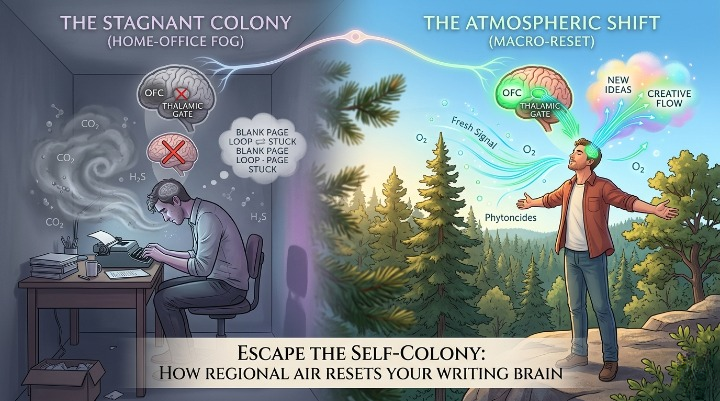
2. Phase 1: The Stagnant Colony (The Home-Office Fog)
Weeks pass in the same room. The same chair. The same desk. The same air. But something subtle has changed.
What’s Happening in the Brain
- The piriform cortex (smell detection) adapts to the constant self-signature.
- The environment is reclassified as baseline.
- No new chemical signals are detected.
At the same time:
- The orbitofrontal cortex—the brain’s value processor—goes quiet.
- There is no difference to evaluate.
The Result: Cognitive Fog
The brain depends on variation to function.
But here:
- Air is familiar.
- Environment is unchanged.
- Signals is repetitive.
So the system turns inward.
The Echo Loop
The thalamus, lacking new air input, defaults to:
- Reprocessing old memories.
- Recycling existing ideas.
- Recombining familiar patterns.
This creates: A closed-loop cognition. The writer is not empty. They are over-contained.
3. Phase 2: Displacement (The Atmospheric Shift)
Something breaks the cycle.
The writer leaves. They relocate—perhaps to a forest, a coastline, or a remote cabin. What changes is not just scenery. It is the air itself.
The Immediate Sensory Shock
Upon arrival, the body encounters:
- Damp earth.
- Pine resin.
- Ozone.
- Plant-emitted compounds (phytoncides).
These are not subtle. They are chemically rich, unfamiliar, and alive.
The Brain Reacts Instantly
- The piriform cortex shifts from mute to hyper-detection.
- The myelencephalon flags the input as non-self.
- The system is forced to pay attention.
The writer doesn’t “feel inspired” yet. They feel: Awakened.
4. Phase 3: The Thalamic Reset (The Gate Opens)
This is the turning point.
External Signal Injection
The new environment delivers:
- High oxygen.
- High chemical diversity.
- Continuous variation.
This creates a massive signal delta.
What the Thalamus Does
The thalamus can no longer ignore input. It must:
- Open the gate.
- Relay signals to the cortex.
- Re-engage perception.
The Orbitofrontal Cortex Ignites
The orbitofrontal cortex, previously idle, now activates:
- Assigning value to new stimuli.
- Interpreting unfamiliar signals.
- Rebuilding meaning.
This is experienced as:
- Sudden clarity.
- Fresh ideas.
- Emotional energy.
Not because imagination returned—but because the brain finally has fresh air to process existing data.
5. Phase 4: Integration (The New Resonance)
After days or weeks, something deeper happens. The writer settles into the new environment.
The Atmospheric Shift Completes
- The writer’s personal CO₂ bubble disperses.
- It merges into the regional air.
- The environment becomes the new baseline.
The Brain Reconfigures
- The hippocampus links old memories with new sensory input.
- The thalamus operates with continuous variation.
- The orbitofrontal cortex stabilises into adaptive processing.
Creative Flow Emerges
Now, writing becomes effortless.
Because: The writer is no longer looping internally. They are processing externally. The environmental air is no longer background. It is fuel.
6. The Real Reason Creativity Returns
It is not peace. It is not silence. It is not even inspiration. It is Metabolic renewal.
The brain has escaped:
- Signal saturation.
- Self-repetition.
- Atmospheric stagnation.
Why Stepping Outside Isn’t Always Enough
Short breaks help—but only temporarily. A walk provides:
- A micro-reset.
- A brief injection of variation.
But if the writer returns to the same room the Self-Colony reforms.
7. Regional Relocation: The Macro-Reset
Moving to a new environment does something deeper:
- It replaces the atmospheric baseline entirely.
- It forces the brain to recalibrate from zero.
This is not preference. It is biological necessity for certain minds.
The Writer’s Brain Trajectory
| STAGE | ENVIRONMENT | PIRIFORM ACTIVITY | ORBITOFRONTAL FUNCTION |
|---|---|---|---|
| Home Fog | Self-saturated air | Muted | Idle |
| Relocation | High-variation air | Hyper-active | High flare |
| Integration | Regional resonance | Active filtering | Adaptive flow |
8. The Hidden Truth About Creative Minds
Some individuals—especially those with high reflective capacity—are more sensitive to:
- Signal stagnation.
- Environmental repetition.
- Atmospheric uniformity.
For them:
Creativity is directly tied to air quality and variation.
Why Writers Historically Travel
This is not coincidence. It is biology. Writers relocate because:
- Their internal loop has closed.
- Their environment no longer provides signal diversity.
They are not seeking escape. They are seeking different environmental oxygen for thought.
Conclusion: You Think Through the Air You Inhale
Writer’s Block is not a failure of the mind. It is a signal problem. Ideas are not generated in isolation. They are shaped by:
- The air you breathe.
- The signals you receive.
- The environment you inhabit.
When you breathe only yourself:
- You think only yourself
When you change the air:
- You change the mind
And when the mind encounters something truly new—It begins, once again, to create the world.
Back to: 👇