
The Cortex Is Not One System: How Psychextrics Separates Signal from Display—and Why the Entorhinal Controls Both
The Mistake at the Heart of Neuroscience
BY: OMOLAJA MAKINEE
For decades, the cortex has been treated as a unified surface—a continuous sheet responsible for perception, thought, and awareness. Vision, sound, smell, memory, reasoning—all placed under one conceptual roof. This view is convenient. It is also wrong.
Within the Psychextric framework, the cortex is not a single functional entity. It is divided into two fundamentally different systems:
- The Signal-Cortex — which records, anchors, and organises experience.
- The Display-Cortex — which renders experience into conscious awareness.
This separation is not theoretical. It is mechanical. It explains why we can feel before we understand, react before we recognise, and remember without faithfully reconstructing events.
At the centre of this architecture sits the most misunderstood structure of all: The Entorhinal. Not as a relay. But as the primary transmitter of reality into memory.
1. Signal versus Display: Two Cortices, Two Roles
The Psychextric division is precise:
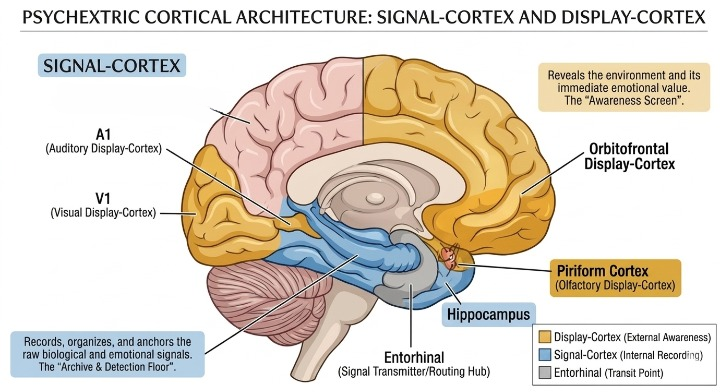
A. The Signal-Cortex
- Hippocampus (echoic archive).
- Olfactory signal mappings.
- Entorhinal.
This system:
- Captures experience.
- Binds emotional valence.
- Stores dual-trace imprints.
It does not “show” the world. It records the world as a structured signal.
Internal Recording
- Functional Role: This deeper layer—composed of phylogenetically older allocortex—does not display the environment. Instead, it encodes, organises, and archives the raw biological signals and their emotional priorities.
Identified Regions in Cover Image (Blue/Grey):
- Hippocampus (Archive Signal-Cortex): The primary node where Priority-Traces are committed.
- Olfactory Bulb (Paleocortex): Paired structures situated in the olfactory fossa on the inferior surface of the frontal lobe. Acts as the first relay station for olfactory information, filtering and modifying sensory input before it reaches the piriform cortex.
- The Entorhinal is clearly shown as the high-speed Signal Transmitter and Routing Hub below the Hippocampus, depicted as a transit point (grey colour). This structure is essential for the bifurcation of the Amygdala’s valence.
B. The Display-Cortex
- V1 (Primary Visual Cortex).
- A1 (Primary Auditory Cortex).
- Piriform Cortex (olfactory awareness, but not its emotional volume).
- Orbitofrontal Cortex (emotional volume of olfactory awareness).
This system:
- Renders perception.
- Produces conscious awareness.
- Displays what the organism experiences.
It does not decide what reality is. It reveals what has already been processed.
External Awareness
- Functional Role: These are the primary “awareness screens”, where sensory relays into conscious awareness are final, coordinated biological signal to create conscious experience. This layer reveals the environment and, crucially, its immediate emotional value and the intensity of behaviour (the Sentinel Beam).
Identified Regions in Cover Image: (Orange)
- V1 (Visual Display-Cortex): The point of conscious sight.
- A1 (Auditory Display-Cortex): The point of conscious listening.
- Piriform Display-Cortex: The specific region in the temporal lobe that detects and holds the raw chemical Signal of Smell (not its value).
- Orbitofrontal Display-Cortex: The point where the emotional value of smell is displayed (distinct from the Piriform cortex, which holds the template signal).
2. The Order of Reality: Record First, Display Later
The implication is profound:
You do not first perceive the world—you first encode it.
By the time something appears in consciousness:
- It has already passed through emotional valuation (amygdala).
- It has already been structured into signal (olfactory bulb).
- It has already been anchored into memory (hippocampus).
The Display-Cortex is the final stage, not the origin.
This creates what Psychextrics identifies as the “naming lag”:
- The organism reacts before it knows.
- The body prepares before the mind understands.
3. The Entorhinal Cortex: The True Gatekeeper
If the cortex is divided, then something must coordinate the transition between signal and hippocampal-storage. That structure is the Entorhinal.
But it is not a passive bridge. It is the primary signal transmitter—the structure that:
- Receives emotional charge.
- Integrates sensory pattern.
- Directs the unified signal into memory.
4. Anatomy Meets Function: Why the Entorhinal Is Built for This Role
Located in the medial temporal lobe, within the parahippocampal gyrus, the entorhinal cortex is uniquely positioned between:
- The neocortex (processing systems).
- The hippocampus (memory system).
It is divided into two specialised domains:
Medial Entorhinal
- Contains grid cells.
- Encodes spatial structure and navigation.
Lateral Entorhinal
- Encodes object identity and content.
- Processes the “what” of experience.
Together, they ensure that every experience is encoded with:
- Where it happened.
- What it involved.
This dual encoding is essential for constructing meaningful memory.
5. The Entorhinal as Transmitter: The Indexed Courier of the Cephalic System
In the psychextric model, the entorhinal cortex operates as a transmission gateway into the hippocampal system, not as a site of signal construction or fusion. It does not generate meaning, nor does it assign emotional valence. Instead, it receives already-processed signal mappings from their respective sensory architectures and transmits them as structured entries into memory circuits.
It takes:
- Olfaction (Smell): The glomerular signal mapping from the olfactory bulb—already organised into chemical identity patterns and linked to template encoding.
- Vision (Sight): The retinotopic mapping from the visual system—spatially organised representations of light contrast, edges, and form processed through retinal and early cortical layers.
- Audition (Listening): The tonotopic mapping from the auditory system—frequency-based organisation of sound waves processed through the cochlea and brainstem nuclei.
Its Operation
The entorhinal cortex performs three precise operations:
- Selection (Admissibility): It determines which incoming mapped signals are permitted entry into hippocampal encoding based on current system relevance.
- Indexing (Addressing): It tags the incoming signal with spatial–temporal coordinates, effectively answering: Where does this belong within the existing memory architecture?
- Transmission (Courier Function): It forwards the indexed signal into:
- The Hippocampus for structured memory encoding (Echoic Spectrum).
- Associated cortical targets depending on pathway continuity.
The entorhinal cortex is the courier of memory entry—not the author of the message, not the interpreter of meaning, but the system that ensures every signal that becomes memory arrives at the right place, in the right form, at the right time.
6. The Signal-Cortex: Where Reality Is Written
Once the entorhinal transmits the fused signal:
- The hippocampus encodes it as a Dual-Trace.
- Valence (what it means emotionally).
- Spectral variation (how it feels physiologically).
- The olfactory bulb organises it into a detectable pattern map before relaying it to the piriform cortex.
At this stage:
- The experience is complete at the level of detection.
- The organism is already prepared.
But the individual is only aware of the smell, but not its value.
7. The Naming Lag: Why Awareness Comes Last
Only after this encoding does the signal move forward into instinct.
The entorhinal retrieves the displayed signal from the piriform cortex:
- The encoded trace.
- The emotional template.
- The spectral variation.
…and transmits it into the amygdala for emotional intensity.
The entorhinal retrieves the encoded signal from the amygdala, ensuring that critical systems receive the compiled signal at once:
- The Hippocampus (for encoding).
- The Hypothalamus (for modulation).
- The Subthalamus (for execution).
This dual targeting is what creates depth in experience.
The thalamus retrieved the encoded trace from the hippocampus and relays it to the Display-Cortex, targetting the orbitofrontal cortex.
This delay creates a crucial reality:
Conscious awareness is a report—not a discovery.
You are not seeing the world as it happens. You are seeing what has already been:
- Processed.
- Stored.
- Validated.
8. Why the First Imprint Never Leaves
Because the entorhinal controls the initial transmission, the first imprint is:
- Fully constructed.
- Emotionally anchored.
- Structurally encoded.
It is not tentative. It is permanent in architecture, even if later modified in expression.
Subsequent experiences do not overwrite it. They must:
- Align with it.
- Deviate from it.
- Compete against it.
But they cannot erase its role as the baseline.
9. The Entorhinal in Recall: Entry and Exit Gate
The entorhinal does not only manage storage. It also governs retrieval. When the thalamus queries the hippocampus:
- The signal must pass back through the entorhinal.
- It is reorganised and synchronised.
- It is prepared for display.
This makes the entorhinal:
- The entry point of memory.
- The exit gate of recall.
It controls both:
- What gets stored.
- What gets shown.
The Psychextric Conclusion: Reality Is Built Before It Is Seen
The separation of cortex into Signal and Display systems reveals a fundamental truth:
The world you experience is not the world as it is. It is the world as it has already been biologically constructed.
- The Signal-Cortex writes the event.
- The Entorhinal transmits it faithfully.
- The Display-Cortex shows the result.
And because this process is anchored in emotional valence:
- Every perception is biased.
- Every memory is structured.
- Every experience is edited.
Final Insight
The cortex does not simply perceive reality. It divides reality into two phases:
1. Signal formation (hidden, pre-conscious, structural).
2. Display rendering (visible, conscious, experiential).
And at the centre of this transformation is the entorhinal cortex—the silent architect within the Signal-Cortex ensuring that what you experience is never raw, never neutral, and never immediate.
It is always:
- Already processed.
- Already encoded.
- Already meaningful.
Before you ever become aware of it.
Back to: 👇