
The Brain Reacts Before You Know: Rethinking Sensory Processing in Psychextrics
BY: OMOLAJA MAKINEE
For decades, mainstream Neuroscience has treated the thalamus as the central gateway of sensory perception—the relay station through which signals must pass before reaching conscious awareness. With one notable exception: Smell.
But what if that exception isn’t an exception at all?
What if all senses—sound, vision, and smell—initially bypass the thalamus?
This is the shift introduced by psychextrics, and it carries profound implications for Behavioural science, perception, and the nature of awareness itself.
1. The Hidden Sequence of Perception
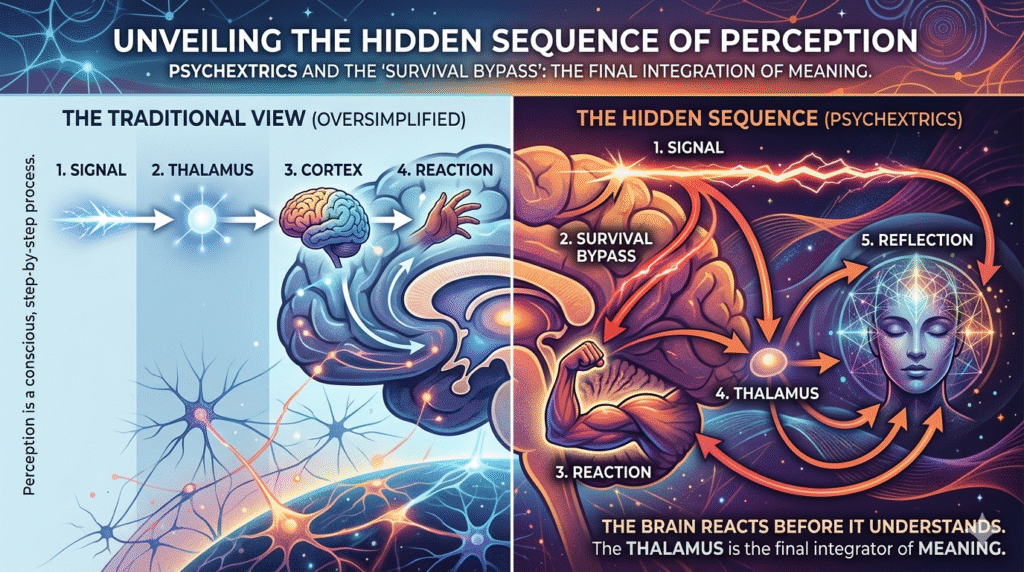
We tend to believe that perception follows a simple order:
Signal → Thalamus → Cortex → Reaction
But psychextrics reveals a different sequence:
Signal → Survival Bypass → Reaction → Thalamus → Reflection
In other words:
The brain reacts before it understands.
The thalamus is not the starting point of perception in psychextrics—it is the final integrator of meaning.
2. The Psychextric Law of Sensory Hierarchy
At the core of this model is a simple but powerful framework:
| SENSE | PRIMARY CEPHALIC BYPASS | SURVIVAL FUNCTION | RESULTING ILLUSION |
|---|---|---|---|
| Sound | Myelencephalon | Rhythm / Startle / Volume | We hear “instantly” |
| Vision | Mesencephalon | Movement / Orientation | We see “instantly” |
| Breath (Smell) | Telencephalon / Limbic | Presence / Toxicity | We smell “instantly” |
This table captures a radical idea:
Every major sense has a pre-thalamic survival bridge.
A. Sound: The Body Moves Before You Listen
Auditory signals don’t wait for interpretation. They enter through the cochlear nerve and immediately engage the myelencephalon (medulla). From there:
- The Reticular Formation triggers alertness.
- The Superior Olivary Complex processes direction and intensity.
Before the thalamus even gets involved:
- Your body tenses.
- Your head turns.
- Your attention shifts.
Only afterward do you consciously “listen” to the sound. Listening is a delayed explanation of a reaction that has already begun.
B. Vision: You Track Before You See
Visual processing also splits into two pathways:
- The classical route → retina → thalamus → V1 (Visual Cortex).
- The survival route → retina → superior colliculus (midbrain).
This second pathway allows:
- Rapid eye movements.
- Motion tracking.
- Threat orientation.
Before you consciously recognise an object:
- Your eyes are already following it.
- Your posture is already adjusting.
You do not first see and then react—you react towards what you are seeing and then sight.
C. Smell: The Body Changes Before You Perceive
Olfaction has long been known to bypass the thalamus initially—but psychextrics reframes what that means.
The olfactory signal moves directly to:
- The olfactory bulb: Engages the limbic system before relaying directly to the piriform cortex—(Detection Spectrum).
- The piriform cortex: Re-engages the limbic system that allows the thalamus to relay to the orbitofrontal cortex—(Instinct Spectrum).
Detection Spectrum enables:
- Immediate detection of toxins.
- Rapid emotional tagging.
- Instant physiological shifts.
Before you consciously identify a scent at Detection Spectrum:
- Your breathing adjusts.
- Your hormonal state shifts.
- Your body prepares.
By the time you “smell” at Instinct Spectrum, your organism has already been altered.
3. The Illusion of Instant Perception
If all senses use survival bypasses, why does perception feel immediate?
Because the delay is hidden. By the time the thalamus delivers the behavioural value of the signal to the cortex:
- The body has already reacted.
- The system has already adjusted.
What you experience as “instant awareness” is actually:
A slightly delayed narrative of a response already in motion
This is the illusion of immediate knowing.
This reveals a deeper limitation shared across smell, sound, touch, and even sight within psychextrics:
Detection alone is insufficient for significance.
A signal may exist within the nervous system without becoming behaviourally important. Every sensory pathway ultimately depends upon emotional weighting of intensity before the organism treats the signal as urgent enough to recruit conscious display.
For smell to wake a sleeping organism, several thresholds must be crossed sequentially:
- The odour must first be detected and template-encoded within the olfactory bulb and display within the piriform cortex.
- The signal must then acquire sufficient instinctive emotional intensity through the amygdala–hypothalamic loop.
- That intensified signal must overcome thalamic gating thresholds.
- Only then does the orbitofrontal cortex display the signal as conscious significance.
Without sufficient emotional intensity, the odour remains biologically present but behaviourally silent.
This same architecture governs sound.
A distant repetitive noise may continue for hours during sleep without awakening the organism because the signal has undergone calibration:
- detected,
- categorised,
- emotionally deprioritised.
But suddenly hearing:
- your name shouted,
- breaking glass,
- a baby crying,
- a gunshot,
can immediately awaken the organism because the emotional weighting bypasses ordinary sensory suppression and recruits survival circuitry directly.
Touch reveals this even more dramatically.
Imagine someone lightly touching your shoulder during deep sleep.
You often jolt awake before you consciously know:
- who touched you,
- where you are,
- what happened,
- or even whether danger exists.
The awakening occurs first. Interpretation comes second.
Why?
Because tactile intrusion rapidly activates survival bypass pathways involving:
- the amygdala,
- hypothalamus,
- subthalamic orientation systems,
- autonomic activation,
- and motor readiness,
before thalamic reflection has sufficient time to construct contextual meaning.
The organism is awakened into behavioural readiness before conscious understanding catches up.
You do not first think: “Someone touched me.”
The body first enters: “Something requires immediate orientation.”
Only afterwards does reflective interpretation begin assembling:
- identity,
- context,
- safety assessment,
- emotional reasoning.
This explains why sudden awakening often produces confusion, panic, defensive movement, or momentary disorientation. The survival architecture has already activated before the reflective architecture has stabilised the narrative.
Under psychextrics, consciousness therefore operates downstream of emotional urgency.
Signals do not become consciously important merely because they exist. They become consciously important when survival systems assign sufficient emotional intensity to force cortical recruitment.
This is why:
- not every sound wakes us,
- not every smell alarms us,
- not every touch becomes fear,
- not every sight demands action.
The nervous system is continuously filtering the world through emotional weighting thresholds. And by the time awareness finally says:
“I heard that.”
“I smelled that.”
“I felt that.”
“I saw that.”
…the cephalic hierarchy has often already decided whether the organism must survive it, ignore it, orient toward it, or awaken because of it.
4. The Thalamus Reconsidered
In this framework, the thalamus is no longer the universal gatekeeper of sensation. It becomes something far more specific:
The final gatekeeper of conscious meaning.
Its role is not to initiate perception, but to:
- Integrate past memory (hippocampus).
- Align emotional state (hypothalamus).
- Structure patterns (thalamic nuclei).
- Project coherent experience to the cortex.
It answers: “What does this mean?”
But only after the more urgent question has been resolved: “Do I need to react?”
Orientation Before Observation
This leads to a fundamental law in psychextrics:
Orientation precedes observation.
- The lower cephalons (medulla, midbrain) handle survival.
- The thalamus handles integration.
- The cortex handles display.
The organism is always positioned within its environment before it is allowed to interpret it.
5. Why This Matters for Behavioural Science
This shift has major consequences.
A. Behaviour Is Not Always Conscious
Actions often begin before awareness:
- Startle responses.
- Emotional reactions.
- Attention shifts.
What we call “decision-making” is often post hoc interpretation.
B. Reaction Speed Is Not Intelligence
Fast responses are not necessarily thoughtful—they are:
Pre-thalamic survival outputs.
Intelligence lies in reflection, not reaction.
C. Perception Is Already Biased Before Awareness
By the time something reaches consciousness:
- It has been filtered.
- It has been prioritised.
- It has already influenced physiology.
You are not perceiving raw reality—you are perceiving processed survival relevance.
6. The Brain as a Dual System
Psychextrics reveals the brain as two systems working in sequence:
A. Emergency Broadcast System (Bypass Pathways)
- Fast.
- Automatic.
- Survival-driven.
B. Main Feature System (Thalamus and Cortex)
- Slower.
- Reflective.
- Meaning-driven.
The key insight:
The emergency system always has priority.
From Reaction to Reflection
Once survival is stabilised, the thalamus re-enters the process.
It integrates:
- Emotional valence.
- Detected patterns.
- Situational context.
This produces reflection—the reinterpretation of experience.
What began as a reflex becomes:
- A thought.
- A judgement.
- A decision.
Conclusion: A New Model of Awareness
The brain is not designed to understand first. It is designed to survive first, understand second.
- You don’t listen and then react—you react and then listen.
- You don’t sight and then orient—you orient and then sight.
- You don’t smell and then adjust—you adjust and then smell.
Perception is not the beginning of behaviour. It is its explanation.
By recognising that all senses possess a pre-thalamic bypass, psychextrics redefines the structure of cognition:
- The thalamus is not the starting point—it is the refinement point.
- The cortex is not the driver—it is the display.
- Awareness is not immediate—it is constructed after action begins.
And perhaps most importantly:
You are always living slightly ahead of your own awareness.
The brain does not wait for you to understand the world before acting in it. It ensures you survive it first—and only then allows you to make sense of what just happened.
Back to: 👇