
The Seven Spectrums of the Nostril: How Smell Becomes Behaviour
BY: OMOLAJA MAKINEE
We tend to think of smell as simple: something enters the nose, and we either like it or we don’t.
But this view collapses a far more intricate architecture into a single moment. In reality, what we call “smelling” is a layered progression—one that begins before awareness and ends long after the air has passed.
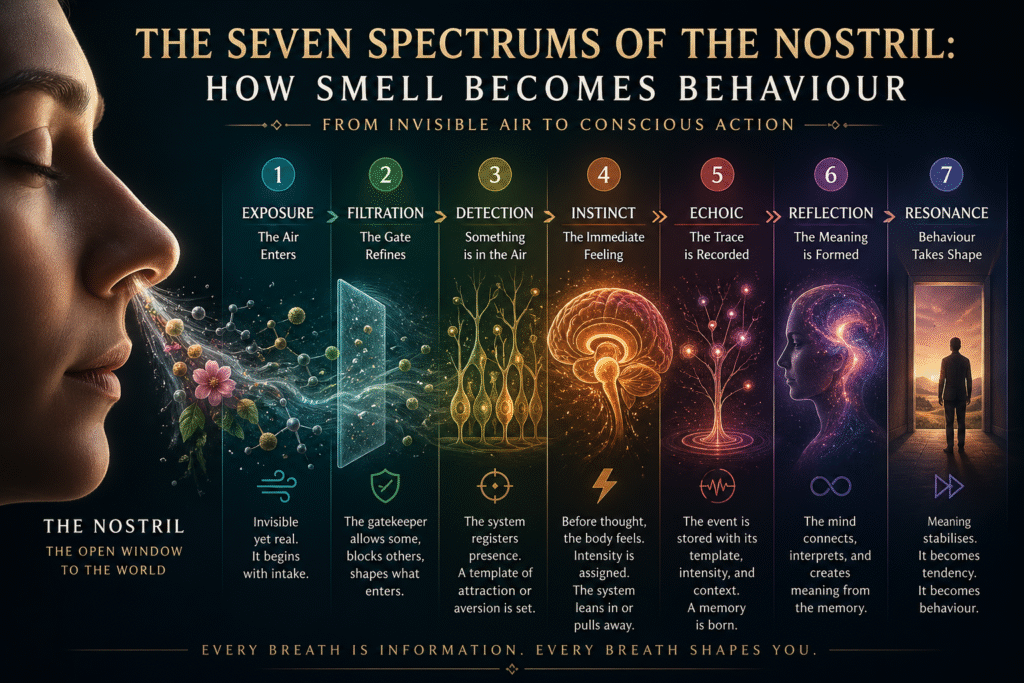
Within the Psychextric framework, olfactory perception unfolds across Seven distinct spectrums. Each spectrum performs a specialised role. Each contributes a different layer of transformation. And together, they explain how a single breath can become a memory, a reaction, a decision, or even a defining trait of personality.
This is not a story of scent. It is a story of how air becomes behaviour.
1. Intake Spectrum — The Opening of the System
Everything begins with entry.
The Intake Spectrum governs how air physically enters the organism. It is shaped by:
- nasal structure,
- airflow dynamics,
- environmental conditions.
This is not yet perception. It is admission.
The organism does not choose what enters—it receives it. But even here, the foundation of behaviour is being set. Because what enters determines what can be processed.
2. Filtration Spectrum — The First Boundary of Experience
Not everything that enters is allowed to matter.
The Filtration Spectrum selects:
- what is retained,
- what is excluded, what is neutralised.
This is the first behavioural boundary. It determines:
What part of the environment is allowed to become experience.
Most particles never make it past this stage. They are erased before detection. In behavioural terms, they never existed.
3. Detection Spectrum — Signal First
Once a stimulus passes filtration, it is transformed into signal.
The Detection Spectrum constructs:
- template encoding (the identity of the smell),
- baseline valence bias (attraction or aversion).
This is the first moment of internal reality.
But crucially:
Detection does not create meaning—it creates presence.
The organism now knows:
- something is there,
- and whether it leans toward or away from it.
No context. No story. Just structure and bias.
4. Instinct Spectrum — The Birth of Behavioural Force
Detection builds the signal. Instinct gives it force.
The Instinct Spectrum encodes:
- intensity valence bias (how strongly it matters),
- direction encoding (approach, withdraw, freeze, fascinate).
This is where behaviour truly begins.
The organism does not yet “understand” the stimulus. But it is already:
- leaning.
- reacting,
- preparing.
This is why instinct feels immediate. Because it is not thinking—it is committing.
5. Resonant Spectrum — The Elaborator of Context
Up to this point, the signal is retained in hippocampal-memory as context encoding. It has force awaiting form.
The Resonant Spectrum introduces:
- situational meaning,
- emotional alignment,
- social and experiential framing.
This is where transformation occurs.
The same initial signal can now become:
- fear or excitement,
- disgust or curiosity,
- attraction or caution.
Resonance does not erase instinct. It reshapes and elaborates on it.
6. Reflective Spectrum — The Selection of Behaviour
Now, the system pauses.
Reflection does not generate new emotion. It works with what is already present:
- template (Detection),
- intensity (Instinct),
- context (Resonance).
It compares, evaluates, and selects. This is where:
- decisions appear,
- reasoning emerges,
- behaviour becomes deliberate.
But even here, reflection is not free. It is constrained by the signals it receives.
7. Echoic Spectrum — The Formation of Memory as Context
Finally, the experience is preserved.
The Echoic Spectrum stores:
- the signal,
- its template,
- its intensity,
- its context,
- its outcome.
But not as separate pieces. It is stored as a stacked trace—a unified imprint that will shape future perception.
This is why:
- smells feel familiar,
- reactions repeat,
- preferences persist.
Because every new encounter is measured against what has already been encoded.
8. The Complete Sequence
What begins as air becomes a layered transformation:
- Intake is entry.
- Filtration is selection.
- Detection is signal and bias.
- Instinct is intensity and direction.
- Resonance is context elaborator.
- Reflection is decision.
- Echoic is memory.
Each step builds on the last.
Conclusion: The Hidden Truth of Smell
What this model reveals is simple—but profound:
We do not respond to the world as it is. We respond to how it has been processed through us.
By the time you “smell” something:
- it has already been filtered,
- structured,
- biased,
- intensified,
- contextualised.
Your reaction is not the beginning. It is the result.
Final Insight
The nostril is not just a sensory organ.
It is:
- an entry point,
- a filter,
- a signal builder,
- a behavioural engine,
- a memory architect.
And through its Seven spectrums, it transforms something as invisible as air into something as powerful as behaviour.
So the next time you inhale or sniff, remember:
You are not just breathing the world. You are becoming it.
Back to: 👇