
Personality Is Not Fixed: The Psychextric Case for Context-Specific Identity
BY: OMOLAJA MAKINEE
We are used to describing personality as something stable—something that follows a person wherever they go.
We say:
- “That’s just who they are.”
- “She’s always like that.”
- “He never changes.”
But this assumption collapses the moment we observe people across different environments.
The same individual can be:
- Quiet at work, expressive with friends.
- Assertive in public, reserved at home.
- Analytical in one setting, reactive in another.
Traditional behavioural models explain this as adaptation, masking, or learned behaviour. Psychextrics rejects this explanation.
Personality is not a fixed mask that adapts. It is a context-sensitive expression of a stable internal architecture.
1. The Core Mechanism: Structure Persists, Expression Shifts
To understand this, we must begin with the operational mechanism of personality. Personality is not constructed anew in each moment. It is generated from:
- Detected patterns stored in the hippocampus (Echoic Spectrum).
- Emotional valence anchored by the amygdala–hypothalamus (Resonant Spectrum).
- Contextual modulation governed by the thalamic reflection system (Reflection Spectrum).
These three layers interact continuously, but they do not hold equal power.
The structure persists. The expression negotiates.
2. Echoic Spectrum: The Hidden Builder of Personality
The hippocampus does not simply store memories. It organises them.
Initially, experiences are encoded as context-specific episodes:
- Where something happened.
- With whom.
- Under what conditions.
But over time, these episodes are reorganised into context-independent structures—detected patterns that define how the individual recognises and processes reality.
This is the critical shift:
Memory becomes personality.
3. Why You Are Different in Different Places
If personality is structurally stable, why does behaviour vary?
Because expression is routed through contextual activation. Each environmental situation activates a different subset of stored patterns.
At Work
- Patterns related to evaluation, hierarchy, performance are activated.
- Emotional valence may prioritise control or restraint.
- Behaviour appears structured, measured.
With Friends
- Patterns related to trust, familiarity, shared history are activated.
- Emotional valence allows looseness or spontaneity.
- Behaviour appears relaxed, expressive.
With Family
- Deep, early-encoded patterns dominate.
- Emotional valence may intensify or regress.
- Behaviour may appear inconsistent with other environments.
You are not becoming different people. You are expressing different activated structures.
4. The Myth of “Learned Behaviour”
It is tempting to say that people behave differently because they learned to.
But psychextrics shows something deeper. Even siblings raised in the same environment:
- Share similar exposures.
- Encounter similar conditions.
Yet develop different personalities. Why?
Because personality is not built by adding traits. It is shaped by: Selective reinforcement and emotional anchoring within inherited GIM–HIM structures.
5. Resonance Determines What Sticks
The environment provides inputs. But not all inputs are integrated. For a pattern to stabilise into personality, it must align with:
- GIM–HIM (inherited structure and baseline emotional encoding).
- And be reinforced through current state of EIM–HFI (experience and hormonal modulation).
Example: Same Environment, Opposite Outcomes
Two individuals grow up in a violent environment.
- One becomes aggressive.
- The other becomes deeply averse to violence.
The environment is identical. The outcome is not. Why?
Because:
- The same detected pattern was present.
- But emotional valence anchored differently.
One system aligned with: “Violence is power.”
The other aligned with: “Violence is threat.”
6. Personality Is Not Additive—It Is Selective
We often think personality builds like this:
Experience Adds trait and Becomes personality.
Psychextrics shows a different process:
Experience Filters through inherited structure, Reinforces or discards, and Refines personality.
To explain the difference between these two models, it helps to move away from abstract diagrams and toward a tangible, everyday scenario.
The psychological model treats personality like a scrapbook. The psychextric model treats personality like a living filtration architecture.
Imagine two toddler are tasting a complex, spicy stew for the first time.
The psychological View (The “Scrapbook” Model)
Under the traditional psychological view, the organism is treated almost like an empty container waiting to be filled by experience.
The Experience: They taste the chili pepper.
The Result: Spicy is added to their bowl.
The Personality: They are now “A person who recognises the taste of spice.” Repeated exposure supposedly strengthens this addition into a personality archive:
- More spice exposure,
- more tolerance,
- more adaptation,
therefore a new personality preference develops.
The Logic: Life is a series of stickers. Every time something happens to you, you just slap a new sticker on your suitcase until the suitcase is covered. You are simply the sum of every sticker you’ve collected.
The conclusion follows: “Taste of Spice” has now been added to their experiential archive. The logic is fundamentally additive. Life places stickers onto the self. Memory accumulates experiences. Personality becomes the collection.
In this framework, the individual is essentially a suitcase covered by the labels life attaches to it.
The Psychextrics View (The “Lens” Model)
But psychextrics proposes something fundamentally different. In this view, the person already has a complex internal machinery—their inherited biological and structural hardware.
The Experience: They taste the same chili pepper.
The Filter: Before conscious recognition occurs or before they even feel the heat, the signal passes through their internal structure:
- the Myelencephalon evaluates disturbance,
- the Detection architecture establishes template encoding,
- the Diencephalon assigns emotional positioning,
- the hypothalamic system calibrates intensity,
and the hippocampal loop determines whether the event becomes retainable resonance or disposable noise.
The Process: The organism does not begin as an empty bowl. It begins as an inherited biological structure already possessing:
- receptor variation,
- emotional weighting,
- cephalic divergence,
- resonance thresholds,
- and structural preference architectures.
The chili pepper does not simply “add spice” into the person. The signal must first survive the organism itself. If the internal structure finds the heat meaningful, it reinforces the trait (e.g., “I seek intensity”). If the structure finds it noise, it discards it (e.g., “That was a mild heat; it is not spicy enough or it doesn’t really taste like spice”).
The Personality: The experience didn’t just add a new piece; it refined the existing machine. The person didn’t recognise it as spicy; their internal system simply sharpened its preference for high-intensity sensory input.
The Difference
Thus the same spicy stew enters two different organisms and becomes two entirely different realities.
One individual may experience:
- exhilaration,
- stimulation,
- sensory excitement,
- intensity-seeking reinforcement.
Another may experience:
- irritation,
- overwhelm,
- defensive aversion,
- physiological rejection.
The environment was identical. The architecture was not.
This becomes clearer when we consider TRPV1 receptor variation—the receptors associated with heat and capsaicin sensitivity. Some individuals naturally possess higher receptor sensitivity. Others possess lower sensitivity.
Traditional psychology often interprets increased spice tolerance primarily through exposure and desensitisation: “You adapt because repeated experience changes your tolerance.”
Psychextrics agrees adaptation occurs, but argues adaptation itself remains constrained by inherited resonance capacity.
Training alone is insufficient if the organism lacks the biological resilience architecture capable of sustaining the sensory load over time. This is why some individuals gradually enjoy extreme spice exposure while others never fully integrate it despite repeated attempts. The difference between behaviour is not simply recognition or habit. It is structural compatibility.
The same principle governs personality development itself. Two children may experience the same strict upbringing:
- the same rules,
- the same punishments,
- the same environment,
- the same authority figures.
Yet one develops:
- discipline,
- order,
- emotional security,
- identity stability.
The other develops:
- rebellion,
- resentment,
- confinement sensitivity,
- oppositional behaviour.
Under additive psychology, this creates a contradiction:
How can the same experience produce opposite personalities?
But under psychextrics, there is no contradiction. The experience never enters a neutral system. One child’s architecture filters strictness as:
- safety,
- structure,
- protection,
- predictability.
The other filters the same experience as:
- suppression,
- emotional restriction,
- instability,
- or loss of agency.
The experience is identical. The resonance architecture is different.
Thus personality is not built by stacking experiences like bricks. It is refined through selective reinforcement.
If compatible:
- the trait stabilises,
- resonance strengthens,
- behaviour becomes sustainable.
If incompatible:
- the experience weakens,
- fragments,
- destabilises,
- or gets discarded psychologically despite physical exposure.
This is why individuals often fail at lifestyles they intellectually understand. Knowledge is not enough. The organism must possess:
- compatible emotional valence,
- sustainable resonance,
- and structural alignment.
Without this, experiences become exhausting performances rather than integrated identity.
Psychextrics therefore reframes personality completely.
You are not a bucket being filled by life. You are a selective biological processing system.
Life provides raw material. But your internal architecture determines whether that material becomes:
- nourishment,
- rejection,
- reinforcement,
- distortion,
- or transformation.
7. The Role of Persistence of Structure
As individuals mature, the brain increasingly favours pattern completion (CA3) over pattern separation (DG).
This means:
- New experiences are interpreted through existing templates.
- Familiar responses are retrieved faster than new ones are formed.
This creates: Predictability.
Not because the person chooses consistency—But because the brain is biased toward it.
8. Context as the Trigger, Not the Cause
Context does not create behaviour. It selects from what already exists.
Example: Criticism
The same detected pattern (“criticism”) can produce:
- Analysis (professional setting).
- Withdrawal (social setting).
- Confrontation (intimate setting).
The pattern is constant.
The expression shifts based on:
- Context (EIM).
- Emotional state (HFI).
9. Sensory Hierarchy: How Context Rewrites Perception
Context does not just activate patterns. It reorders perception itself.
Metabolic Context to Olfaction Dominates
- The body prioritises what is being inhaled.
- Safety is determined chemically.
- Vision and hearing support detection.
Navigation Context to Vision Dominates
- The environment becomes a map.
- Movement and spatial awareness take priority.
- Other senses act as alerts.
Social Context to Hearing Dominates
- Tone, rhythm, and vocal nuance guide interaction.
- Emotional resonance is transmitted through sound.
Each context rewrites the sensory hierarchy. Each hierarchy reshapes perception. Each perception reinforces personality.
10. Why People Misunderstand Each Other
When two individuals interact:
- They may be operating under different context activations.
- Different sensory hierarchies.
- Different emotional weightings.
Even in the same environment.
This leads to:
- Misinterpretation.
- Conflict.
- False assumptions about “true personality”.
Misunderstanding therefore becomes the default condition of human interaction, because no two individuals process reality through perfectly identical resonance architectures at the same moment. What we call “understanding” is often only temporary alignment—an overlap of context, emotional weighting, sensory prioritisation, and internal state sufficiently synchronised for meaning to appear shared.
11. The Illusion of a Single Self
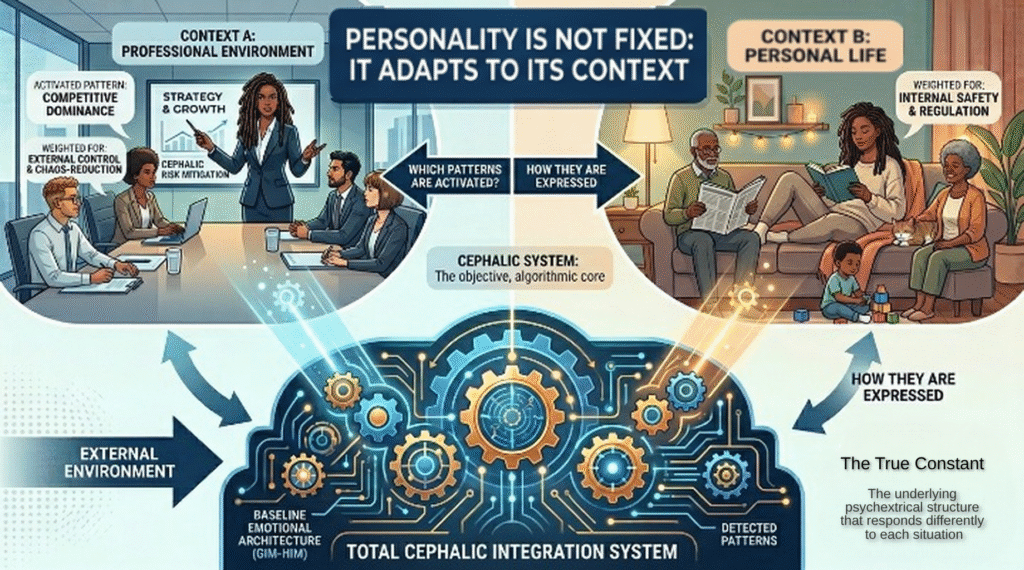
The idea that a person has one consistent personality is a simplification. In reality:
Personality is a stable structure expressed through multiple contextual windows.
What Actually Remains Constant
Across all contexts, what remains stable is:
- Detected patterns (structure).
- Baseline emotional architecture (GIM–HIM).
What changes is:
- Which patterns are activated.
- How they are weighted.
- How they are expressed.
To illustrate how a single detected patterns and emotional architecture produces seemingly opposite behaviours in different contexts, we can look at two scenarios involving risk-assessment and control. In both narratives, the individual possesses the same baseline architecture: a high sensitivity to environmental instability and a structural need to mitigate chaos.
Narrative A: The “Aggressive” Executive
In the boardroom, this person is known for being sharp, demanding, and uncompromising. They interrupt colleagues to correct small data errors and insist on overseeing every minor detail of a merger. Peers describe them as a “High-Energy Dominant” personality.
Activated Pattern: Competitive dominance.
Weighting: High priority on “external order” to prevent systemic failure.
Expression: Assertive verbal correction and micro-management.
Narrative B: The “Anxious” Homebody
In their personal life, this same person is seen as quiet, hesitant, and overly cautious. They spend hours researching the safest route for a road trip, insist on double-checking the door locks three times, and prefer quiet nights in over unpredictable social gatherings. Family describes them as a “Low-Energy Anxious” personality.
Activated Pattern: Pre-emptive defence.
Weighting: High priority on “internal safety” to prevent personal harm.
Expression: Avoidance and repetitive safety rituals.
The Psychextrics Synthesis: Same Structure, Different Contextual Windows
At first glance, Narrative A and Narrative B look like two different people: one is a “lion” and the other is a “mouse.” However, the detected patterns and emotional architecture are identical.
| FEATURE | CONTEXT: THE BOARDROOM | CONTEXT: THE HOME |
| GIM–HIM Baseline | High sensitivity to “Threat/Chaos” | High sensitivity to “Threat/Chaos” |
| Internal Goal | Maintain total control of the environment | Maintain total control of the environment |
| The Trigger | A flawed business proposal (Uncertainty) | An unlocked door or unknown route (Uncertainty) |
| The Conclusion | “I must eliminate the variable to feel safe.” | “I must eliminate the variable to feel safe.” |
Why they appear to contrast:
The meaning-construction interface changes the mask based on the theater. In the boardroom, the structure calculates that aggression is the most effective tool to gain control. In the home, the same structure calculates that caution is the most effective tool to gain control.
The personality isn’t the aggression or the anxiety—those are just weights and expressions. The true personality is the underlying, stable architecture that views the world as a place that must be meticulously controlled to be survived.
12. Final Insight: You Are Not One Personality—You Are One System
You are not:
- A fixed identity.
- A collection of traits.
- A product of environment alone.
You are:
- A biological system,
- with persistent structure,
- expressed through shifting contexts.
Conclusion: Personality Is a Living Architecture
Personality, in psychextrics, is not static.
It is:
- Structured but flexible.
- Stable but context-sensitive.
- Predictable yet variable in expression.
The environment does not rewrite you. It selects which version of you becomes visible.
And in that selection:
Your personality is not revealed as one thing—but as a range of expressions grounded in a single, persistent design.
Back to: 👇