
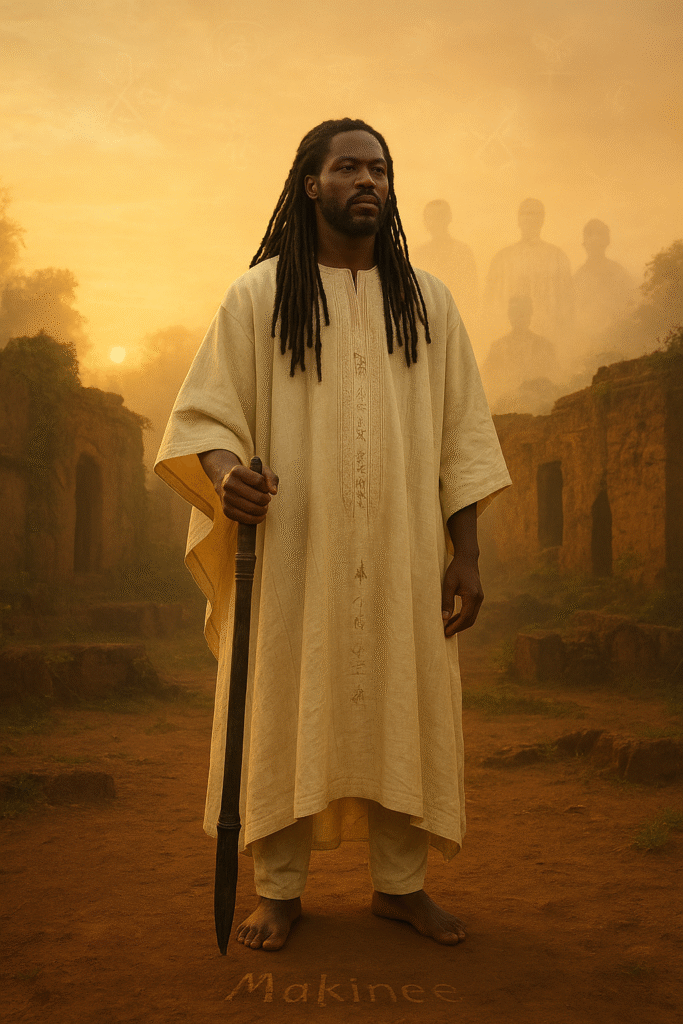
“Makinee: The Return of the Hero’s Child”
By: OMOLAJA MAKINEE
1
In the sacred cosmology of the Yoruba, the soul does not wander aimlessly. It travels with purpose, tied by invisible cords to its soul lineage—a divine ancestry woven like strands in sacred cloth. Each strand is a family lineage, and together, they form a larger bundle, like stiff fibers bound into a broom: separate, yet one. This unity of soul ancestry is called a soul-lineage.
Each time a sibling marries and creates their own household, they initiate a new strand like a thread—a distinct family lineage—that remains spiritually woven with the lineages of their brothers and sisters. Though each strand may branch outward with its own name, children, and life path, they are all still part of the same original bundle, rooted in the soul-lineage from which they emerged. This is how a lineage bundle expands: through generations of siblings who carry forward the soul’s ancestral thread, each adding to the tapestry of interrelated lineages.
When a soul prepares to reincarnate, it must choose between two possible entry points—either through the lineage of one of its offspring or through that of an offspring of a sibling—both of which belong to the same soul lineage. Each of these threads is a single strand within the greater bundle. Once a soul makes its choice and returns through one of these threads, that decision is permanent. Its destiny, spiritual obligations, and ancestral memory become tied to that lineage thread, shaping the soul’s journey across lifetimes.
The soul’s choice between its own offspring or offspring of a sibling is not random—it is determined by the order of origin within the soul realm. This selection is cosmic and automatic, guided by the soul’s ancestral memory and spiritual contract. In some families, all children may reincarnate through the father’s lineage, leaving the mother’s lineage unrepresented among her own offspring. In such cases, it is the mother’s siblings—her brothers or sisters—who will carry on the soul-thread of her lineage. At her next reincarnation into human form, the order of origin will direct her to one of the sibling’s offspring where she belong in the soul lineage. There are also situations where no soul chooses to come through a particular individual in a lifetime, no matter how fertile or spiritually prepared they may seem.
In other families, a couple may have three children, with two souls reincarnated from the mother’s lineage and one from the father’s. Though biologically they are siblings, spiritually they do not share the same soul lineage—each is tied to a different ancestral thread. This divergence often explains deep familial discord: unresolved tensions, rivalries, or feelings of disconnect within families are not always personal, but can be traced to the spiritual misalignment of souls that do not share the same root lineage. What appears as a dysfunctional family in the physical world may in fact be a reflection of disparate soul origins inhabiting the same household in a single lifetime. This is also why a child may feel an inexplicable closeness to one parent over the other—their soul may share the same ancestral thread with that parent, while feeling distant or even resistant toward the one whose lineage they did not reincarnate through.
In rare and divinely orchestrated cases where both parents originate from the same soul lineage, an extraordinary harmony exists within the family—one that is spiritually rooted and emotionally unshakeable. In such unions, all their children are guaranteed to reincarnate from that same unified soul lineage, creating a home filled with natural understanding, deep connection, and minimal conflict. This profound harmony is rare precisely because, in most cases, siblings from the same soul lineage who have lived and died tend to reincarnate back into their own direct ancestral lines. However, when distant relatives—often unknown to each other—cross paths and marry, sometimes up to six or more biological generations removed, their soul threads recognise one another. Though they may not know it consciously, their union represents the reweaving of long-separated branches of a single lineage. When this happens, it is not coincidence—it is ancestral design, and the resulting family becomes a powerful vessel of continuity, healing, and lineage restoration.
This is where the wisdom of Ifá divination becomes essential. Within the Yoruba spiritual system, Ifá serves as the bridge between the visible and the invisible, the physical family and the soul lineage. Through the sacred process of consulting the Ifá Oracle, a person’s origin of reincarnation—whether through the father’s or mother’s lineage—can be revealed. Ifá not only identifies which soul-thread one belongs to, but also uncovers the deeper reasons behind recurring family conflicts, emotional detachment, or generational patterns that seem to defy logic. It provides clarity where there is confusion, revealing when a family is composed of souls from multiple ancestral roots.
In cases where siblings or parents and children seem to be spiritually disconnected, Ifá offers rituals of alignment, appeasement, and ancestral reconnection, helping to restore harmony even when unity cannot be fully achieved. In this way, Ifá does not erase the reality of different soul origins, but honours them—guiding each person to understand their true place within the complex weave of their soul-lineage and offering tools to walk their path with awareness and peace.
2
Among these ancient lineages was one known as Makinee—a proud Yoruba family from the region of the Ọyọ empire in the Yoruba land, known by the name “Ọmọ akọn ni eleyi,” meaning “This is the child of a hero.”
In Yoruba tradition, names are not just identifiers—they are living expressions of a person’s essence, deeds, or the destiny they carry. While children are given names at birth, often based on the circumstances of their arrival or spiritual messages from divination, names can also be bestowed later in life. These are known as Oríkì—praise names, identity titles, or honourifics given based on one’s character, achievements, or social contributions.
A man who becomes known for wisdom may be renamed accordingly. A woman who displays courage, resilience, or spiritual power may receive an Oríkì reflecting her strength. It is not unusual for these names to replace birth names in communal usage, especially when the name begins to carry the weight of respect or legend.
The name Makinee—from the phrase “Ọmọ akọn ni eleyi,” “This is the child of a hero”—bears all the hallmarks of an Oríkì name. It was not found across the Yoruba ethnic group, and appears to be localised to a single family lineage from the region of the powerful Ọyọ empire. This points to a powerful moment in the past when a singular act of valour, defiance, or sacrifice led the community to rename a man, or perhaps his son, as a living remembrance of the heroic father before him. The name Makinee may have first been uttered by elders, pointing to a child in the village and proclaiming, “This one… this is the child of a hero.” From that moment, the title stuck—not only as a name but as a legacy.
It is possible that the father, the original hero, stood against the tides of slavery or war, perhaps saving others or refusing to surrender his people to the invading forces. His bravery may have delayed the inevitable, or even saved a part of his village. In such a case, the son would be seen not only as an heir to the bloodline, but also to the spiritual weight of that defiance. Naming the child Makinee was not just about honour—it was a way of recording history through the body of the male child heir, especially in a culture where oral traditions carry the memory of a people.
Yet, there is a deep irony in this. If the child of that hero was indeed the only surviving male offspring, as the disappearance of the name suggests, then the lineage suffered a tragic fate. The one who carried the name—the living legacy of resistance—may have ultimately succumbed to the very forces his father fought to resist. Whether taken by slavers, or lost through the breakdown of the family unit under colonial disruption, the child’s removal from the ancestral land caused the name Makinee to vanish from Yoruba oral memory and written records alike.
That is, until now.
3
The reemergence of the name Makinee through reincarnation and soul memory retrocognition—revealed by the Ifá oracle in a descendant—suggests that names, like souls, are never truly lost. They may go underground, passed silently through generations of unknowing carriers, waiting for the right time and the right soul to speak them again. The name Makinee was not simply remembered—it was reclaimed, not as an invention, but as a spiritual inheritance finding its way back through the cosmic threads of soul lineage.
The name Makinee—interpreted from the Yoruba phrase “Ọmọ akọn ni eleyi”—carries a layered and powerful meaning. While “Ọmọ akọn ni” directly translates to “child of a hero” or “child of a brave one” as Makini, it is the word “eleyi”, meaning “This one”, that sharpens the edge of the statement. In Yoruba language and culture, “eleyi” is far from neutral. It is a demonstrative term, but one charged with emotional weight—often used to point out someone with awe, fear, or emphatic distinction.
When the elders of a village or members of a lineage say, “Ọmọ akọn ni eleyi,” they are not simply making a statement of fact. They are saying, “Be warned—this one is not ordinary.” The emphasis on “eleyi” acts as a specific marker of dread and caution, a signal to others that this person carries the spiritual and ancestral power of a formidable lineage. It is a name layered with both honour and threat: to disrespect or mistreat this individual could invite grave spiritual consequences.
In Yoruba metaphysics, the child of a warrior or a hero does not just inherit blood, but also the spiritual backing—àṣẹ—of their lineage. A hero’s child is believed to walk with the shield of their ancestors, and often with unseen forces that guard and avenge injustice. Thus, calling someone “eleyi” in this context is almost an invocation—a reminder that this one carries the bloodline fire of someone whose name once struck fear or commanded awe. It is both a proclamation of pride and a subtle warning to others: tread carefully around this individual.
The use of eleyi is especially potent when one considers how Yoruba speech codes work. Language is never just literal—it is poetic, coded, and filled with cultural subtext. The community, in choosing to call someone “Makinee”, were not just naming them—they were protecting them, ensuring that everyone who encountered them remembered whose child they were and what their ancestral lineage stood for. It is a way of preserving legacy through reverence and fear, ensuring that even if the father was no longer present, his memory—and the recognition of who he was and what he represents in his lifetime—would walk before the child like a spiritual bodyguard.
While the names Makini and Makinee may appear similar at a glance, within Yoruba culture—where names are given deliberately, purposefully, and never by accident—the distinction is critical. There is no known trace or linguistic root of the name “Makini” in Yoruba oral or cultural tradition. However, the name Makini is widely known in Africa as a gender-neutral name of Swahili and Hawaiian origin. It can translate to “skillful” and “perfect” in Swahili and “calm” and “serenity” in Digo. Its absence in the Yoruba naming convention suggests that the name Makini may never have existed within the system—or, if it did, it may have vanished along with an entire lineage lost to slavery. Those who bore such a name, possibly signifying a hero or warrior, may have been among the first to resist enslavement and, as a result, their bloodlines could have been extinguished early in the historical record.
In contrast, a soul memory retrocognition—revealed by the Ifá oracle in a descendant—suggests Makinee is deeply rooted in Yoruba syntax and meaning, originating specifically from the ancient empire of Oyo sub-group, where the word “akọn” (meaning hero or warrior) is commonly used. The suffix reflected in the double “ee” captures the final emphasis in the phrase “Ọmọ akọn ni eleyi”—“This is the child of a hero.” The presence of “eleyi” in the name is not decorative; it is essential. It conveys specificity, dread, reverence, and a warning, setting the bearer apart as someone spiritually significant. Thus, Makinee is not just a name, but a deliberate Oríkì—a title woven with legacy, power, and ancestral recognition. Makini, by contrast, is not recorded or recognised in Yoruba history or language, yet, affirming that the divine memory of Makinee existed to express exactly what it means—nothing more, and certainly, nothing less.
This may also explain why the Makinee lineage remained small and localised in ancient time. Such a name, heavy with mythic weight, may have been passed down selectively, or even guarded within the family. Perhaps the community, recognising the symbolic power of the name, ensured that only those who carried the exact soul-thread of that hero received it. In such a case, the name wasn’t lost by accident—it was waiting, buried deep in the soul-lineage, until the rightful heir returned through reincarnation to reclaim the identity, and with it, the warning embedded in “eleyi.”
To speak Makinee is to remember that the past is never dead—it is living, and it walks among us. And eleyi—this one—reminds the world not to forget.
But history, brutal and unrelenting, uprooted the Makinee from ancestral land.
4
During the transatlantic slave trade, the Makinee lineage suffered a grave misfortune. Torn from the ancestral lands, the one who carries this lineage was shipped across oceans into slavery. Those who remained behind, possibly as siblings, faced the slow erosion of identity through colonialism. Their names, culture, and traditions were bent to the will of foreign tongues.
In tracing the divine memory of the Makinee lineage, a deeper historical silence begins to speak: the silence of a lineage without male heirs. In Yoruba tradition—as in many African cultures—the male offspring typically carry the family name forward, preserving the ancestral thread of identity through generations. The name Makinee, bearing the Oríkì of a heroic father through the phrase “Ọmọ akọn ni eleyi”, appears to have been passed down to a single child, possibly the only surviving son of the hero.
If the father—the one whose son’s oríkì is “This is the child of a hero”—was taken into slavery or died young, or even lived but never bore any more male child afterwards, the name would still carry on in the spiritual soul lineage of his offspring regardless of their gender. While fragments of divine memory retrocognition suggest the presence of siblings, none appear to have been male heirs capable of carrying the name Makinee forward in the patrilineal structure of the Yoruba naming tradition. The lineages of surviving siblings that survived, likely through marriage and colonial assimilation, took on other surnames, suggesting a surviving female heir, further obscuring any link to the original soul-lineage name.
This absence of a male lineage bearer had grave consequences. With no son to echo the name, and no community structure left to protect it, Makinee was completely uprooted—not just forgotten, but erased. What began as a powerful identity rooted in honour, heroism, and ancestral strength was eventually lost in the cracks of slavery, displacement, and forced renaming of women in marriage or under colonial rule. The soul-lineage continued, reincarnating across oceans and generations, but the name—its banner, its shield—was hidden away from them in history.
This loss was not only personal but cosmic. In Yoruba cosmology, names given by the oríkì are spiritual markers; they are a soul’s fingerprint in the physical world. The disappearance of Makinee from Yoruba records signified not just the loss of a word, but the disconnection of an entire ancestral thread from its point of origin. Only through reincarnation, divination, and the soul’s own journey back home could the name be retrieved—not as a re-invention, but as a restoration of what was always there.
Over time, the name Makinee disappeared entirely from Yoruba land—lost in the winds of marriage, assimilation, and forced name-changes.
But souls remember what history forgets.
In the spirit world, each soul must return to its original family lineage, reincarnating within its soul-bundle—the broom of interwoven ancestors. Only rarely can a soul reincarnate into a different lineage, even within the same soul bundle. For the Makinee, this meant generations of this soul family lineage, now born into Black African Americans, Caribbeans, and South Americans, could not fully return home.
Instead, they wandered—trapped in distant lands—reincarnating over and over within displaced echoes of their true family soul lineages. A handful who witnessed the end of slavery in their lifetime as freed American slaves made their way back to Liberia. It was close—but not home. Close—but not the soil where their ancestors first whispered the name given to the thread of their soul lineage into the wind.
And yet, the soul never forgets.
5
In the life of a soul’s journey, across generations and lands, a soul-bag—the spiritual essence carried between lives—crossed paths with another. A Makinee descendant, whose lineage had remained in West Africa but lost its name, married into a family from the same soul bundle. This marriage was more than a union of people; it was a cosmic reunion.
One of their children was not just a child. He was a reclaimed soul. The soul of the one whose soul-path gave breath to the name Makinee, and whose oríkì formed the new thread of the Makinee lineage within his ancestral’s soul bundle.
Through the sacred divination of the Ifá Oracle, the child’s true soul lineage was revealed. The name Makinee—long lost—was spoken once more. Not as a memory, but as a living name. A name reborn. A soul returned.
This was not merely a personal victory. It was a spiritual return.
In Yoruba cosmology, reclaiming a name is an act of ancestral restoration—a reweaving of the soul’s severed thread back into its rightful place in the tapestry of lineage. A name like Makinee, once lost to the violence of history, holds energetic memory, ancestral power, and spiritual protection. To speak it again—through divination, revelation, and conscious reclaiming—is to awaken the presence of the ancestors who bore it, and to reverse the erasure imposed by slavery and colonialism.
It signifies the moment when a soul says, “I have found my way back.” Spiritually, this act repairs what centuries of disruption attempted to destroy: the soul’s memory of its origin, its voice, and its inherited destiny. In reclaiming Makinee, the bearer does not simply revive a forgotten name—they restore an entire ancestral pathway, creating space for others within the same soul-lineage, scattered across the diaspora, to begin their own return. It is not only a return of the name, but a re-sanctification of identity, and an invocation of dignity, pride, and spiritual continuity that slavery and colonialism tried to erase but could never fully destroy.
The ancestral line had been reunited with its homeland. The soul-lineage of Makinee, once scattered by slavery and erased by colonialism, had found its way back to its root. The “Ọmọ akọn ni eleyi”—the child of the hero—had come home.
Now, every child born of this line carries more than blood. They carry the burden of remembrance, the honour of return, and the strength of a soul lineage that refused to vanish. The name Makinee walks once again upon Yoruba soil.
The child of the hero is home.
And the soul lineage lives on.
Back to 👇