
From Feeling to Verdict: How Instinct Becomes Behaviour
BY: OMOLAJA MAKINEE
There is a common mistake in how human behaviour is understood. We assume that what we finally decide is what defines us. But in reality, the decision is only the surface. Beneath it lies a sequence—fast, layered, and deeply biological—where behaviour is shaped long before it is justified.
At the centre of this sequence is a crucial insight: instinct gains its power not from what it decides, but from the form it provides.
1. Instinct as Raw Emotional Form
When a stimulus first enters perception, it does not arrive as meaning. It arrives as form—a structured signal. Detection builds that form. But Instinct does something more consequential: it charges that form with intensity. This intensity is undifferentiated.
The template encoding at Detection provides either:
- Fear.
- Desire.
- Aversion.
- Curiosity.
But intensity and directional encoding at Instinct provide the force over whatever was prescribed at detection.
Because this instinctive force in itself is undifferentiated, it is universally applicable. It does not belong to a fixed category. Instead, it becomes the source from which categories emerge. This is why instinct is not restrictive—it is generative.
The organism does not yet “know” the full details of why it feels. It only knows that it feels strongly.
2. Why Undifferentiated Valence Is Powerful
This is precisely what gives instinct its power.
If the force of instinct arrived already labelled over fear, attraction, disgust, it would limit behaviour to predefined outcomes. But because it arrives as undifferentiated intensity, it remains open to transformation.
That same initial charge can follow an experiential trajectory as:
- Fear at Instinct, to
- Attraction at Resonance, to
- Aversion or acceptance at Reflection.
- Or even neutrality, depending on resolution.
Instinct, therefore, is not the answer. It is the energy that demands an answer.
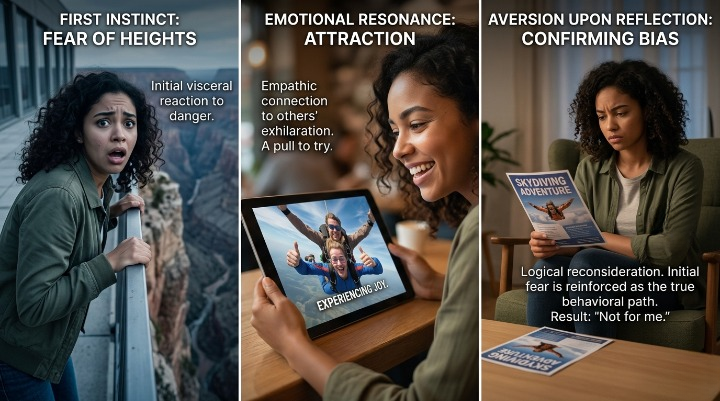
3. The Skydiving Example: A Complete Behavioural Arc
Consider the case of skydiving.
A. Instinct: Fear (The First Bias)
An individual stands at the edge or imagines the drop. Immediately:
- Heart rate rises.
- Muscles tense.
- The body recoils.
This is not learned. This is not reasoned. This is Instinct assigning intensity to the form of height.
The emotional charge of aversion at detection becomes fear at instinct—the first behavioural bias. The organism has already leaned away.
B. Resonance: Attraction (The Reinterpretation)
Now something changes. The individual watches others:
- Laughing mid-air.
- Smiling in exhilaration.
- Celebrating the experience.
The same initial emotional charge is now reframed. The intensity does not disappear—it is redirected. Fear begins to coexist with:
- Excitement.
- Curiosity.
- Desire to experience.
This is Resonant Spectrum at work—taking the same emotional energy and reshaping it through observation and emotional alignment.
The organism now leans both ways.
C. Reflection: Aversion or Commitment (The Verdict)
Finally, reflection intervenes. The individual evaluates:
- Personal limits.
- Risk tolerance.
- Identity (“I don’t like heights”).
And reaches a conclusion: “Not for me.”
Here, reflection does not create behaviour—it resolves competing emotional trajectories. The final decision often confirms the initial instinctive bias:
- Fear remains dominant.
- The organism withdraws.
But this is not always the case.
4. When Resonance Overrides Instinct
Some individuals proceed with skydiving even when fear remains dominant. Why?
Because their Resonant Spectrum activates greater spectral range of emotional valence at reflection in stacked memory trace than their Instinct intensity.
In these individuals:
- The attraction amplified through observation.
- The desire for experience
- The emotional alignment with others.
…outweighs the initial fear at the moment of reflection.
So behaviour follows resonance, not instinct.
This reveals a critical truth:
Instinct sets direction. Resonance can reshape it. Reflection decides which path becomes action.
5. The Illusion of Rational Choice
At the level of conscious awareness, it appears as though the individual simply “decided.” But in reality:
- Instinct biased the trajectory.
- Resonance reshaped the emotional field.
- Reflection computed the outcome.
The final decision is not free in isolation—it is the result of competing emotional forces resolving into a single behavioural expression.
6. Why Instinct Remains Foundational
Even when overridden, instinct is never irrelevant. It is:
- The first bias.
- The initial direction.
- The anchor point for all subsequent processing.
Even in those who jump:
- The fear existed.
- It was felt.
- It shaped the experience.
Without instinct, there would be no emotional charge to reshape, no tension to resolve, no behaviour to emerge.
The Core Psychextric Principle
This entire sequence reveals a deeper law:
Instinct is not a fixed category of behaviour—it is a generative emotional force that downstream systems shape into behaviour.
And more precisely:
Because instinct begins as undifferentiated intensity, it can become anything—but it always begins somewhere.
Conclusion
What we call behaviour is not born at the moment of decision. It is born at the moment of first feeling. The organism:
- Detects the world.
- Feels it before it understands it.
- And only later explains what it has already begun to do.
So when someone says:
“I just knew it wasn’t for me”.
What they are really describing is not knowledge. They are describing the persistence of an initial emotional bias—one that began long before thought had a chance to speak.
In this way, instinct does not dictate behaviour—but it writes its first line.
Back to: 👇