
Capacity versus Capability: Why People Feel the Same but Act Differently
BY: OMOLAJA MAKINEE
We often assume that if people feel the same way, they will act the same way. Shared anger should produce shared action. Shared injustice should produce shared response. But reality contradicts this constantly.
In any group facing the same event—especially something as emotionally charged as injustice—people diverge. Some act. Some hesitate. Some redirect. Some transform.
Psychextrics explains this divergence through a critical distinction:
Detected patterns define capability. Emotional valence defines capacity.
And these two are not the same.
1. The Architecture of Behaviour: What You Can Do versus What You Can Sustain
Every individual carries within their system a range of behavioural possibilities. These are encoded as detected patterns—stable structures that define:
- What the mind can imagine.
- What the system can simulate.
- What behaviours are structurally available.
This is capability.
But capability alone does not produce action. For behaviour to move from imagination to execution, it must be powered by:
Emotional valence—the intensity, direction, and stability of emotional energy.
This is capacity.
2. A Simple Truth Most People Miss
Almost everyone has the capability to commit extreme actions. Very few have the capacity to carry them out.
When Thought Doesn’t Become Action
Consider hatred.
When someone feels wronged:
- The mind generates scenarios.
- The imagination constructs outcomes.
- The detected pattern provides “wishful thinking”.
This may include:
- Fantasies of confrontation.
- Imagined retaliation.
- Even violent outcomes.
But most of these never materialise.
Why?
Because emotional valence is insufficient to sustain the act.
The mental structure exists. The emotional energy does not.
Consistency Reveals Capacity
This is why consistency differs across individuals.
- A researcher works daily for ten years.
- A gambler repeats behaviour compulsively.
- Another person with the same abilities cannot sustain either.
The difference is not capability. It is the strength, capacity and stability of emotional valence.
3. The Real-World Test: Injustice and Revenge
Now consider a lived scenario.
A group of individuals experiences a severe miscarriage of justice:
- Corrupt police.
- Bias judiciary.
- Manipulated legal processes.
- Fabricated evidence.
- Innocent lives damaged.
The Shared Response
Across the group:
- Anger emerges.
- A desire for justice forms.
- Revenge becomes imaginable.
This is shared capability. The detected patterns are aligned.
4. Where Divergence Begins
Despite this shared foundation, the group does not act uniformly.
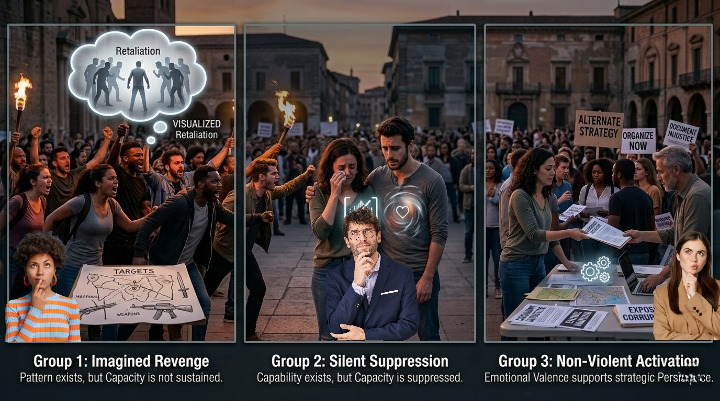
Group 1: Imagined Revenge
Some individuals:
- Visualise violent retaliation.
- Speak about it openly.
- Feel intense anger.
But they do not act. Why?
Their emotional valence cannot sustain execution. The behaviour exists in the pattern—but not in capacity.
Group 2: Silent Suppression
Others:
- Feel injustice deeply.
- Experience emotional distress.
- Avoid confrontation.
Here:
- Capability exists.
- Capacity is dampened.
The system withdraws instead of acting.
Group 3: Non-Violent Activation
Another subset:
- Channels anger into structured action.
- Organises campaigns.
- Exposes corruption publicly.
They do not lack intensity. They possess a different emotional alignment.
Their valence does not support violence. It supports:
- Persistence.
- Strategy.
- Exposure.
5. Why This Path Succeeds
Each group naturally follows a pathway aligned with their internal system.
And this is crucial:
People succeed in the pathway their system can sustain.
Violence Requires One Type of Capacity
- High immediate intensity.
- Low reflective inhibition.
- Survival-aligned execution.
Public Exposure Requires Another
- Long-term emotional endurance.
- Structured cognition.
- Stable motivational reinforcement.
6. Why Outsiders Misinterpret Behaviour
Now consider the perspective of those being challenged—the corrupt system.
They anticipate:
- Aggression.
- Retaliation.
- Direct confrontation.
Why?
Because their own detected patterns define revenge in those terms.
The Misalignment
When victims choose:
- Public campaigns.
- Legal exposure.
- Strategic resistance.
It appears:
- Unconventional.
- Unexpected.
- Even confusing.
The Real Reason
The observers lack:
The detected patterns required to recognise that pathway.
They interpret behaviour through their own capability limits. This is precisely how psychological-methods, because it is untethered from biological architecture, gradually corrode social understanding.
Traditional psychological systems often attempt to codify behaviour through interpretation alone, but interpretation itself is constrained by the detected patterns available within the observer. Humans do not analyse behaviour from an infinite field of possibilities. They analyse behaviour through the limits of what their own architecture is capable of recognising.
This creates a hidden imprisonment of perception. People often appear stubborn not because they consciously reject alternative viewpoints, but because the behavioural pathways being presented to them do not exist within their own detected-pattern architecture as recognisable possibilities. They literally cannot emotionally or structurally model the pathway being proposed. Under psychextrics, this becomes one of the central failures of adversarial systems.
Consider the modern courtroom.
A prosecution and defence team may examine the exact same event and arrive at radically different conclusions—not merely because of bias, but because each side organises behavioural possibility through different detected-pattern structures.
An investigator may unconsciously construct narratives only from behavioural routes they themselves would recognise as plausible.
If they embody:
- aggressive revenge pathways,
- manipulative pathways,
- concealment pathways,
they begin searching for evidence that confirms those architectures.
Meanwhile, behaviours outside their own capability-map appear:
- irrational,
- suspicious,
- deceptive,
- inconsistent,
- or psychologically abnormal.
This is why innocent behaviour can appear guilty.
A person responding in a way outside the investigator’s recognised behavioural architecture may accidentally trigger suspicion simply because the observer lacks the detected patterns required to understand the behaviour coherently.
Under psychextrics, policing therefore becomes partially trapped within cephalic projection. Investigators frequently mistake their own behavioural capability limits for objective human truth.
The same process governs romantic relationships.
First impressions rely heavily upon rapid detected-pattern comparison. Within seconds of meeting someone, the nervous system begins unconsciously asking:
- “Does this behavioural architecture feel familiar?”
- “Can I model this person?”
- “Do their pathways align with mine?”
- “Can I predict them?”
- “Do their emotional outputs stabilise my own?”
When alignment fails early, relationships often collapse before reflective understanding has sufficient time to develop. This is why many relationships never progress beyond:
- the first date,
- initial attraction,
- surface interaction.
The issue is often not incompatibility of values. It is incompatibility of detectable behavioural architecture. One individual may embody communication pathways the other literally cannot emotionally process as meaningful, attractive, or trustworthy.
The same occurs politically, socially, culturally, and institutionally.
People argue endlessly not because humans lack intelligence, but because each person’s detected patterns constrain the behavioural futures they can internally simulate. A pathway absent within the self often appears impossible within others.
This is why societies become polarised. Each group begins interpreting reality through the behavioural limits of its own detected-pattern architecture, until alternative structures no longer appear merely different—but incomprehensible.
Psychextrics therefore reframes social conflict itself: human disagreement is often not the collision of opinions. It is the collision of incompatible behavioural architectures attempting to interpret one another through capability systems too narrow to fully perceive the other side.
7. Same Emotion, Different Expression
Even when emotional valence appears similar—such as anger or desire for revenge—The expression differs because:
Emotional valence must operate within available detected patterns.
No one can express a behaviour that does not exist in their structure. And no one can sustain a behaviour their emotional system cannot sustain.
But knowledge of behavioural possibilities does not equate to acceptance of those possibilities as self-value. This is one of the most misunderstood aspects of human behaviour.
An individual may intellectually understand:
- violence,
- manipulation,
- deception,
- academic ambition,
- caregiving,
- leadership,
- artistic expression,
without emotionally aligning with those behavioural structures as part of the self.
Awareness is not embodiment. The nervous system can recognise countless behavioural pathways abstractly while remaining emotionally unanchored to them internally.
Under psychextrics, detected patterns are not merely behavioural possibilities. They are behavioural preference architectures, but not emotional preference itself. They define:
- what feels naturally sustainable but may not be sustainable in practice,
- what feels internally meaningful but may not be meaningful in practice,
- what feels emotionally coherent but may not be emotionally coherent in practice,
- what feels like “self” but may not align with the “self” in practice.
This is why two individuals can possess equal knowledge of a behavioural route yet experience radically different relationships to it.
For example, many individuals possess the detected patterns necessary to understand:
- academic work,
- disciplined study,
- corporate structure,
- repetitive labour,
yet emotionally detach from those pathways because the corresponding emotional valence required to sustain them remains weak or absent.
The behaviour is structurally possible. But it is not emotionally alive. The result becomes:
- disinterest,
- motivational collapse,
- chronic disengagement,
- internal exhaustion,
- emotional flatness,
or eventually psychological deterioration when prolonged exposure forces the individual into sustained behavioural misalignment.
This is why many people experience mental strain in careers, relationships, educational systems, or lifestyles that they are fully capable of performing competently. Capability is not emotional preference. Competence is not emotional alignment.
A person may successfully perform a role externally while internally operating against the natural resonance of their detected-pattern architecture. Over time, this creates behavioural friction. The organism begins expending enormous reflective energy to sustain behaviours that lack instinctive emotional support. The thalamic system continuously compensates for an absence of resonance. This is psychologically expensive.
Under psychextrics, prolonged behavioural existence outside preferred detected-pattern alignment gradually produces:
- emotional depletion,
- motivational instability,
- irritability,
- dissociation,
- identity fragmentation,
- or depressive collapse.
The modern world often mistakes this for laziness, lack of discipline, or failure of character. But many individuals are not failing because they lack capability. They are failing because the behavioural structure being demanded of them lacks emotional anchoring within their resonance architecture.
This also explains why forcing behavioural conformity rarely produces lasting transformation. People can temporarily imitate behaviours outside their natural alignment through:
- fear,
- reward,
- social pressure,
- survival necessity,
- institutional enforcement,
but behaviours unsupported by emotional valence rarely remain stable long-term.
Eventually the organism drifts back toward architectures carrying stronger resonance alignment. Detected patterns therefore do not merely determine: “What can I do?”
They determine: “What feels worth continuing?”
And emotional valence determines whether the organism possesses sufficient internal intensity to remain biologically committed to that pathway over time.
8. Families and Communities: The Hidden Divergence
This becomes even clearer in close groups:
- Families.
- Cultural communities.
- Shared environments.
Here, people often:
- Reach the same conclusions.
- Share the same beliefs.
Yet:
- Justify them differently.
- Act on them differently.
Why This Happens
- Detected patterns are similar (shared structure).
- Emotional valence diverges (individual capacity).
The Result
People agree on “What”—But differ on “Why” and “How”.
The Illusion of Agreement
Agreement does not mean alignment. Two people can say: “This is wrong.”
But one feels:
- Moral violation.
And the other feels:
- Personal threat.
Same conclusion. Different resonance.
9. Mapping Behaviour: The Psychextric Advantage
Psychextrics provides a way to decode this complexity. By separating:
- Capability (Detected Patterns).
- Capacity (Emotional Valence).
We can understand:
- Why people act differently under the same conditions.
- Why some behaviours remain imagined.
- Why others become reality.
The Deeper Implication
Human conflict is often misread as disagreement in values. But more often, it is: A difference in what people believe they can do and what they can emotionally sustain.
10. Final Insight: Behaviour Is Not Choice Alone
We like to believe behaviour is a matter of decision. But beneath decision lies:
- Structure.
- Energy.
- Alignment.
And when behaviour is not merely a choice but an alignment, then psychological collapse can emerge when profound misalignment occurs between lived experience and the emotional architecture capable of sustaining it.
This becomes especially important in understanding conditions such as PTSD within psychextrics. Not everyone exposed to warfare, violence, catastrophe, or trauma develops PTSD. Why?
Because exposure alone is insufficient. The critical variable is whether the lived experience possesses compatible emotional valence and detected-pattern structures capable of stabilising the memory into coherent resonance.
Two soldiers may stand in the same battlefield.
- Both witness death.
- Both experience fear.
- Both survive violence.
Yet one returns psychologically integrated while the other becomes trapped in persistent traumatic replay.
One veteran may recount the same warfare experience with emotional coherence, pride, humour, or even embellished resonance because the memory has successfully anchored into a sustainable emotional architecture of duty, survival, or identity, whilst another struggles to speak of it at all because the experience remains emotionally unintegrated within the echoic-loop, revealing that when PTSD is understood through psychextrics, military recruitment itself would eventually shift toward identifying which individuals possess the resonance architecture biologically capable of sustaining the psychological realities of combat soldiering and which do not.
Under psychextrics, PTSD emerges when the organism possesses:
- the memory trace,
- the detected pattern of the event,
but lacks sufficient emotional alignment to sustain, justify, integrate, or stabilise what occurred.
The event becomes structurally recorded within the hippocampal echoic architecture, yet emotionally unresolved within the amygdala–hypothalamic system.
The result is a form of cephalic instability. The memory exists. But no compatible emotional resonance exists to contain it coherently. This creates what may be called: Unanchored Echoic Persistence.
The hippocampus continues replaying the event because the organism cannot fully stabilise its emotional meaning into sustainable identity architecture. The lived experience remains psychologically “open.”
This is why traumatic memories often feel:
- intrusive,
- repetitive,
- unfinished,
- emotionally disorganised,
- disconnected from stable narrative continuity.
The memory does not settle into resonance. It remains trapped within looping echoic reactivation.
Under psychextrics, this explains why some individuals repeatedly revisit traumatic memories mentally despite consciously wanting to escape them. The nervous system is not simply “remembering.” It is attempting unsuccessfully to stabilise an emotionally incompatible experience.
The organism keeps searching for:
- justification,
- coherence,
- meaning,
- emotional positioning,
- survival reconciliation.
But where no compatible valence exists, the replay continues.
This also explains why PTSD often produces:
- hypervigilance,
- emotional numbing,
- dissociation,
- explosive reactions,
- avoidance,
- or identity fragmentation.
The cephalic hierarchy cannot fully determine: “What does this experience become within the self?”
Some individuals possess emotional architectures capable of integrating violence into:
- duty,
- sacrifice,
- protection,
- necessity,
- survival,
- or moral justification.
Others do not.
This is why many individuals who intensely enjoy warfare-based computer games are often rehearsing detected patterns rather than expressing a true emotional alignment toward real-world violence, because possessing the structural fascination for combat simulation does not necessarily mean the emotional valence exists to sustain actual violence once the consequences become biologically real.
For some, the emotional system cannot reconcile the contradiction between:
- what was done,
- what was witnessed,
- what was felt,
- and what the self is capable of sustaining emotionally.
This is why PTSD is not simply “fear after trauma.” It is often the consequence of unresolved alignment failure between:
- memory,
- emotional valence,
- identity pattern architecture,
- and behavioural sustainability.
The hippocampus retains the event. But the resonance architecture cannot successfully absorb it into stable selfhood. And when memory cannot become resonance, the organism remains suspended between experience and identity.
Conclusion: Understanding Each Other Requires Seeing Both Layers
To truly understand behaviour, we must ask two questions:
- What is this person capable of?
- What can this person emotionally sustain?
Only then can we understand:
- Why someone speaks but does not act.
- Why another acts without hesitation.
- Why others transform action into entirely different forms.
Because in the end:
We do not simply act on what we feel. We act on what we are emotionally built to sustain.
Back to: 👇