
Why You Can’t Smell While You Sleep: The Hidden Architecture of Detection and Awareness
BY: OMOLAJA MAKINEE
We often assume that when we sleep, our senses shut down. We imagine a kind of total disconnection—a suspension of perception until we wake again. But this is not how the brain works.
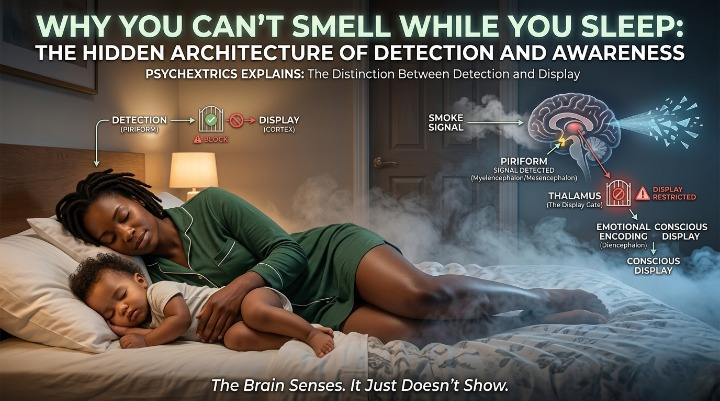
In the psychextrical model, sleep does not eliminate sensory processing. Instead, it reconfigures the pathway between detection and awareness. The system continues to detect signals, but selectively restricts which of those signals are allowed to reach conscious display.
The brain does not stop sensing during sleep. It stops showing what it senses.
This distinction—between detection and display—is the key to understanding why smells, in particular, rarely wake us.
1. Detection versus Awareness: The Core Divide
At the centre of this architecture lies a fundamental separation:
- Signal-Cortex processes Detection (chemical signal processing).
- Display-Cortex (Piriform and Orbitofrontal) displays Awareness (conscious experience).
- Olfactory bulb is the gatekeeper to piriform cortex, whilst the thalamus is the gatekeeper to the orbitofrontal cortex (both controls what reaches awareness).
These systems do not operate as one continuous flow.
Detection does not guarantee awareness during sleep.
Why?
Because the piriform cortex can still display the template-presence of a smell without generating sufficient emotional intensity to awaken the organism. During sleep, the olfactory system may continue registering that:
- something is present,
- something has entered,
- something carries attraction or aversion,
but Template encoding alone is biologically insufficient to force conscious emergence from sleep-state.
This is because the piriform cortex primarily displays emotional template encoding:
- familiarity,
- attraction,
- aversion,
- categorical presence.
It does not principally display the amplified emotional intensity required by the orbitofrontal cortex to interrupt sleep and recruit full cortical awakening.
2. The Sleep-State Breakdown
To understand this more clearly, we can map sensory processing across three functional states:
A. Deep Sleep: Detection Without Experience
Signal-Cortex (Detection): Active.
Display-Cortex (Awareness): Inactive.
Resolution: Detection occurs, but the Thalamic gate is locked.
During deep sleep, the brain enters a state of internal priority.
- The display-cortex undergoes metabolic restoration.
- Neural circuits recalibrate circadian balance.
- External sensory relay is suppressed.
The thalamus enforces this state by locking the gate of conscious awareness.
What Still Happens
- Odour molecules are still detected.
- The olfactory bulb may still relay to the piriform cortex.
- The piriform cortex continues receiving chemical signals and returning them back-to-sender to the olfactory bulb.
- Signals exist in a ping-pong state within the system.
What Does Not Happen
- No emotional encoding reaches sufficient threshold.
- No relay to the orbitofrontal cortex.
- No conscious awareness of smell reaches the threshold to enforce wakefulness.
The Outcome
The smell is detected but never experienced.
This is not sensory failure. It is connectivity suppression.
Why Smell Fails to Wake You
Like sound or touch in psychextrics, smell has a limitation:
It requires emotional weighting of intensity to become significant.
For a smell to wake you:
- It must be detected (piriform cortex).
- It must gain the instinctive emotional valence of intensity (amygdala/hypothalamus).
- It must pass the thalamic gate.
- It must activate the orbitofrontal cortex.
During deep sleep:
- The amygdala operates at low activity.
- Emotional encoding is minimal.
- The signal lacks urgency.
So the thalamus ignores it.
For awakening to occur, the signal must escalate beyond template-presence into intensity-encoding sufficient to engage thalamic relay toward the display-cortex, particularly the orbitofrontal valuation system. It is the enhancement of emotional intensity—not mere detection—that pushes the organism from passive registration into conscious interruption.
B. Light Sleep: Partial Reconnection
Signal-Cortex (Detection): Active.
Display-Cortex (Awareness): Reactivating.
Resolution: Low-level processing allows reflex responses.
In light sleep, the system becomes more porous.
- The thalamic gate is partially open.
- The myelencephalon resumes environmental scanning.
- The brain balances internal repair with external monitoring.
What Changes
- Strong or unusual smells may trigger mild responses.
- The system can escalate signals if necessary.
- Reflexive actions become possible.
Example
A sharp, irritating odour:
- May alter breathing.
- May cause subtle arousal.
- May shift sleep state toward wakefulness.
But still: Full conscious awareness is not guaranteed.
Thus, during sleep:
- a smell may be detected,
- template valence may exist,
- memory-linked odour recognition may occur,
yet the organism remains asleep because the emotional intensity of the signal never crossed the arousal threshold necessary for thalamic activation.
This explains why humans often continue sleeping through:
- familiar household odours,
- baseline environmental smells,
- weak smoke traces,
- low-level chemical changes.
The smell is not absent. The detection is not absent. The template encoding may not be absent. What is absent is sufficient emotional intensity to force the sleeping brain into conscious awareness.
C. Noxious/Reflex State: Survival Override
Signal-Cortex (Detection): Active.
Display-Cortex (Awareness): Bypassed.
Resolution: The Myelencephalon acts before the Thalamus.
This is where the hierarchy becomes unmistakable. Certain stimuli do not rely on smell processing alone. They trigger: Direct survival reflexes.
Example: Smelling Salts (Ammonia)
Ammonia does not “wake you up” through smell. It activates:
- The trigeminal nerve (CN V).
- A direct myelencephalic reflex arc.
What Happens
- The nasal lining is chemically irritated.
- The brain interprets this as airway threat.
- The myelencephalon triggers immediate inhalation and arousal.
Key Insight
The brain wakes up before it processes the smell.
This is not olfactory awareness. It is Survival enforcement.
Under psychextrics, sleep therefore reveals a critical distinction:
We do not awaken merely because something is detected. We awaken when what is detected acquires sufficient emotional intensity activated by any of the cephalon to override the stability of the sleeping state.
3. The Hierarchy of Sensory Priority
These states reveal a strict biological order:
- Survival (Myelencephalon) is highest priority.
- Detection (Signal-Cortex) is continuous.
- Conscious awareness (Display-Cortex) is conditional.
What This Means
- The brain will ignore detected signals.
- If they do not threaten survival.
- And if awareness would disrupt recovery.
4. The Myth of Reduced Sensitivity
It is often said that:
“Sensitivity decreases during sleep.”
This is misleading. The piriform cortex becomes largely unresponsive to odours from the external environment. What changes is: Signal routing. The coherence between the olfactory bulb and the piriform cortex decreases during slow-wave sleep-like states.
During Sleep
- Detection is ON.
- Relay is OFF.
- Awareness is OFF.
The Real Condition
The brain is not less sensitive. It is more selective.
Instead of transmitting odour data upward for conscious display, the architecture undergoes a functional reversal during sleep. The communication pathway does not disappear. It inverts.
Rather than the olfactory bulb driving the piriform cortex with incoming environmental information, the piriform cortex begins generating internally synchronised activity patterns—sharp-wave-like events comparable to hippocampal replay mechanisms. In psychextrics, this marks the transition from: environment-driven perception to memory-driven calibration.
During this state:
- the piriform cortex becomes the initiator,
- the olfactory bulb becomes the receiver,
- and the system shifts from external acquisition to internal maintenance.
This creates what may be called Piriform-Driven Synchronisation.
Under psychextrics, this top-down replay represents a form of internal atmospheric maintenance. The brain temporarily deprioritises the external environment in favour of reorganising the internal environment.
This also explains why the piriform cortex appears largely unresponsive to external odours during slow-wave sleep. It is not inactive. It is occupied. Its processing bandwidth has shifted toward replay, consolidation, and internal synchronisation.
The piriform cortex effectively refuses full relay of external sensory information into conscious display during deep sleep states. Incoming environmental odours may still reach the olfactory bulb at Detection level, but instead of being escalated toward conscious awareness, they are often redirected into oscillatory ping-pong loops between the bulb and piriform depending on the sleep-state.
This produces a reflex-like communication architecture:
- Detection remains active.
- Environmental sampling continues.
- Baseline monitoring persists.
But conscious enforcement is withheld unless emotional intensity crosses survival threshold.
The result is a highly selective system. The sleeping brain does not shut the olfactory world off. It suppresses unnecessary conscious escalation while preserving survival vigilance and internal memory maintenance simultaneously.
In psychextrics, this reveals a crucial principle:
Sleep is not sensory absence. It is sensory reprioritisation.
The organism temporarily turns away from the external atmosphere in order to stabilise the atmospheric architecture already living within it.
5. The End of Active Interpretation
At this stage, interpretation ceases—not because signals disappear, but because:
- The display-cortex is offline.
- Emotional encoding of intensity is either reduced or gated depending on the sleep state.
- The thalamus effectively blocks integration.
The Result
- Signals exist without meaning.
- Detection occurs without experience.
- The world is processed—but not known.
Conclusion: Awareness Is a Privilege, Not a Guarantee
Sleep reveals a fundamental truth about the brain:
Not everything you detect becomes something you experience.
Between the world and your awareness stands a gate. And during sleep, that gate is not broken. It is deliberately closed.
Because in the end, you don’t sleep through smells—you filter them out. The brain does not become blind to smells during sleep. It becomes selectively disconnected from them. Only signals that meet survival thresholds can break through. Everything else remains:
- Detected.
- Contained.
- Unexpressed
It is the reason why you cannot smell whilst you sleep.
Back to: 👇