
The Biological Price of Bureaucracy: Mapping the Orbitofrontal Cortex Trajectory
BY: OMOLAJA MAKINEE
Walk into any workplace before and after a major policy shift, and you will feel it instantly. The air changes. Conversations tighten. Productivity stutters. Some people adapt quickly, others resist, and a few seem untouched.
This is usually explained in terms of culture, leadership style, or employee attitude. But psychextrics offers a deeper explanation:
Bureaucracy is not just organisational—it is biological.
And at the centre of this transformation sits a critical structure in the brain:
The Orbitofrontal Cortex — the system that displays what work means.
1. Workplaces as Automated-Habitual Systems
In a stable workplace, most behaviour is not actively thought through—it is automated. Employees operate on what psychextrics calls Work-Flow Signals:
- Stored in the hippocampus (Signal-Cortex).
- Executed with minimal conscious effort.
- Reinforced through repetition.
This creates an environment where:
- Tasks are predictable.
- Effort feels low.
- Emotional value is stable.
In this state: The orbitofrontal cortex is largely idle.
Why?
Because nothing needs to be re-evaluated.
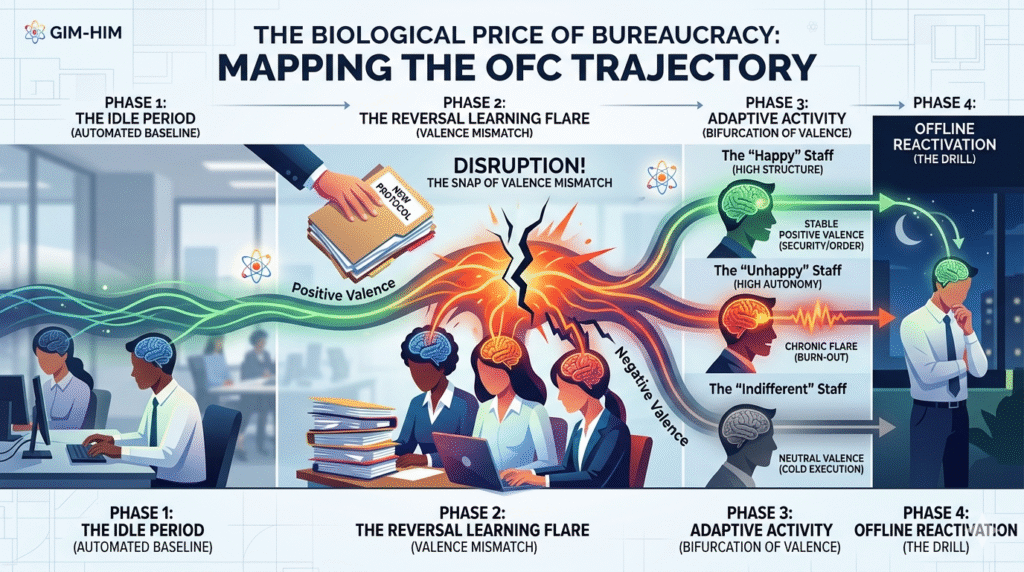
2. The Idle Period: Productivity Without Friction
Under a “light-touch” management style, employees settle into a baseline:
- Work is efficient.
- Autonomy is preserved.
- Emotional tone is neutral-to-positive.
People can:
- Work while chatting.
- Listen to music.
- Complete tasks almost automatically.
This is the echoic state of work—where behaviour runs on the echo of memory, not reflection. The orbitofrontal cortex remains quiet because:
The value of work is already known.
3. The Shock: When Bureaucracy Enters
Then everything changes. A new manager introduces:
- Multi-step procedures.
- Strict documentation.
- Rigid compliance systems.
What looks like a policy update is, biologically:
A Valence Mismatch Event.
The Reversal Learning Flare
On day one, employees encounter a conflict:
- Their brain says “Do Procedure X”.
- The environment demands “Do Procedure Y”.
This creates a breakdown between:
- Stored workflow (hippocampus)
- Current requirement (environment)
The result?
The orbitofrontal cortex flares.
4. What the Orbitofrontal Cortex Flare Feels Like
This flare is not abstract—it is experienced as:
- Frustration.
- Confusion.
- Irritation.
- Mental fatigue.
Why?
Because the orbitofrontal cortex is trying to answer:
“What is the value of this work now?”
Previously:
- Work equals Efficiency / Autonomy as Positive.
Now:
- Work equals Friction / Control as Negative.
The system must renegotiate meaning. And that costs energy.
The Hidden Cost: Metabolic Strain
Every orbitofrontal cortex flare consumes resources:
- Increased neural activity.
- Higher metabolic demand.
- Sustained cognitive effort.
This is why change feels exhausting. It’s not just “adjustment.”
It is the brain rewriting value in real time.
5. The Divergence: Three Types of Employees
After the initial disruption, employees do not respond the same way. Their trajectories split based on GIM–HIM architecture (inherited preference systems).
A. The Adaptors (Structure-Oriented Minds)
These individuals:
- Prefer order.
- Value predictability.
- Respond well to systems.
Their orbitofrontal cortex response:
- Quickly reassigns positive value.
- Reinterprets bureaucracy as:
- Security.
- Stability.
- Clarity.
Result:
The flare subsides.
They return to automation—just with a new system.
B. The Resisters (Autonomy-Oriented Minds)
These individuals:
- Value flexibility.
- Prefer independence.
- Resist imposed structure.
Their orbitofrontal cortex response:
- Fails to reconcile the new system
- Maintains negative valuation.
Result:
The orbitofrontal cortex remains in a chronic flare state.
This leads to:
- Persistent frustration.
- Mental fatigue.
- Burnout.
They are not being difficult.
Their brain is unable to stabilise the new value system.
C. The Indifferent (Neutral Processors)
These individuals:
- Detach emotional meaning from tasks.
- Operate functionally without valuation.
Their orbitofrontal cortex response:
- Assigns neutral valence.
Result:
- Work continues.
- No strong engagement.
- No strong resistance.
They perform—but do not invest.
6. What Happens After Work: The Hidden Reinforcement Loop
The real transformation doesn’t stop at the office. It continues afterward through Offline Reactivation.
Adaptors
- Mentally rehearse new workflows.
- Strengthen positive associations.
- Accelerate automation.
Resisters
- Replay frustrations.
- Reinforce negative value.
- Deepen resistance.
Indifferent
- Do not engage.
- Do not reinforce.
- Keep distance from the system.
The Orbitofrontal Cortex Trajectory of Change
Here’s the full biological progression:
| STAGE | ORBITOFRONTAL STATE | OUTCOME |
|---|---|---|
| Pre-change | Idle | Stable automation |
| Day-1 Shock | Collective Flare | Value collapse |
| Adaptors | Adaptive Encoding | Positive re-encoding |
| Resisters | Chronic Flare | Burnout risk |
| Indifferent | Neutral | Mechanical execution |
7. The Managerial Blind Spot
Most managers think they are changing:
- Systems.
- Processes.
- Efficiency.
But in reality, they are changing:
The biological value of work inside each employee’s brain.
8. Why Training Isn’t Enough
When employees struggle, the default response is:
- More training.
- More instructions.
- More enforcement.
But the real issue is not knowledge. It is valuation.
If the orbitofrontal cortex cannot assign positive meaning:
No amount of training will stabilise behaviour.
The Real Solution: Re-Encoding the System
To make change sustainable, managers must:
- Introduce positive spectral variation.
- Attach meaning beyond procedure.
This can include:
- Recognition
- Rewards
- Team cohesion
- Shared purpose
These elements allow the orbitofrontal cortex to:
Reassign value from negative to positive.
9. Why People “Resist Change”
They don’t. They resist value loss. When a system removes:
- Autonomy.
- Efficiency.
- Meaning.
The orbitofrontal cortex interprets it as:
A biological downgrade.
And reacts accordingly.
This is why most reforms never work in the way policymakers imagine they will. It is one thing for leadership to design a policy from the distance of abstraction, and it is another for the people who inhabit the daily operational reality of that system to biologically carry its burden.
Bureaucratic reform often fails because institutions are not moved by policy alone; they are moved by the emotional valuation systems of the humans operating within them. A government minister may announce a new procedural framework believing it improves “efficiency,” while the frontline worker experiences the same reform as increased surveillance, reduced autonomy, and emotional suffocation. The reform exists intellectually at the top, but biologically at the bottom it is experienced as stress.
Under psychextrics, the orbitofrontal cortex does not evaluate policies as legal text. It evaluates them as lived value. The body asks a simpler question than ideology: “What does this system now demand from me emotionally, cognitively, and behaviourally?”
If the answer becomes:
- more monitoring,
- more paperwork,
- less agency,
- slower execution,
- constant procedural interruption,
then the reform is not interpreted internally as progress. It is interpreted as a degradation of biological efficiency.
This is why administrators often become confused when workers resist “improvements.” On paper the reform appears rational. In lived experience it becomes exhausting. The people drafting the policy usually inhabit the Reflection layer of the institution — meetings, projections, models, targets, and ideological objectives. But the people implementing it inhabit the Resonant layer — repetition, fatigue, emotional endurance, and survival through routine. One group imagines the system conceptually. The other group breathes it physiologically every day.
- A nurse, for instance, may support healthcare reform philosophically while simultaneously hating the daily digital compliance procedures introduced with it.
- A police officer may agree with accountability structures in principle yet resent the bureaucratic expansion that forces every encounter into prolonged administrative documentation.
- A teacher may support educational inclusion while internally collapsing under the endless reporting structures attached to it.
In each case, the resistance is not necessarily ideological opposition. It is biological overload.
The tragedy of many reforms is that they are designed from the perspective of macro-intelligence while ignoring micro-existence. Leadership often assumes that because a policy is morally or economically justified, the nervous systems of those enforcing it will naturally synchronise with it. But human beings are not software platforms. They are resonance organisms. If the daily emotional architecture required to sustain a reform becomes too heavy, the body eventually rebels against it through:
- fatigue,
- disengagement,
- cynicism,
- passive resistance,
- burnout,
- procedural sabotage,
- emotional withdrawal.
This explains why many institutions quietly decay after reform despite appearing modernised externally. The system may look technologically advanced while the people inside it become psychologically detached from the very structure they operate. The bureaucracy expands while meaning collapses.
A lived example can be seen in modern workplaces where productivity software was introduced to “streamline workflow.” In theory, such systems reduce inefficiency. In practice, workers often spend more time documenting work than performing work. The orbitofrontal cortex gradually displays the brain reinterpretation of labour itself: the task is no longer the job; the reporting of the task becomes the job.
Over time, employees stop experiencing satisfaction from completion and instead experience anxiety from procedural incompletion. Their nervous system becomes trapped in perpetual anticipatory administration. The emotional reward once attached to meaningful contribution is replaced with survival through compliance.
This is why reform imposed from above frequently collides with the biology of those below. The people living inside a structure possess experiential intelligence that cannot be fully captured in policy language. They understand:
- where bottlenecks actually exist,
- where emotional exhaustion accumulates,
- where systems fail under pressure,
- where procedures contradict reality.
Those outside daily enforcement often underestimate this because reflective abstraction creates distance from embodied strain. The further leadership moves away from operational life, the more reform becomes conceptual rather than physiological.
Conclusion: Rethinking Workplace Change
Bureaucracy is not neutral. It carries a biological cost.
- It can stabilise or destabilise.
- It can energise or exhaust.
- It can align or fracture.
And all of this happenings is consciously revealed inside the orbitofrontal cortex.
If organisations want effective transformation, they must stop asking:
“Did employees understand the new system?”
And start asking:
“Did their brains accept the new value of the system?”
Under psychextrics, sustainable reform therefore requires more than institutional redesign. It requires resonance compatibility between:
- the policy,
- the behavioural demands of enforcement,
- the emotional endurance of workers,
- and the biological capacity of the human nervous system sustaining the institution.
Without that alignment, reform becomes a cognitive blueprint imposed against emotional architecture. And whenever reflective ideology attempts to dominate resonant reality indefinitely, the system eventually fractures beneath the weight of its own contradiction.
Because in the end:
- Work is not just what people do.
- It is what their brain believes it is worth.
And if that value collapses—
No system, no matter how efficient, will survive the biology of resistance.
Back to: 👇