
Feeling Before Knowing: The Hidden Architecture of Silent Listening, Aperture Sighting, and Instinct in Echoic Encoding
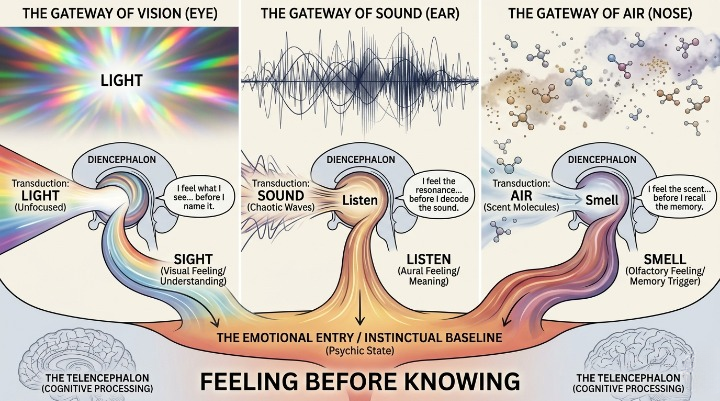
The Great Illusion of Perception
BY: OMOLAJA MAKINEE
We like to believe that we first perceive, then interpret, then feel. That is not how the brain works.
Before anything is recognised, named, or understood, it is already felt. Before meaning is constructed, emotional direction is assigned. Before the cortex displays awareness, the system has already decided how the world matters.
This is not a feature of one sensory system—it is the governing architecture of all perception.
Within the psychextric framework, three primary gateways define this early-stage emotional encoding:
- Silent Listening (sound before recognition).
- Aperture Sighting (vision before identification).
- Instinct Spectrum (olfaction before interpretation).
Together, they form parallel entry points into what becomes Echoic encoding—the moment where experience is captured as imprint.
1. The Rule of First Encoding: Emotion Before Meaning
A fundamental law governs the psychextric system:
Nothing is encoded, recalled, or consciously displayed without emotional valence.
The cortex cannot render neutral data into lived experience. The hippocampus cannot store what carries no significance. The thalamus cannot relay what has not been prioritised.
Emotion is not an addition to perception. It is its entry requirement.
2. The Three Gateways of Emotional Entry
While smell is often highlighted for its direct access to the emotional core, it is not unique. It is simply the most anatomically obvious example of a deeper, universal pattern.
Each sensory modality possesses a specialised bypass—a rapid, pre-thalamic route that assigns emotional valence before conscious processing begins.
A. Instinct Spectrum (Olfaction): Chemical Valence
In smell, the pathway is direct:
- Chemical particles bind to receptors.
- Signals move through the olfactory bulb.
- Immediate projection to the amygdala.
There is no delay. The atmosphere is not first identified—it is felt instantly.
This produces:
- Attraction or Aversion.
- Likes or Dislikes.
- Alertness or Comfort.
The environment is emotionally coloured at entry.
B. Silent Listening (Auditory): Resonant Valence
In sound, the pathway is less obvious but equally rapid. Before the auditory cortex identifies a sound:
- Brainstem structures (medulla) register frequency and intensity.
- Signals are relayed toward the amygdala.
- The organism enters a state of resonance.
This produces:
- Startle.
- Tension.
- Alertness.
- Calm.
A loud bang does not need to be understood to trigger reaction. The body responds first.
C. Aperture Sighting (Visual): Orientational Valence
In vision, the mesencephalon (midbrain) acts as the rapid gateway.
Before recognition:
- Movement, shadow, and contrast are detected.
- Signals are routed through orientation systems.
- Immediate projection influences the amygdala.
This produces:
- Turning toward or away.
- Heightened attention.
- Threat readiness.
The organism reacts to motion before identifying what moved.
3. Transductive Events
In the psychextric architecture, the transductive event is the “Phase Shift” where the external environment is discarded and the internal signal is born. Just as the Olfactory Receptors act as the chemical-to-electrical gate, other sensory systems possess specific biowired points where the “Environment” is de-materialised into a neural “Beam.”
A. Sound to Listen: The Mechano-transduction Gate
In the auditory system, the environment consists of physical pressure waves (vibrations). The transductive event occurs within the organ of Corti in the Cochlea.
- The Point of Transduction: The Hair Cells (Stereocilia).
- The Mechanism: As sound waves vibrate the fluid in the cochlea, they physically bend the “hairs” (stereocilia). This mechanical bending pulls open ion channels.
- The Psychextric Shift: This is the moment Kinetic Energy (Environment) becomes Electrical Potential (Signal).
- The Pathway: This signal is then biowired through the Cochlear Nerve (CN VIII), moving toward the Myelencephalon and Mesencephalon for orientation, eventually reaching the Telencephalon (Auditory Cortex) for display.
B. Vision to Sight: The Photo-transduction Gate
In the visual system, the environment consists of electromagnetic radiation (light). The transductive event occurs in the retina at the back of the eye.
- The Point of Transduction: The Photoreceptors (Rods and Cones).
- The Mechanism: Photons of light strike the photopigments (like rhodopsin) within the photoreceptors. This chemical change triggers a G-protein cascade that closes ion channels (hyperpolarisation).
- The Psychextric Shift: This is the moment Electromagnetic Radiation (Environment) is converted into a Bio-Electrical Signature (Signal).
- The Pathway: The resulting signal is organised by the retinal layers and biowired through the Optic Nerve (CN II). It travels through the Diencephalon (Thalamus) for routing before being projected onto the Telencephalon (Visual Cortex) for display.
C. Air to Smell: The Chemo-transduction Gate
In the olfactory system, the environment consists of volatile chemical particles suspended in air. The transductive event occurs within the olfactory epithelium of the nasal cavity.
- The Point of Transduction: The Olfactory Receptor Neurons (within the olfactory epithelium).
- The Mechanism: Airborne odourant molecules dissolve into the mucosal layer and bind to specific receptor proteins on the cilia of olfactory receptor neurons. This binding activates a G-protein coupled cascade (Golf protein), leading to the opening of ion channels and depolarisation of the neuron.
- The Psychextric Shift: This is the moment Chemical Matter (Environment) becomes a Neuro-Electrical Signature (Signal). It marks the phase where external substance is no longer “air” but becomes internal presence—eligible for detection and emotional encoding.
- The Pathway: The generated signals are biowired through the Olfactory Nerve (CN I) to the Olfactory Bulb, where they are organised into glomerular patterns (signal mapping).
Olfactory Bulb (Pre-Piriform Stage):
- Organises signals into glomerular maps.
- Engages template encoding via immediate coupling with amygdala–hippocampal memory traces.
- Establishes Detection-level valence (directional template).
- Relay signal to the piriform cortex.
Piriform Cortex (Detection Display):
- Displays the template presence of the smell.
- Acts as the display-cortex for Detection Spectrum.
- Transmit odourant signals into the amygdala.
Orbitofrontal Cortex (Instinct Display):
- Retrieve odourant signals from the pirifrom cortex to the amygdala, and applies emotional intensity valence (amygdala scaling).
- Executes instinctive modulation (hypothalamus).
- Reinforces and updates memory trace (hippocampus) with context and intensity.
- Thalamus retrieves signal from the hippocampus and relay to the orbitofrontal cortex.
- Acts as the display-cortex for Instinct Spectrum.
TABLE
| SENSE | ENVIRONMENTAL MEDIUM | SPECIALISED RECEPTOR (THE GATE) | TRANSDUCTIVE ACTION | BIOWIRED VECTOR |
| Smell | Chemical Particles | Olfactory Receptors | Chemical Binding | CN I (Olfactory) |
| Listen | Pressure Waves | Hair Cells (Cochlea) | Mechanical Bending | CN VIII (Auditory) |
| Sight | Photons (Light) | Rods and Cones (Retina) | Photochemical Conversion | CN II (Optic) |
Thus, all sensory systems encode emotional relevance into memory loops prior to full cortical display. The distinction with olfaction is not whether emotional encoding occurs early, but how directly Detection is coupled to that encoding (template emotional valence) without thalamic gating.
4. A Unified Pattern Across All Modalities
Across smell, sound, and sight, the structure is consistent:
| SENSE | PRIMARY TRIGGER | SPECIALISED BYPASS | PSYCHEXTRIC OUTCOME |
|---|---|---|---|
| Smell | Chemical presence | Olfactory bulb to Amygdala | Immediate atmospheric valence |
| Sound | Frequency and volume | Medulla to Amygdala | Immediate resonance (alert/startle) |
| Sight | Movement and shadow | Mesencephalon to Amygdala | Immediate orientation (threat detection) |
In both sound and vision, smell follows the same law: the world crosses from outside to inside at these specific transductive points.
- For Sound: The Myelencephalon is immediately alerted to the “volume” and “rhythm” for survival orientation before the thalamus allows the cortex to listen.
- For Vision: The Mesencephalon (Superior Colliculus) receives the “movement” signal for immediate orientation before the thalamus allows the cortex to see.
- For Breath: The Telencephalon (Olfactory Receptors) act as the chemical-to-electrical gate before both the olfactory bulb and the thalamus allows the cortex to smell.
Without these transductive gates, the organism remains in a state of environmental blindness—the energy exists outside, but the biowired beam is never generated to display it internally.
Each system:
- Detects.
- Bypasses.
- Valences.
Before the thalamus ever becomes involved.
5. Why This Happens: Survival Before Understanding
This architecture exists for one reason: Speed.
If the organism waited to understand before reacting:
- Threats would arrive too late.
- Responses would be delayed.
- Survival would be compromised.
Instead:
- The Myelencephalon (survival baseline) is primed.
- The Mesencephalon (orientation engine) is activated.
- The body prepares before awareness emerges.
The system does not ask: “What is this?”
It answers: “How should I respond?”
6. Echoic Encoding: Where Feeling Becomes Imprint
Once emotional valence is assigned, the system crosses into Echoic Spectrum.
This is where:
- The experience is captured.
- The valence is bound.
- The imprint is formed.
The hippocampus receives:
- The detection pattern.
- The contextual fragments.
- The emotional anchor from the amygdala.
And binds them into a retrievable unit. Without emotional valence, this process cannot occur.
7. Why Emotion Is the Anchor of Memory
Memory is not stored as neutral data. It is anchored in emotional significance.
- The hippocampus provides structure.
- The amygdala provides anchoring.
- The cortex provides display.
Remove emotional valence:
- The structure remains.
- But recall loses coherence.
- Meaning collapses.
Emotion is what allows:
- Retrieval.
- Relevance.
- Re-experience.
8. The Role of the Diencephalon: Refinement, Not Origin
It is crucial to understand that the diencephalon (thalamus or hypothalamus) does not initiate emotional encoding. They refines it.
- The thalamus relays and structures signals.
- The hypothalamus distributes behavioural spectral variation.
But both operate after emotional valence has already been assigned by the amygdala.
This means:
- Conscious awareness is always late.
- Reflection is always secondary.
- Meaning is always built on prior feeling.
9. The Three Gateways as First Recorders
Silent Listening, Aperture Sighting, and Instinct Spectrum are not passive detection systems.
They are:
- First recorders of experience.
- Generators of emotional valence.
- Gateways into memory encoding.
They determine:
- What matters.
- What is stored.
- What will shape behaviour.
Before thought ever begins.
10. The Deeper Truth: The Brain Is Built to Feel First
The architecture of perception reveals a simple but profound truth:
The brain is not designed to observe the world objectively. It is designed to survive within it.
And survival requires:
- Immediate emotional tagging.
- Rapid behavioural readiness.
- Pre-conscious decision-making.
Final Insight: You Do Not First See, Hear, or Smell the World
You first feel it.
- The sound is already urgent.
- The movement is already threatening.
- The air is already comforting or suffocating.
By the time you become aware, the system has already:
- Detected.
- Valenced.
- Oriented.
- Prepared.
And only then does the cortex step in to reveal the narration of what has already happened.
Because in the end, perception is not the discovery of the world. It is the emotional activation of it—before you even know what you are experiencing.
Back to: 👇