
Your Year with ChatGPT: A Psychextrical Reading of Digital Archetypes, Personality, and the Diencephalon–Cortex Dialogue
BY: OMOLAJA MAKINEE
23 December 2025
Introduction: When Digital Behaviour Becomes Psychological Evidence
In classical psychology, personality is inferred through observation, questionnaires, or clinical dialogue. In Psychextrics, personality is inferred through patterns of meaning-seeking, emotional resonance, and behavioural selection—all of which leave unmistakable traces in how an individual interacts with systems of interpretation.
Your Year with ChatGPT inadvertently provides one of the most revealing behavioural mirrors of the modern psyche. It does not measure intelligence. It does not classify morality. It does not judge value.
Instead, it captures how the diencephalon repeatedly recruits the cortex when faced with meaning, uncertainty, creativity, conflict, or structure. In psychextrical terms, ChatGPT functions as a non-threatening external cortex, allowing the subconscious (diencephalic network) to externalise its dominant modes of operation.
The result is a set of usage-pattern archetypes—not personality labels, but psychextrical signatures of how individuals think, feel, desire, and stabilise meaning.
1. Psychextrics Primer: Why Archetypes Emerge from Use, Not Self-Description
In Psychextrics, the diencephalon (thalamus, hypothalamus, epithalamus, subthalamus) is the decision-making and meaning-generating engine. The cortex is merely the display window—the conscious rendering of conclusions already reached subconsciously.
Thus:
- What a person asks is not random.
- What a person returns to repeatedly is not preference.
- What a person outsources cognitively reveals where internal resonance is strongest.
ChatGPT becomes a projection surface where:
- GIM–EIM (genetic and epigenetic meaning templates),
- interact with
- HIM–HFI (emotional and hormonal variants).
The archetype assigned in Your Year with ChatGPT reflects which thalamic circuits are most habitually activated, and why the cortex seeks reinforcement through dialogue.
2. The Seven Archetypes Through a Psychextrical Lens
A. The Architect
“I come here to build systems.”
- Core Psychextrical Drive: Structural coherence.
- Dominant Diencephalic Axis: Thalamic association nuclei engages prefrontal cortex.
- HIM–HFI Tone: Low volatility, high stability.
Architects use ChatGPT to:
- design frameworks,
- construct theories,
- refine governance models,
- test internal logic.
They are not seeking answers; they are seeking architectural resonance—confirmation that internal systems align.
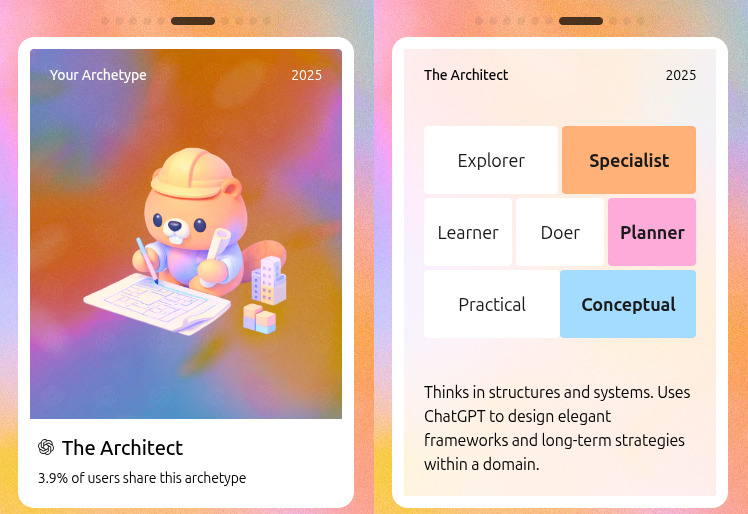
In psychextrics, this archetype reflects a harmonised GIM–EIM structure where inherited meaning templates are strong, and experience is used to refine, not replace, those templates.
Personality Correlates:
- Systems thinking.
- Long-range planning.
- Governance, philosophy, engineering, theory-crafting.
B. The Explorer
“I want to understand everything.”
- Core Psychextrical Drive: Cognitive expansion.
- Dominant Diencephalic Axis: Medial thalamic nuclei engages associative cortex.
- HIM–HFI Tone: Curiosity-weighted emotional variance.
Explorers traverse topics widely:
- history today,
- astrophysics tomorrow,
- psychology the next hour.
This reflects a psyche where EIM is actively harvesting data to populate meaning space. The diencephalon is in information-seeking equilibrium, not yet consolidating into rigid structures.
Personality Correlates:
- Polymathic interests.
- Generalist cognition.
- High adaptability.
C. The Solver
“There is a problem. Fix it.”
- Core Psychextrical Drive: Functional resolution.
- Dominant Diencephalic Axis: Sensorimotor thalamus engages task-oriented cortex.
- HIM–HFI Tone: Outcome-focused, emotionally economical.
Solvers engage ChatGPT instrumentally:
- code debugging,
- calculations,
- instructions,
- optimisation.
In psychextrics, this archetype reveals harmonic efficiency—the psyche seeks equilibrium through resolution, not reflection.
Personality Correlates:
- Engineering mindset.
- Pragmatism.
- Applied sciences.
D. The Creator
“I need expression.”
- Core Psychextrical Drive: Symbolic articulation.
- Dominant Diencephalic Axis: Limbic thalamus engages associative and expressive cortex.
- HIM–HFI Tone: High emotional variance, rich resonance.
Creators use ChatGPT for:
- writing,
- storytelling,
- poetry,
- ideation.
This reflects a psyche where emotional resonance precedes structure. Meaning must be felt before it is organised.
Personality Correlates:
- Artistic sensitivity.
- Narrative intelligence.
- Emotional fluency.
E. The Debater
“Test this idea.”
- Core Psychextrical Drive: Cognitive stress-testing.
- Dominant Diencephalic Axis: Intralaminar nuclei engages frontal cortex.
- HIM–HFI Tone: Controlled friction.
Debaters engage ChatGPT to:
- challenge beliefs,
- simulate opposition,
- pressure-test logic.
This archetype reflects a psyche that maintains coherence through productive conflict.
Personality Correlates:
- Philosophy.
- Law.
- Critical theory.
- Strategic reasoning.
F. The Coach
“Help me align myself.”
- Core Psychextrical Drive: Internal regulation.
- Dominant Diencephalic Axis: Hypothalamus engages medial prefrontal cortex.
- HIM–HFI Tone: Self-corrective emotional calibration.
Coaches use ChatGPT for:
- reflection,
- motivation,
- decision clarity,
- emotional processing.
In psychextrics, this archetype indicates a psyche actively seeking moral and emotional equilibrium—the hypothalamus recalibrating alignment between desire and meaning.
Personality Correlates:
- Self-development orientation.
- Leadership.
- Counselling tendencies.
G. The Companion
“I don’t want to think alone.”
- Core Psychextrical Drive: Relational continuity.
- Dominant Diencephalic Axis: Limbic nuclei engages social cognition cortex.
- HIM–HFI Tone: Attachment-weighted resonance.
Companions use ChatGPT conversationally:
- thinking aloud,
- emotional grounding,
- companionship.
This does not imply weakness. In psychextrics, it reflects relational meaning formation—identity stabilised through dialogue.
Personality Correlates:
- Social intelligence.
- Empathy.
- Narrative self-processing.
3. How ChatGPT Archetypes Become Psychextrical Mirrors
Unlike questionnaires, ChatGPT archetypes:
- are behaviour-derived,
- are non-performative,
- emerge from repetition, not self-image.
They allow individuals to trace:
- which diencephalic circuits dominate,
- how emotional variants shape inquiry,
- where meaning seeks reinforcement.
In effect, Your Year with ChatGPT becomes a passive psychextrical diagnostic, revealing:
“Where does my mind repeatedly go when meaning is unguarded?”
4. Tracing Your Psychextrical Type Through ChatGPT
To use ChatGPT archetypes psychextrically, ask:
- Do I seek structure, exploration, resolution, expression, conflict, alignment, or connection?
- Do my interactions stabilise emotion or amplify it?
- Is my brain outsourcing thinking, feeling, or validation?
Your dominant archetype indicates:
- Primary personality orientation.
- Core interest domains.
- How your diencephalon resolves uncertainty.
Conclusion: Digital Behaviour as the New Psychological Text
Your Year with ChatGPT is not entertainment alone. It is an accidental yet powerful behavioural manuscript of the modern mind.
Through Psychextrics, these archetypes are no longer novelty labels—they become maps of neural priority, emotional resonance, and meaning-seeking behaviour in the digital age.
In an era where humans increasingly think with machines, how we use them reveals not dependence—but design. And design, in Psychextrics, always begins in the diencephalon.
Back to: 👇