
WHY SATAN DOES NOT EXIST: THE PRACTICAL DOCTRINE OF ORTHODOX-PANTHEISM
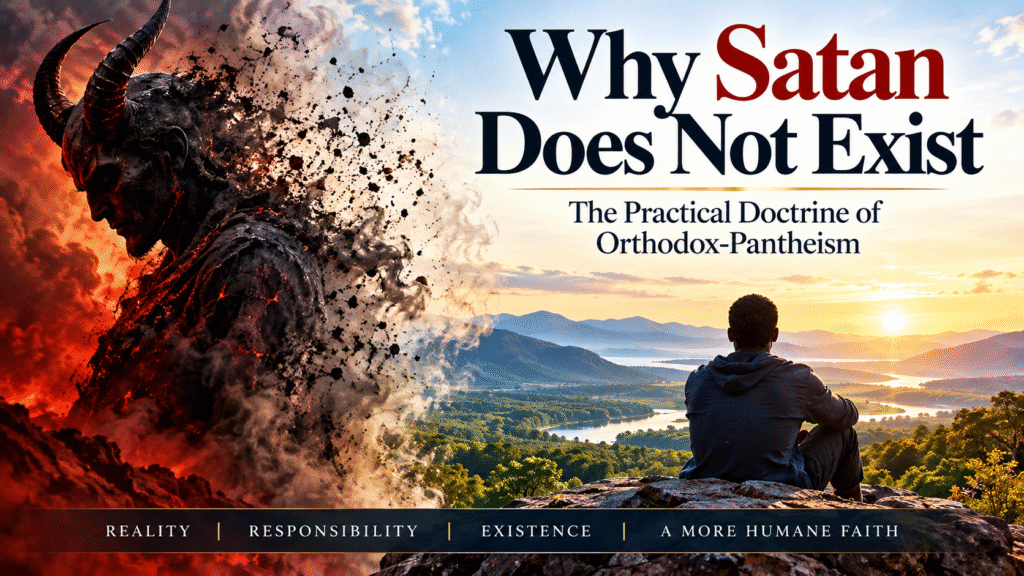
Why the rejection of a supernatural Devil restores human responsibility and removes the need for a cosmic enemy.
BY: OMOLAJA MAKINEE
Introduction: Beyond the Theology of Satan
The existence of Satan or the Devil has occupied a central position in numerous religious traditions, particularly those that explain the relationship between good and evil through a conflict between divine and demonic powers. Within these traditions, the Devil is frequently understood as a supernatural antagonist who tempts humanity, encourages disobedience and attempts to undermine the purposes of God. Human wrongdoing can consequently be interpreted through the influence of a malevolent entity whose intentions stand in opposition to divine authority.
Orthodox-Pantheism rejects this interpretation. It does not recognise Satan or the Devil as a literal supernatural being, nor does it accept that the existence of evil requires a corresponding cosmic personality responsible for producing it. Its position is not an attempt to compete with Christianity, Islam or any other religious tradition that recognises the Devil. It is a declaration of a different theological architecture, one that begins with existence itself and asks whether an external supernatural antagonist is necessary to explain the conduct of living beings.
The distinction is fundamental. Orthodox-Pantheism does not deny that human beings commit destructive acts, that suffering exists, or that some conduct causes profound harm. It rejects the necessity of placing a supernatural agent between the person who acts and the consequences of that action.
A person can deceive, exploit, assault, persecute or kill another human being without requiring the existence of Satan to explain the act. Such conduct can be examined through what the individual did, the circumstances in which it occurred, the consequences that followed and the responsibility that belongs to the person who acted.
The practical question is therefore not whether Satan possesses sufficient power to influence humanity. It is whether the concept of Satan is necessary to understand human wrongdoing, and whether attributing evil to an external supernatural agent risks obscuring the responsibility of the human being who commits it.
Orthodox-Pantheism answers both questions by rejecting the Devil as a literal entity and returning the examination of evil to the observable world of conduct, consequences and relationships.
1. The God of Genesis and the Problem of Divine Rejection
The Book of Genesis presents an account of humanity’s relationship with God that provides a useful starting point for examining the Orthodox-Pantheist position. In Genesis 1:26–27, humanity is described as being created in the image of God. In Genesis 2–3, Adam and Eve inhabit the Garden of Eden, receive a prohibition concerning the tree of the knowledge of good and evil, disobey the command and are subsequently expelled from the garden.
Within traditional Christian interpretations, this narrative has been used to explain disobedience, sin, human alienation from God and the need for reconciliation with the divine. Satan is often incorporated into the wider interpretation of humanity’s fall, although the Genesis account itself does not explicitly identify the serpent as Satan.
Orthodox-Pantheism approaches the narrative through a different question.
If humanity was created in the image of God, what does that image mean? Does it refer to physical resemblance, moral character, spiritual capacity or a symbolic relationship between humanity and divinity? The answer matters because the expression cannot simply be assumed to mean that human beings must behave exactly as God behaves. That conclusion does not follow automatically from the language of divine image.
Nevertheless, the narrative raises a further philosophical question about the relationship between creation, obedience and rejection.
Before the expulsion, the garden is depicted as a place in which humanity inhabits an immediate relationship with God. After the prohibition is violated, that relationship changes. The human beings are expelled, access to the tree of life is restricted, and the conditions of human existence become fundamentally different.
The Orthodox-Pantheist inquiry is not that the biblical narrative must be dismissed as meaningless. It is that the narrative should not automatically be interpreted as establishing a universal model in which wrongdoing must be explained through an external enemy who opposes God.
Consider the implications of the story from the perspective of a creator and a creation. If a creator produces a living system, the subsequent conduct of that system raises questions about its design, its capacities, its limitations and the conditions under which it operates. If the creation acts contrary to an instruction, one must examine the act, the instruction, the circumstances and the consequences. Introducing a separate supernatural antagonist does not, by itself, explain those relationships.
Orthodox-Pantheism therefore directs attention away from the assumption that humanity’s difficulties require a cosmic enemy and towards the practical relationship between living beings and the conditions of their existence.
The central question becomes not whether humanity has angered a supernatural ruler, but how human conduct operates within the natural order and what follows from the choices people make.
2. The Creator and the Invention: Why Would God Hide from His Own Creation?
Consider a practical analogy.
A person invents an electronic vehicle. The vehicle is designed, assembled and brought into operation. After completing the invention, the inventor does not ordinarily need to disappear from the vehicle, hide from it or establish a supernatural relationship through which the vehicle must seek forgiveness for operating incorrectly.
If the vehicle malfunctions, the relevant questions concern its design, components, operating conditions and the actions of those using it. If the vehicle is damaged, the damage must be examined. If it causes an accident, the circumstances and the responsibilities of those involved must be investigated.
The vehicle does not need to believe that an invisible adversary has corrupted its machinery before its malfunction can be understood.
The analogy is not a literal equivalence between a human invention and a universe. An electronic vehicle is an artefact with a known human inventor, whereas the origins and nature of existence raise much deeper philosophical questions. Its purpose is narrower: to illustrate the difference between explaining an event through the relationships and conditions that can be investigated and explaining it through an additional invisible agent.
Apply that distinction to the traditional image of a personal God who creates humanity, communicates with humanity and subsequently becomes inaccessible to ordinary human perception.
Why must this relationship be explained through a supernatural antagonist? Why must human wrongdoing be attributed to an external agent rather than examined as the conduct of the human being who committed it?
The fact that people cannot ordinarily see God or Satan with their eyes does not logically prove that neither exists. Invisible things can exist, and many physical processes are known through their effects rather than direct visual observation. The stronger Orthodox-Pantheist argument is therefore not that invisibility alone disproves supernatural beings.
It is that Orthodox-Pantheism has no need to posit Satan as an additional entity in its account of existence.
Its conception of God is also fundamentally different from the anthropomorphic model. God is not a human-shaped sovereign standing outside the universe, observing creation from a remote location. In Orthodox-Pantheism, Nature is the divine totality, and divinity is understood through the unfolding of existence itself.
This removes the need to explain the world through a supernatural war between two opposing rulers. There is no external divine monarch whose purposes must be defended by another invisible force, and there is no corresponding requirement for a Devil who attempts to sabotage the creation from outside it.
The practical emphasis shifts from the imagined intentions of invisible personalities to the relationships, processes and consequences that constitute the world in which human beings live.
3. Why Orthodox-Pantheism Rejects the Cosmic Enemy
The traditional opposition between God and Satan introduces a dualistic interpretation of existence. God represents the divine authority, while Satan represents the opposing malevolent agency. Human conduct can then be understood as occurring within a larger struggle between these supernatural powers.
Orthodox-Pantheism rejects the necessity of this arrangement.
Nature contains growth and decay, cooperation and competition, birth and death, pleasure and suffering. These processes do not establish the existence of two supernatural rulers fighting for control of the universe. They demonstrate the diversity of conditions and processes through which existence unfolds.
A storm does not need to be an act of Satan to destroy a building. A disease does not need to be a demonic attack to cause suffering. A person does not need to be possessed by the Devil to deceive another person, and a political institution does not need supernatural instructions to organise persecution.
These events require different explanations according to their circumstances. Some involve physical processes, some involve biological processes, and others involve human decisions, institutions and relationships. Treating all destructive outcomes as manifestations of an external malevolent power obscures the distinctions between them.
The rejection of Satan is therefore not a declaration that everything in Nature is harmless or that all human conduct is ethically acceptable. It is a refusal to turn destructive outcomes into evidence of a cosmic personality.
Within Orthodox-Pantheism, evil is not an independent supernatural substance competing with good for control of reality. It is examined through conduct, its effects and the conditions that produce or sustain harm.
This distinction is important because it preserves the reality of suffering without requiring the invention of a supernatural perpetrator.
A child who is abused has suffered a real harm. A community subjected to violence has experienced a real violation. A person who deliberately deceives another has performed an identifiable act. None of these realities becomes more intelligible simply by attributing the event to Satan.
The question is what happened, who acted, what enabled the conduct, who was harmed and what can be done to prevent further harm.
That is the practical orientation of Orthodox-Pantheism.
4. The Devil as an Explanation That Can Remove Responsibility
One of the central ethical problems with the belief in Satan concerns the way responsibility may be interpreted when wrongdoing is attributed to supernatural influence.
Suppose an individual deliberately harms another person and subsequently claims that the Devil made them do it. The explanation introduces a second agent into the account of the conduct. Instead of examining the individual’s decision, the explanation shifts attention towards an invisible being said to have influenced the decision.
This does not mean that every Christian, Muslim or other believer who accepts the existence of Satan avoids responsibility. Many religious traditions explicitly teach that people remain accountable for their choices despite temptation. The problem arises when belief in demonic influence is used to excuse conduct that would otherwise require direct examination.
The distinction can be represented as follows:
Attribution to Satan
Wrongdoing → External supernatural influence → Reduced personal responsibility → Appeal for divine forgiveness.
Orthodox-Pantheist interpretation
Conduct → Examination of circumstances and decisions → Identification of harm → Responsibility and practical response.
The first sequence can become an escape route when the supernatural explanation displaces the human one. The second requires the conduct to remain visible and open to examination.
Consider a person or group of people who commits perjury and falsified evidence against an innocent person who ended up in prison for offences he did not commit. If the individual who commits perjury claims to have been influenced by Satan, that claim does not establish whether the lies told against another human being occurred, identify its victims, restore their losses or determine the appropriate legal response. Those questions must still be answered.
The same applies to violence, abuse, exploitation and persecution. Invoking a supernatural adversary does not reverse the harm or remove the need for accountability.
Orthodox-Pantheism therefore refuses to make the Devil a necessary intermediary in the interpretation of wrongdoing. It asks human beings to confront what they have done and what their actions have produced.
This is not an argument against spiritual reflection or forgiveness. It is an argument that forgiveness must not become a substitute for responsibility.
5. Religious Violence and the Possibility of Moral Evasion
The distinction becomes particularly important when religious language is used to legitimise violence.
Across history, people have committed acts of violence while claiming divine authority, religious necessity or spiritual justification. Different traditions have interpreted these acts in different ways, and the causes of religious violence cannot be reduced to one explanation. Political ambition, territorial conflict, social division, institutional authority and material interests can all contribute.
Nevertheless, a dangerous interpretive pattern emerges when an individual or institution can attribute evil to an external spiritual enemy while simultaneously claiming divine approval for its own actions.
A group may identify another community as demonic, satanic or spiritually corrupt. Once the opposing group has been placed outside the boundaries of legitimate humanity, hostility can be represented as a sacred duty rather than a decision requiring moral scrutiny.
The mechanism can become self-reinforcing:
Religious certainty → Identification of an enemy → Demonisation of the enemy → Moral justification for hostility → Harm represented as divine service.
This is not an inevitable consequence of monotheism, nor is it confined to monotheistic religions. Any ideology can dehumanise opponents, and polytheistic societies have also experienced persecution and violence. The issue is the use of supernatural or ideological authority to shield human conduct from criticism.
Orthodox-Pantheism rejects that shield.
If a person harms another person, the invocation of God does not automatically make the act righteous. Equally, identifying the opposing person as an agent of Satan does not automatically make that person deserving of harm.
The conduct must be examined in its own right.
- Who initiated the violence?
- What was done? Who suffered?
- What justification was offered?
- Were the actions necessary, proportionate or defensible?
- What consequences followed?
These questions cannot be answered merely by declaring one side divine and the other demonic.
Orthodox-Pantheism therefore treats the externalisation of evil as a practical danger. When a community locates evil entirely in its opponents, it can become less willing to examine the harm committed by its own members. When individuals believe that their wrongdoing can be transferred to Satan, they can become less willing to confront their own decisions.
The rejection of Satan removes this particular explanatory refuge. It does not guarantee ethical conduct, but it requires human wrongdoing to be addressed without presuming the existence of an invisible culprit.
6. Forgiveness Cannot Replace Consequences
The belief that God can forgive wrongdoing occupies an important place in several religious traditions. Forgiveness can provide a framework for repentance, reconciliation and moral transformation. Orthodox-Pantheism does not need to deny the value of these practices in order to challenge the assumption that an external Devil is necessary to explain human behaviour.
The problem emerges when the expectation of eventual divine forgiveness becomes a reason to treat present consequences as secondary.
Imagine an individual who commits a serious offence, attributes the conduct to Satan, seeks forgiveness through prayer and expects reconciliation with God after death. The victim, however, remains alive with the consequences of the offence. The harm may continue to affect the victim’s health, relationships, finances, security or sense of dignity.
A declaration of repentance does not automatically restore what was taken.
Nor does the possibility of divine forgiveness determine whether the victim has received justice, whether restitution is required or whether further harm has been prevented.
Forgiveness and accountability are different questions. One concerns the possibility of reconciliation; the other concerns the reality of conduct and its consequences.
Orthodox-Pantheism places particular emphasis on the second question because its theology does not depend upon a supernatural judge who intervenes to reward or punish people according to a divine decree. Nature is not conceived as a celestial courtroom in which human beings can escape the consequences of their actions by securing the favour of an external ruler.
Instead, actions occur within a network of relationships and conditions. Their consequences can extend beyond the moment in which they are performed, affecting individuals, communities and the wider environment.
A person who damages another’s property may face legal consequences. A person who betrays a relationship may destroy trust. An institution that persecutes a community may create lasting social divisions. A government that destroys an ecosystem may impose consequences on generations that did not participate in the original decision.
These outcomes do not require Satan to administer them. They arise through the relationships between conduct, conditions and consequences.
The practical doctrine of Orthodox-Pantheism therefore rejects the idea that moral responsibility must be mediated through a cosmic struggle between God and the Devil. Its emphasis is on recognising harm, understanding its causes, responding to its effects and restoring damaged relationships wherever restoration is possible.
7. Nature Does Not Require a Supernatural Explanation for Every Harm
To understand the Orthodox-Pantheist position fully, it is necessary to distinguish the rejection of Satan from the rejection of all evil or suffering.
Orthodox-Pantheism does not claim that everything that occurs is pleasant, just or beneficial. Nature contains processes that sustain life and processes that destroy it. Human beings can experience suffering through natural events, biological conditions, accidents and the actions of others.
The existence of suffering does not, by itself, establish the existence of a supernatural being responsible for producing it.
A flood can destroy a settlement through physical processes. A disease can damage the body through biological processes. A person can inflict suffering through a deliberate act. These events differ in their immediate causes, and a practical response must recognise those differences.
The flood may require evacuation, engineering and rebuilding. The disease may require diagnosis, treatment and prevention. Deliberate violence may require protection, investigation, legal accountability and measures to prevent recurrence.
Describing each event as the work of Satan does not provide the practical explanation needed to address it.
The Orthodox-Pantheist approach therefore begins with the conditions that exist rather than assuming a supernatural antagonist behind every undesirable outcome.
This also clarifies the distinction between Nature as the sacred totality of existence and individual events within Nature. To regard Nature as divine does not mean that every event must be celebrated or that every action should be accepted without criticism. It means that existence is not divided into a sacred realm controlled by God and an opposing realm controlled by Satan.
There is one interconnected field of existence, containing many different processes, relationships and consequences.
Human responsibility operates within that field. We can investigate causes, reduce preventable suffering, protect vulnerable beings and respond to harmful conduct without requiring the existence of a supernatural enemy.
8. Why the Doctrine Is Practical Rather Than Psychological
Orthodox-Pantheism’s rejection of Satan can be interpreted psychologically if the Devil is described solely as a projection of fear, aggression, guilt or the human shadow. Such an interpretation may be relevant to the symbolic history of the concept, but it does not fully express the practical position developed here.
The doctrine does not need to diagnose the mental state of a believer or determine why an individual imagines a supernatural adversary. Its central concern is more direct:
What explanatory work does the concept of Satan perform, and is that explanation necessary to understand existence and human conduct?
The question is architectural rather than diagnostic.
A psychological account might examine how a person projects unwanted impulses onto an external figure. A practical Orthodox-Pantheist account asks whether the external figure is needed to explain the action in the first place.
A person commits an act of violence. The relevant inquiry concerns the act, the circumstances, the victim, the consequences and the responsibilities involved. Whether the perpetrator believes in Satan is a separate matter. Whether the perpetrator claims to have been influenced by Satan does not establish that Satan exists or that the claim explains the event.
The same principle applies to natural disasters, disease and social conflict. The practical task is to identify the processes involved, establish what can be known, recognise the limits of that knowledge and respond appropriately.
Orthodox-Pantheism therefore does not require a psychological reinterpretation of every reference to the Devil. It rejects the need for Satan as a literal supernatural entity within its own account of reality.
This distinction preserves the doctrine’s independence. The position is not that Satan exists inside the mind rather than outside it, as though the Devil’s location were the only question. It is that the existence of a supernatural Devil is not required to account for the world as Orthodox-Pantheism understands it.
The doctrine may recognise that the concept has symbolic, cultural and psychological significance in other traditions. Recognition of that significance does not require acceptance of the entity as a literal being.
9. The Consequences of Living Without a Devil
What changes when people no longer require Satan to explain wrongdoing?
- First, the person who acts remains central to the examination of the act. Responsibility cannot automatically be transferred to a supernatural adversary.
- Second, the victim’s experience remains visible. The explanation of wrongdoing must not become more important than the harm that has occurred.
- Third, moral inquiry becomes practical. Rather than asking only whether a person has offended God or yielded to Satan, the inquiry considers what was done, whom it affected and what response is necessary.
- Fourth, prevention becomes possible without dependence upon supernatural warfare. Violence can be addressed through protection, education, institutional reform, accountability and changes to the conditions that enable harm. These responses do not guarantee that wrongdoing will disappear, but they engage directly with the world in which it occurs.
Finally, the relationship between spirituality and responsibility changes. A person does not need to fear a supernatural adversary in order to recognise the value of compassion, nor must a person await divine punishment before considering the consequences of destructive conduct.
Within Orthodox-Pantheism, Conscience is understood as a means of recognising one’s relationship with the wider order of existence. When that relationship is damaged through destructive conduct, the task is to restore awareness, repair harm where possible and recover a more responsible relationship with the world.
This is consistent with the broader doctrine’s understanding of the sacred. If all existence participates in the divine totality of Nature, then harm to another living being is not simply an offence committed against a distant authority. It is an event within the same interconnected reality to which the person causing the harm also belongs.
The perpetrator and the victim do not inhabit separate universes, one belonging to God and the other to Satan. Both exist within the same field of being, and the consequences of their relationship unfold within it.
The absence of a Devil therefore does not remove the need for ethical conduct. It removes one supernatural explanation for why ethical conduct fails.
10. A Different Relationship Between God, Humanity and Evil
The rejection of Satan follows from the wider Orthodox-Pantheist conception of God.
If God is not a supernatural monarch standing outside Nature, then the universe does not require a second supernatural monarch whose purpose is to oppose the first. If Nature is the divine totality, then the processes of existence do not need to be divided between a divine territory and a demonic territory.
This does not mean that all processes are ethically equivalent or that destructive conduct should be ignored. It means that moral distinctions must be examined through the effects of conduct and the relationships between living beings, rather than being reduced to membership in a supernatural conflict.
Orthodox-Pantheism consequently rejects the Devil as a literal entity while retaining a serious concern with the realities commonly described as evil.
Cruelty exists. Exploitation exists. Violence exists. Deception exists. Ecological destruction exists. Their reality does not depend upon the existence of Satan.
What matters is whether human beings are prepared to recognise these realities without transferring their causes to an invisible antagonist.
The practical challenge is not to defeat Satan. It is to understand the conditions that produce harm, confront the decisions that sustain it and restore the relationships that destructive conduct has damaged.
That challenge remains whether or not an individual accepts Orthodox-Pantheism. A person can be Christian, Muslim, Hindu, Pagan, atheist or a follower of another tradition and still recognise that attributing wrongdoing to a supernatural adversary does not, by itself, resolve the consequences of the wrongdoing.
Orthodox-Pantheism offers a theological framework in which this recognition is not an optional qualification. It follows directly from the rejection of a literal Devil and the understanding of Nature as the interconnected field of existence.
Conclusion: Evil Does Not Need a Devil to Exist
Orthodox-Pantheism does not deny the reality of evil by denying the existence of Satan. It denies that evil requires Satan in order to be real.
This distinction is the foundation of the doctrine.
- A person who harms another has performed an act that can be examined.
- A community subjected to violence has experienced a reality that requires a response.
- A society that permits exploitation has established conditions that can be investigated and changed.
None of these circumstances requires the existence of a supernatural antagonist before it can be recognised.
The Devil may remain a powerful figure within the theology, literature, rituals and cultural imagination of other religious traditions. Orthodox-Pantheism does not need to prevent those traditions from interpreting the figure according to their own beliefs. Its position is that it does not recognise Satan as a literal entity and does not require the concept to explain existence.
The distinction also establishes a practical limit on the use of supernatural explanations. Invoking Satan cannot, by itself, establish why an action occurred, remove the consequences of that action or absolve the person who committed it. Nor does claiming divine approval automatically make harmful conduct justifiable.
The human task is to confront the reality of conduct, understand its consequences and respond in ways that reduce harm and restore responsible relationships.
In this framework, salvation is not escape from a demonic enemy. It is not the successful negotiation of a cosmic conflict between supernatural rulers. It is a transformation in the way human beings participate in existence: through awareness, responsibility, compassion and a more coherent relationship with Nature.
Orthodox-Pantheism therefore makes no demand that other religions abandon their doctrines of Satan. It makes a declaration about its own understanding of reality.
Satan does not exist as a literal supernatural being within Orthodox-Pantheism because existence does not require a cosmic enemy to explain human wrongdoing, natural suffering or the consequences of conduct.
What exists is the world in which actions occur, the relationships those actions affect and the consequences that follow. The practical responsibility is to understand that world without inventing an invisible perpetrator to take the place of the visible one.
The Devil is not necessary for evil to exist. And the rejection of the Devil does not remove responsibility for evil; it returns responsibility to the world in which evil is done.
Back to: 👇