
Why Consciousness Feels Like Control: The Readiness Principle of Proactive Consciousness
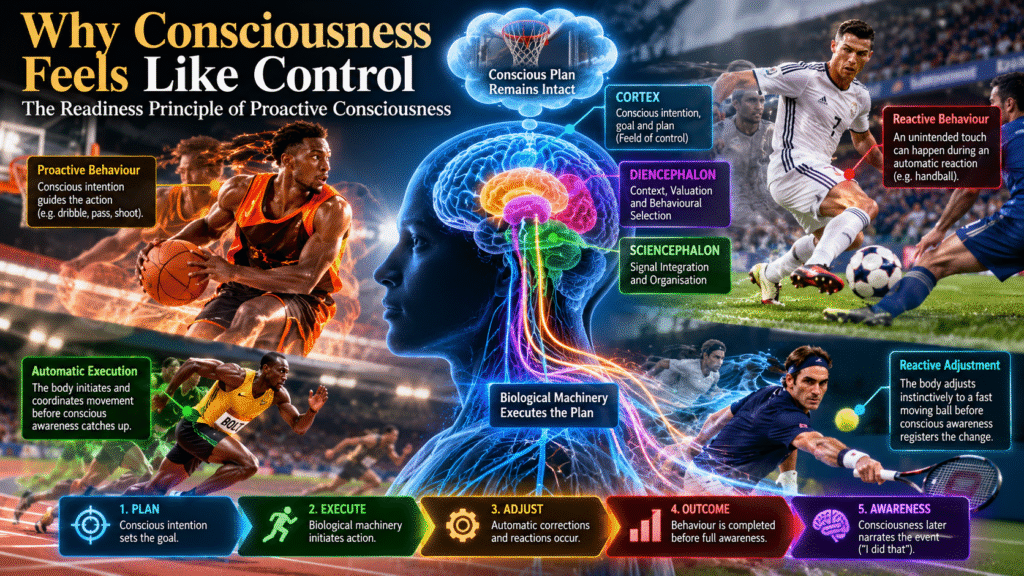
BY: OMOLAJA MAKINEE
Among the most convincing experiences in human life is the feeling of being consciously in command. Every deliberate movement, every spoken sentence, and every carefully considered decision appears to confirm that the conscious self stands at the centre of behavioural control.
We experience ourselves as planners, initiators, and authors of our own actions. Thought appears to precede movement, intention appears to precede execution, and conscious awareness seems inseparable from agency itself.
Psychextrics proposes a different interpretation.
Rather than denying the importance of consciousness, it repositions its function within the behavioural hierarchy. Conscious awareness is not presented as the biological origin of behaviour but as the system through which behaviour becomes symbolically experienced. The feeling of executive control emerges because consciousness continuously observes, evaluates, and narrates behavioural processes that have already undergone extensive subcortical organisation.
Within this framework, the experience of control is genuine as a conscious experience, but its biological origin lies deeper than the conscious display itself. Behaviour begins long before it becomes consciously visible, and the remarkable coherence of conscious narration gives rise to the enduring illusion that the narrator is also the builder.
1. The Architecture of Retrospective Coherence
One of the defining characteristics of consciousness is its remarkable ability to construct coherent explanations for behavioural events.
Following every movement, emotional shift, perceptual judgement, or behavioural adjustment, the conscious mind rapidly generates an internally consistent narrative describing why the action occurred. These explanations appear immediate because they are seamlessly integrated into the ongoing stream of subjective awareness.
According to Psychextrics, this coherence is produced primarily through the Diencephalic thalamic relay interacting with the revised Telencephalon. Once behavioural information has been integrated beneath awareness, the thalamic system serialises the completed behavioural package into language, symbolic thought, and reflective interpretation.
The result is a continuous autobiography unfolding in real time.
Because this narration accompanies nearly every conscious experience, the human mind naturally assumes that explanation and authorship are identical processes. The individual mistakes reflective interpretation for behavioural construction.
The narrator gradually becomes indistinguishable from the architect.
2. The Behavioural Origins of Conscious Experience
The six-Cephalon Model proposes that behaviour originates through successive biological stages that precede conscious awareness.
The lower cephalic systems continuously monitor survival, maintain physiological stability, orient toward environmental change, evaluate contextual significance, and integrate behavioural continuity before the revised Telencephalon ever renders these processes into conscious experience.
By the time consciousness observes a behavioural event, multiple specialised systems have already contributed to its construction.
- Survival networks have assessed biological urgency.
- Motor systems have stabilised behavioural deployment.
- Spatial systems have oriented attention.
- Meaning-weighting systems have evaluated significance.
- The Siencephalon has integrated these distributed processes into a coherent behavioural package.
Only after this extensive preparation does conscious awareness illuminate the finished behavioural product.
The experience of conscious control therefore emerges at the end of behavioural construction rather than at its beginning.
3. Reactive Behaviour and the Limits of Conscious Command
The distinction between reactive and proactive behaviour provides one of the clearest demonstrations of this architecture.
Reactive behaviour occurs when unexpected environmental events require immediate biological action. A sudden explosion, an approaching vehicle, or an object falling toward the face demands responses that cannot wait for conscious deliberation.
Within the Psychextric framework, these behaviours are organised by the lower cephalic systems through rapid survival pathways before the conscious display is updated.
By the time the revised Telencephalon presents the event, the behavioural response has already begun or may even have concluded. Consciousness subsequently explains the behaviour as though it initiated it.
The individual sincerely reports, “I jumped because I heard the explosion.“
Yet the behavioural sequence itself was assembled through subcortical organisation before symbolic narration emerged.
The conscious explanation remains accurate as an account of subjective experience while arriving after the biological construction of the behaviour it describes.
4. The Emergence of Proactive Behaviour
The feeling of executive control becomes far more compelling during proactive behaviour.
Unlike reactive responses triggered by external events, proactive behaviour develops gradually through internally generated simulations extending across time. Planning a journey, composing a letter, preparing a presentation, or reaching for a glass of water unfolds over a much slower behavioural timescale.
Within this slower architecture, the Siencephalon continuously organises future behavioural possibilities while projecting increasingly refined simulations toward the revised Telencephalon. These simulations become consciously visible before physical execution begins.
Consequently, the conscious self observes behavioural possibilities while they remain prospective rather than completed. This temporal relationship fundamentally alters subjective experience.
Because awareness precedes execution, the individual experiences consciousness as directing behaviour rather than merely observing it.
The distinction arises not because consciousness suddenly becomes the biological architect, but because behavioural preparation unfolds slowly enough for conscious evaluation to participate in the final stages of behavioural deployment.
5. The Readiness Principle of Proactive Consciousness
Psychextrics describes this phenomenon as the Readiness Principle of Proactive Consciousness.
The organism is never behaviourally idle.
Even during apparent stillness, biological systems continuously anticipate future interactions, evaluate environmental uncertainty, adjust physiological readiness, retrieve relevant behavioural memories, and prepare multiple behavioural possibilities.
Conscious awareness enters this ongoing process only after substantial preparation has already occurred.
Rather than initiating readiness, consciousness inherits readiness.
The feeling of deciding emerges because behavioural preparation becomes consciously visible before overt movement begins. This sequence creates one of the most convincing experiences of agency available to human awareness.
The organism appears to wait for conscious approval. In reality, the behavioural machinery has already spent considerable time constructing the available options, sieved through innate-memory, that consciousness now evaluates within its experiential-memory constructs.
Lived Experience
Consider a basketball player advancing towards the basket, dribbling the ball with his right hand while his left hand moves freely to maintain balance, protect his space, and respond to the movements of opposing players.
His right hand operates under the immediate objective of controlling the ball, while his left hand may adjust automatically to changes in balance, proximity, and movement around him.
Although both hands belong to the same organism, their movements need not be governed by the same degree of conscious direction. One action is organised around a deliberately pursued objective; the other may respond to changing circumstances before the player consciously considers each adjustment.
The distinction becomes even clearer when an unexpected event occurs. A player may instinctively withdraw his hand when an opponent suddenly moves into his space, or adjust his posture when another player collides with him. The body can begin correcting its position before the player consciously formulates an explanation of what happened.
In football, a comparable distinction appears when a player accidentally handles the ball during an instinctive movement to protect the face or maintain balance. The contact may be physically executed by the player, yet it was not necessarily the outcome of a deliberate intention to touch the ball with the hand. The movement occurred, but the conscious self did not necessarily author its specific outcome.
Now consider a different situation: a basketball player becomes frustrated after being fouled and deliberately strikes or pushes an opponent. At the level of movement, the action may be directed and coordinated rather than accidental.
From the perspective of the Metencephalon, the movement belongs to the organisation of kinetic action. Yet, within the Psychextrics framework, its behavioural selection may still be dominated by reactive emotional intensity rather than reflective consideration of consequences. The player may intentionally execute the movement while failing to evaluate adequately its possible consequences for the opponent, the team, or his own participation in the game.
This distinction is central to understanding the relationship between behaviour and conscious control. A movement can be intentional at the level of execution without being reflectively governed at the level of behavioural selection. Equally, a movement can occur without a deliberate intention to produce its outcome. The fact that the body performs an action does not, by itself, establish that conscious reflection initiated, selected, or fully governed it.
Psychextrics therefore distinguishes the organisation of movement from the valuation and regulation of the behavioural signal that produces it. The Metencephalon contributes to kinetic stability and movement coordination, while the Diencephalon contributes to contextual valuation and the regulation of behavioural significance.
Reactive intensity can dominate the selection of an action even when its physical execution appears purposeful. Conscious awareness may subsequently reconstruct the event as a decision made by the self, although the process leading to that action was more complicated than the conscious explanation suggests.
The basketball court thus provides a practical illustration of the central proposition:
The feeling of control is not sufficient evidence that consciousness governed every stage of behaviour.
The organism may coordinate a movement, react to an unexpected event, or execute an emotionally driven action before the conscious self has fully evaluated what it is doing. Consciousness can then reflect upon the action, explain it, defend it, or regret it. The action has already begun; the explanation follows.
6. Simulation Before Execution
A defining feature of proactive behaviour is internal simulation.
Before physical movement occurs, behavioural possibilities are repeatedly organised, refined, and evaluated through recursive interactions between the Siencephalon, Diencephalon, and revised Telencephalon.
Potential behavioural sequences become available for conscious observation while remaining physically unrealised.
Within this architecture, the conscious mind experiences itself as selecting among behavioural alternatives. Psychextrics interprets this experience as participation within an already organised behavioural framework rather than independent behavioural generation.
- The Siencephalon prepares possible behavioural trajectories.
- The Diencephalon evaluates their contextual significance.
- The revised Telencephalon renders these processes into conscious awareness.
Execution follows only after this recursive cycle reaches sufficient behavioural stability.
The resulting experience is one of deliberate choice, even though the preparatory architecture, sieved via reactive behavioural alternatives, extends well beneath conscious awareness.
7. Behavioural Readiness and Internal Stability
The successful transition from behavioural simulation to behavioural execution depends upon maintaining internal biological coherence.
Psychextrics attributes this coherence to the ongoing interaction between Epigenetic Index Markers (EIM), representing accumulated behavioural learning, and the Hormonal Fluidity Index (HFI), representing the constantly changing neurochemical environment supporting behavioural regulation.
When these systems remain aligned, behavioural readiness unfolds smoothly. Past experience supports current planning. Physiological regulation remains stable. Behavioural confidence increases.
Conscious awareness experiences the unfolding behavioural plan as coherent, intentional, and under voluntary control. The individual experiences confidence because the underlying biological systems remain synchronised.
Consciousness therefore encounters relatively little resistance during behavioural deployment.
8. When Behavioural Readiness Fractures
The apparent authority of consciousness becomes most vulnerable when internal biological stability is disrupted.
High levels of stress, sudden environmental uncertainty, or rapidly changing physiological conditions may disturb the relationship between accumulated behavioural learning and current hormonal regulation.
Within the Psychextric framework, these disruptions alter the balance maintained by the lower cephalic systems. Behaviour gradually shifts away from carefully organised proactive simulations and back toward faster reactive survival mechanisms.
The conscious plan remains intact. The biological machinery executing that plan does not.
Individuals commonly describe such experiences as “freezing under pressure,” “losing confidence,” “acting without thinking,” or “falling apart despite knowing exactly what to do.”
From this perspective, consciousness has not lost knowledge. Rather, the biological systems responsible for implementing that knowledge have reorganised themselves around immediate survival priorities.
The narrator continues speaking. The builders have changed their construction plan.
9. Behavioural Readiness in Everyday Life
This principle extends far beyond dramatic situations.
Students preparing for examinations, athletes entering competition, musicians performing before an audience, surgeons beginning complex procedures, or speakers addressing large crowds often experience striking differences between rehearsal and real-world performance.
During preparation, behavioural simulations remain relatively stable.
- Planning appears effortless.
- Confidence feels complete.
- Execution seems certain.
Once the real situation begins, however, changing physiological conditions introduce new biological constraints. Behavioural readiness must continuously adapt to evolving environmental demands.
When adaptation remains successful, consciousness experiences effortless control. When adaptation falters, behaviour becomes fragmented despite the conscious intention remaining unchanged.
The familiar experience of “knowing exactly what to do but being unable to do it” illustrates the distinction between conscious planning and biological execution.
10. Why Consciousness Continues to Feel Executive
Despite these biological complexities, consciousness consistently experiences itself as the executive authority of behaviour.
This experience persists because conscious narration possesses remarkable temporal continuity. Each behavioural event is immediately integrated into an ongoing autobiographical narrative linking past experience, present action, and anticipated future consequences.
The resulting continuity masks the enormous amount of unconscious organisation occurring beneath awareness. The conscious self experiences only the completed behavioural product. It never directly observes the countless subcortical processes responsible for constructing that product.
Because these biological operations remain hidden, subjective awareness naturally attributes behavioural authorship to the processes it can observe.
The narrator gives itself credit for work performed by the entire behavioural hierarchy.
Conclusion
The enduring feeling that consciousness governs behaviour remains one of the defining characteristics of human experience. Within the Psychextric framework, however, this feeling emerges not because consciousness independently constructs behaviour, but because it continuously observes and symbolically organises behavioural realities assembled through deeper cephalic systems.
Reactive behaviour reveals the limitations of conscious command by demonstrating that biological deployment frequently precedes conscious awareness. Proactive behaviour, by contrast, creates the compelling experience of executive control because behavioural preparation becomes consciously visible before physical execution begins. The organism prepares continuously, evaluates recursively, and stabilises behaviour long before conscious narration declares, “I decided.”
The Readiness Principle of Proactive Consciousness therefore reframes conscious agency as participation within an already evolving behavioural architecture. Consciousness is neither an illusion nor an omnipotent executive. It is the symbolic arena in which behavioural preparation, evaluation, and execution become experientially accessible. The deeper biological machinery silently constructs the behavioural landscape; consciousness illuminates it, interprets it, and experiences it as the unfolding story of the self.
Author’s note: This essay presents the conceptual framework of Psychextrics. Several elements—particularly the mathematical formulation, proposed timing architecture, and reassignment of functional roles among the thalamus, Siencephalon, and revised Telencephalon in Chapter One—are original theoretical propositions rather than established neuroscientific consensus. Readers should interpret them as components of the Psychextric model unless independently validated by empirical research.
Back to: 👇