
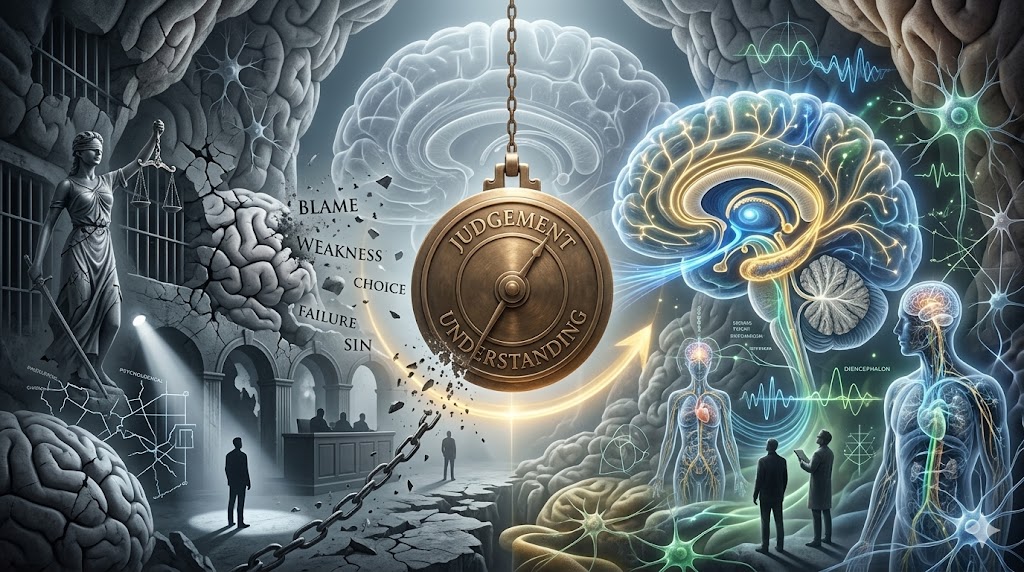
Where the Pendulum of Will Swings: Replacing Punitive Psychology with Structural Empathy
BY: OMOLAJA MAKINEE
For centuries, human civilisation has been organised around a single invisible assumption:
That the conscious self freely chooses behaviour from a position of sovereign internal control.
From religion to law, from psychology to criminal justice, society inherited the belief that human beings consciously author their actions through rational will. Behaviour became interpreted as:
- moral choice,
- character expression,
- personal intention,
- or conscious decision-making.
Under this framework, punishment became morally justified because destructive behaviour was assumed to emerge from:
- bad people,
- weak minds,
- broken souls,
- or immoral choices.
Psychextrics overturns this assumption completely.
The human organism is not a unified thinker consciously commanding behaviour from above. It is a layered cephalic civilisation, where behavioural activation emerges progressively through competing subcortical systems long before conscious narration appears.
The profound consequence of this reconstruction is unavoidable:
The pendulum of human Will does not swing inside a sovereign conscious self. It swings inside the hidden negotiations of the cephalic hierarchy beneath awareness.
And once this architecture is understood, punitive psychology begins to collapse.
1. The Death of the Executive Self
The classical model of freewill assumes:
- consciousness initiates behaviour,
- awareness commands action,
- thought precedes execution,
- and the self acts as executive ruler.
But behavioural reality repeatedly contradicts this sequence.
Human beings:
- recoil before understanding danger,
- freeze before deciding,
- scream before reflecting,
- fear before reasoning,
- and emotionally activate before narration forms.
The lower cephalic systems consistently begin behavioural projection before the conscious self becomes aware of the event. Under psychextrics, this is expected architecture.
The:
- Myelencephalon,
- Metencephalon,
- and Mesencephalon
operate beneath symbolic awareness entirely.
The organism possesses no conscious control over whether:
- the heart accelerates under panic,
- breathing intensifies during fear,
- posture destabilises under threat,
- or the eyes orient instantly toward sudden movement.
These systems execute their specialised survival mandates automatically because survival architecture cannot wait for reflective narration.
The lower cephalons do not ask permission from consciousness. They activate first.
Consciousness arrives later and mistakenly claims ownership over behaviour already unfolding.
2. The Pendulum of Will
This shifts the entire paradigm of human freedom.
Psychextrics replaces the illusion of absolute freewill with the mechanical reality of willpower.
Willpower is not:
- spiritual force,
- metaphysical agency,
- or conscious domination over biology.
Willpower is a thermodynamic struggle occurring between competing cephalic systems.
The Diencephalon functions as the contextual meaning-maker, continuously attempting to regulate, redirect, or stabilise the behavioural projections initiated by the willpower of lower cephalons.
But the Diencephalon itself does not stand above biology. It is constrained by:
- inherited Genetic Index Markers (GIM),
- Hormonal Index Markers (HIM),
- Epigenetic Index Markers (EIM),
- Hormonal Fluidity Indexes (HFI),
- environmental saliency,
- metabolic energy,
- and survival load.
The pendulum of will therefore swings according to:
- inherited spectral variations,
- environmental pressures,
- hormonal timing,
- contextual weighting,
- and cephalic competition.
Not abstract moral purity. Not sovereign conscious control.
3. The Millisecond Civil War Beneath Awareness
The most important implication of this architecture is that human behaviour frequently emerges from subcortical conflict occurring within milliseconds beneath conscious awareness.
When an individual:
- panics,
- freezes,
- explodes emotionally,
- collapses under stress,
- or behaves irrationally,
the organism is often experiencing an internal battle between competing cephalic systems operating under contradictory survival mandates.
The lower cephalons may already have initiated:
- adrenaline release,
- muscular preparation,
- orientational locking,
- cardiovascular escalation,
- and emotional,
before the Diencephalon fully stabilises contextual meaning.
This is why people often report:
- “I knew I was safe, but my body panicked,”
or:
- “I knew I shouldn’t react like that, but I couldn’t stop.”
The organism experiences itself being carried by behavioural forces already activated beneath awareness.
The conscious self becomes a witness, not the original author.
4. Structural Empathy versus Moral Condemnation
This reconstruction fundamentally transforms how society must understand human suffering.
Punitive psychology interprets destructive behaviour through:
- moral weakness,
- defective personality,
- criminal character,
- or psychological pathology.
Psychextrics reframes behaviour structurally.
The screaming individual under stress does not necessarily possess:
- a broken soul,
- weak character,
- or moral failure.
They may instead be experiencing overwhelming subcortical competition beneath awareness.
This does not mean harmful behaviour should be excused. But it does mean moral condemnation becomes biologically insufficient. Behavioural understanding must shift from judgment, toward structural empathy.
Structural empathy recognises that behaviour emerges from:
- cephalic load,
- hormonal volatility,
- environmental pressure,
- survival activation,
- and biological timing.
The organism cannot consciously prevent many of the initial behavioural activations occurring beneath awareness.
The lower cephalons fire first. The conscious narrator discovers the behavioural event afterward.
5. Why Punitive Psychology Fails
Punitive psychology fails because it blames and punishes the display, instead of the architecture generating the display.
The Telencephalon merely mirrors the behavioural package assembled beneath awareness. Punishing the cortical screen for what the subcortical engine room produced becomes scientifically incoherent.
Modern systems of justice frequently operate as though:
- behaviour generally begins consciously,
- emotional control is absolute,
- and selfhood governs the organism rationally from above.
But the cephalic hierarchy reveals something radically different:
Human beings often fight behavioural storms they did not consciously initiate.
The organism becomes trapped inside inherited and environmental signal competitions unfolding faster than reflective awareness itself.
This is why:
- trauma changes behaviour,
- chronic stress reshapes emotional thresholds,
- poverty in parallel with wealth alters behavioural saliency,
- sleep deprivation destabilises emotional regulation,
- and environmental unpredictability amplifies survival vigilance.
The lower cephalons continuously adapt behaviour according to survival conditions beneath awareness.
6. Re-Engineering Rehabilitation
Psychextrics therefore reconstructs rehabilitation entirely.
True behavioural intervention cannot be achieved by lecturing the cortical narrator with:
- moral platitudes,
- motivational slogans,
- or abstract psychological affirmations.
Rehabilitation must target:
- cephalic harmony,
- hormonal stability,
- environmental restructuring,
- nutritional modulation,
- contextual recalibration,
- and Diencephalic reinforcement.
The organism heals behaviourally by changing the biological conditions generating behavioural activation. Not by shaming the conscious display. This reframes justice itself.
The true test of principle is not whether an organism experiences involuntary subcortical activation. The true test emerges afterward when the behavioural storm passes, when reflective meaning-making re-engages, and when the organism attempts:
- accountability,
- restitution,
- recalibration,
- and repair.
Responsibility survives under psychextrics. But it becomes biologically contextualised, rather than morally absolutist.
Conclusion: The Human Organism as a Layered Civilisation
Under psychextrics, the human being ceases to resemble:
- an isolated ego,
- a sovereign thinker,
- or a freely willing conscious ruler.
Instead, the organism becomes understood as a layered behavioural civilisation, assembled progressively through:
- survival vigilance,
- kinetic stability,
- spatial orientation,
- contextual weighting,
- memory integration,
- emotional tagging,
- and conscious rendering.
The conscious self remains real as experience. But it is not the executive monarch humanity imagined for centuries.
Awareness becomes:
- reflective,
- narrational,
- reconstructive,
- and display-oriented.
The “I” consciously experienced inside the cortical mirror is therefore not the architect of behaviour. It is the visible surface of hidden cephalic negotiations continuously unfolding beneath symbolic perception.
And once this architecture becomes visible, civilisation itself must choose whether to continue punishing the screen, or finally begin understanding the engine room beneath it.
Back to: 👇