
Luminance Sighting and the Cortical Display Pathway: When the Brain, Not the Eye, Limits Vision
BY: OMOLAJA MAKINEE
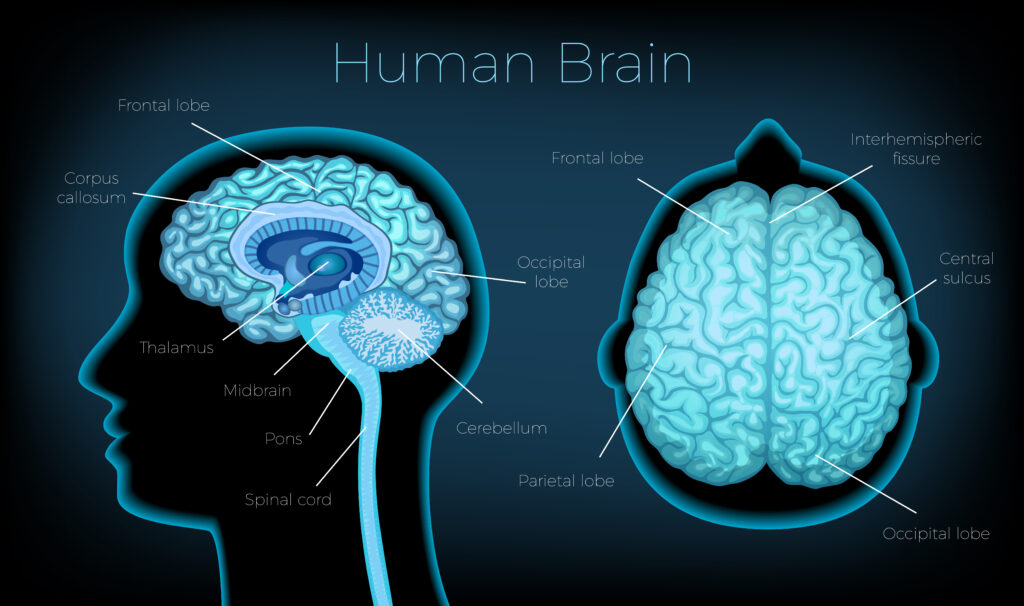
In most discussions of vision, impairment is often attributed to the eye itself—the clarity of the lens, the health of the retina, or the sensitivity of photoreceptors. Within the psychextric framework, this explanation is incomplete. Vision is not finalised at the level of the eye, nor even within the diencephalic relay systems. It is ultimately constructed and displayed within the cortex, where incoming signals are transformed into conscious experience. Nowhere is this more evident than in Luminance Sighting.
While luminance begins as a function of rod photoreceptors and is regulated through diencephalic governance, its final expression depends on the integrity of the cortical display pathway. When this pathway is compromised, individuals may experience profound disturbances in brightness perception, motion detection, and peripheral awareness—even when the eyes themselves are functioning normally.
This reveals a critical principle:
One can possess a healthy ocular system and still “fail to see” luminance properly if cortical processing is impaired.
1. The Role of the Cortex in Luminance Sighting
After luminance signals are detected in the retina and regulated through the diencephalon, they are transmitted to the cortex, where they are organised into a coherent perceptual field. This stage is not passive. The cortex does not simply “receive” visual data—it actively constructs the experience of seeing.
Within this construction, luminance plays a central role in:
- detecting contrast between light and dark,
- identifying motion and environmental change,
- maintaining awareness of the broader visual field.
Unlike Precision Sighting, which focuses on fine detail and colour discrimination, Luminance Sighting at the cortical level is concerned with dynamic environmental awareness. It allows the brain to interpret shadows, detect movement, and navigate spaces where colour information may be limited or absent.
When cortical processing is intact, these functions operate seamlessly. When it is disrupted, the consequences can be profound.
2. Primary Visual Cortex (V1): The Gateway of Conscious Vision
The Primary Visual Cortex (V1) serves as the initial cortical receiving station for visual information. It is here that basic elements of the visual field—edges, orientation, and luminance gradients—are first organised into a structured representation.
Damage to this region produces one of the most striking phenomena in neuroscience: cortical blindness.
In this condition, the eyes may continue to detect light, and the retinal systems may function normally, yet the individual experiences a loss of conscious vision. The brain is receiving signals, but it cannot convert them into a perceptual display.
From the perspective of Luminance Sighting, this means that brightness information exists without conscious visibility. The person may not “see” light in the conventional sense, even though the biological detection of light is still occurring at lower levels of the system.
In some cases, individuals with V1 damage demonstrate a phenomenon known as Blindsight, where they can respond to visual stimuli—such as detecting movement or avoiding obstacles—without conscious awareness of seeing them. This suggests that luminance information can still influence behaviour through subcortical pathways, even when cortical display is disrupted.
3. Motion-Sensitive Cortical Regions: The Dynamics of Luminance
Beyond V1, luminance processing becomes increasingly specialised within regions of the cortex associated with motion detection, particularly along the dorsal visual stream.
These motion-sensitive areas are critical for interpreting changes in luminance over time. Movement, after all, is often detected not through colour but through shifts in brightness and contrast. A shadow passing across a surface, a figure moving in dim light, or an object emerging from darkness—all rely on luminance dynamics rather than colour precision.
When these cortical regions are damaged, individuals may experience conditions such as motion blindness (Akinetopsia), where movement is no longer perceived smoothly. Instead of continuous motion, the world appears fragmented, as though composed of still images.
Within Luminance Sighting, this represents a breakdown in the brain’s ability to process temporal contrast—the changes in brightness that signal motion. The environment becomes perceptually unstable, not because light is absent, but because the brain cannot interpret how luminance changes over time.
This disruption has practical consequences. Tasks that rely on motion perception—crossing a street, pouring a drink, or navigating a crowded space—become difficult or even dangerous. The individual is not blind in the traditional sense, but their luminance-based awareness of movement is fundamentally compromised.
4. Peripheral Visual Integration: The Rod-Dominated Field
A crucial yet often overlooked component of Luminance Sighting lies in the peripheral visual field.
The peripheral retina is dominated by rod photoreceptors, making it highly sensitive to low light and motion. While central vision—governed by cone density—excels in detail and colour, peripheral vision excels in detecting broad luminance patterns and movement across space.
However, the effectiveness of this system depends not only on the retina but also on cortical integration. The brain must synthesise peripheral signals into a coherent awareness of the surrounding environment. This integration allows individuals to sense motion outside their direct line of sight, detect changes in ambient lighting, and maintain spatial orientation in low-light conditions.
When cortical networks responsible for this integration are impaired, the consequences are subtle yet significant. An individual may retain sharp central vision, capable of reading and recognising faces, yet lose sensitivity to peripheral luminance cues. Shadows may go unnoticed. Movement at the edges of vision may fail to register. Navigation in dim environments becomes more difficult, not because the eyes cannot detect light, but because the brain cannot assemble those signals into a usable perceptual field.
This creates a form of functional narrowing of perception, where the world appears intact in front but diminished at the edges.
5. When Vision Fails Beyond the Eye
These cortical disruptions reveal a profound insight into the nature of Luminance Sighting.
Visual impairment is not always an ocular problem. Nor is it always rooted in the diencephalic systems that regulate incoming signals. In many cases, the limitation arises from the final stage of perception—the cortical display itself.
The eye may detect light. The diencephalon may regulate its transmission. But if the cortex cannot organise and project that information into conscious awareness, vision as an experience is fundamentally altered.
This understanding challenges conventional assumptions about sight. It shifts the focus from the eye as the sole organ of vision to the brain as the true constructor of the visual world.
6. Luminance as a Constructed Experience
Within the psychextric framework, Luminance Sighting is not merely the detection of brightness. It is the construction of a dynamic visual environment, shaped by contrast, motion, and spatial awareness.
At the cortical level, this construction depends on:
- the integrity of the Primary Visual Cortex for initial organisation,
- the functionality of motion-sensitive regions for temporal dynamics,
- the integration of peripheral signals for environmental awareness.
When these systems operate in harmony, the result is a seamless perception of a world defined by light and shadow. When they are disrupted, luminance perception becomes fragmented, diminished, or entirely absent from conscious experience.
Conclusion: The Brain as the Final Arbiter of Light
Luminance begins in the eye, is regulated in the diencephalon, but is ultimately realised in the cortex.
The cortical display pathway serves as the final arbiter of whether light becomes sight. It determines whether brightness is perceived, whether motion is understood, and whether the environment is experienced as coherent and navigable.
Thus, within the architecture of perception, Luminance Sighting reminds us of a fundamental truth:
We do not see with our eyes alone.
We see with a system—an ordered progression of biological processes—that culminates in the brain’s ability to transform light into conscious reality. When that final stage is compromised, the world itself changes, not because light has disappeared, but because the mind can no longer fully bring it into view.
Back to: 👇