
When the Body Reacts Before the Mind: Orientation Sighting and the Hidden Architecture of Reflex Behaviour
BY: OMOLAJA MAKINEE
Human behaviour is often explained as the outcome of thought. We assume that actions begin with reasoning, that the brain evaluates a situation, decides what to do, and then instructs the body to act.
Yet everyday life repeatedly contradicts this assumption. People duck before they consciously register a flying object. A driver slams the brake before fully realising a pedestrian stepped into the road. Someone jumps backward when a door suddenly slams behind them. In these moments the body appears to act before the mind has time to think.
Within the framework of psychextrics, such events are not mysterious reflexes. They are expressions of a deeper biological interface between the organism and its environment. This interface operates through three perceptual spectrums embedded directly within the physiology of the phenotype:
- Surface Sighting.
- Aperture Sighting.
- Orientation Sighting.
Together, these systems regulate how the body physically encounters the world before meaning-making processes begin.
1. The Environmental Interface of the Phenotype
In psychextrics, perception does not begin with interpretation. It begins with exposure.
Surface Sighting regulates how the body is positioned within the surrounding environment. It determines how the organism meets the physical world through posture, balance, and bodily alignment with surfaces such as ground, gravity, and nearby structures.
Aperture Sighting governs the admission of environmental information into the perceptual system. It does not interpret images or construct meaning. Instead, it determines how much sensory exposure proceeds deeper into perception.
Orientation Sighting, the focus of this discussion, regulates spatial alignment between the body and moving stimuli. It ensures that the organism can instantly orient itself toward sudden changes in its environment.
These three spectrums form the environmental interface of the organism. They do not interpret signals, detect meaning, or recall memories. Instead, they produce physiological responses shaped by inherited biological architecture.
Their behavioural expressions are spectrally governed by the GIM–HIM network—the interaction between inherited genetic index markers and hormonal index markers regulating emotional and behavioural readiness.
Because these systems operate so quickly, their responses often appear instinctual. But they are not primitive reflexes. They are spectral expressions of inherited biological variants interacting with the environment in real time.
A striking example of this mechanism can be seen in a well-known viral video that circulated widely online over a decade ago.
2. A Viral Prank That Reveals the Mechanics of Behaviour
In the video, a young man is casually being interviewed. The setting is relaxed. Two individuals stand facing each other in conversation while a third person secretly prepares a prank nearby. The hidden participant is crouched inside a wheelie bin wearing a frightening Halloween mask.
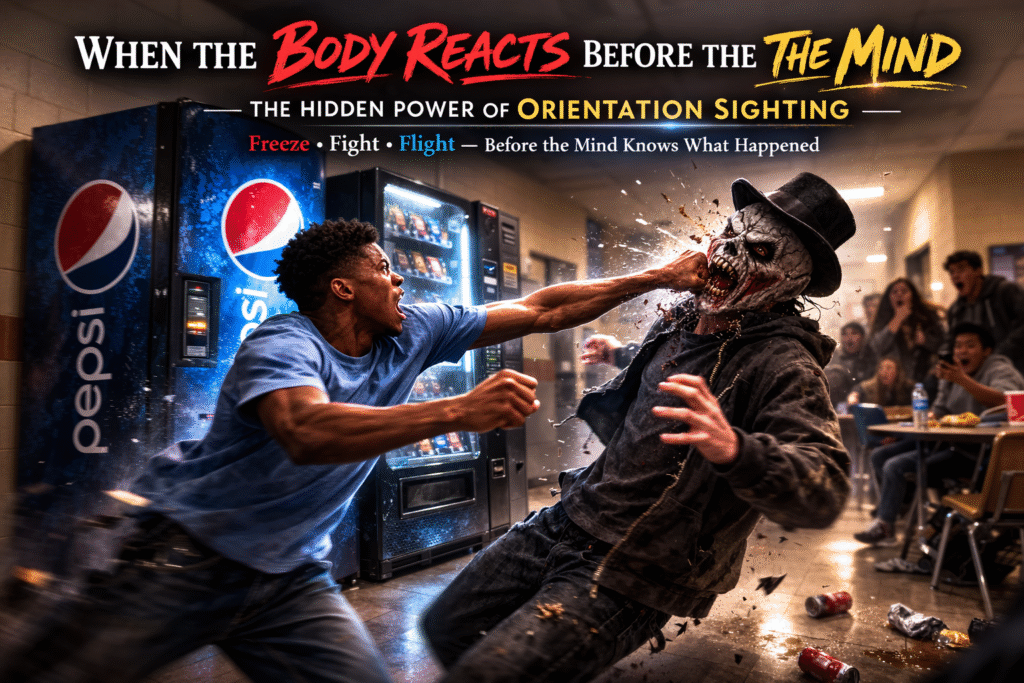
Without warning, the masked individual suddenly jumps out of the bin with a loud shout in an attempt to scare the interviewee. The reaction that follows happens in less than a second. The interviewee leaps backward and simultaneously punches the masked prankster in the face before immediately stepping back from the scene.
The moment is shocking, chaotic, and unexpectedly revealing. I feature the original video below in this article so readers can observe the event directly and see the perceptual chain unfold in real time.
What appears to be a simple prank actually demonstrates the core mechanics of Orientation Sighting within the psychextrical framework.
3. The Calm Before the Disruption
At the beginning of the scene, the interviewee appears relaxed and composed. His body posture is stable, his facial expression calm, and his attention directed toward the interviewer. Several perceptual systems are already functioning in quiet harmony.
Surface Sighting confirms that the environment is stable and non-threatening. The ground is level, the surrounding space familiar, and the posture of the participants relaxed.
Aperture Sighting is open and receptive, allowing the visual environment of the conversation to enter the perceptual system. The hypothalamic emotional valence at this stage remains neutral. Both participants appear comfortable, casually engaged in conversation.
Orientation Sighting, meanwhile, quietly maintains spatial awareness. It continuously monitors the geometry of the environment—positions of nearby objects, movement patterns, and the body’s alignment within the scene.
Nothing in the visual field suggests imminent danger. The perceptual system therefore remains calm, open, and stable.
4. The Moment of Intrusion
The prank disrupts this equilibrium instantly. The masked figure bursts from the wheelie bin with a sudden shout, introducing an unexpected moving object into the interviewee’s spatial field.
At the ocular level, the eyes detect the abrupt motion. The external ocular muscles shift gaze rapidly toward the emerging figure while retinal orientation-sensitive cells register the sudden change in spatial geometry.
These signals travel immediately into the diencephalic network, where the hypothalamus evaluates the stimulus for potential threat. This evaluation happens faster than conscious thought.
The organism does not yet know whether the stimulus represents danger, but the perceptual system cannot afford delay. The spatial intrusion demands an immediate physiological response.
5. Why the Reaction Was Not “Fight”
Many viewers assume that the punch delivered by the startled interviewee represents the “fight” response in the classic fight–flight–freeze model of stress behaviour. But the sequence of events suggests something different. The primary response is actually freeze.
When the masked figure appears, the hypothalamus triggers an instant suspension of voluntary behaviour. This freeze response stabilises perception, allowing the organism to rapidly reassess the spatial field.
During freeze, the body temporarily halts deliberate action while attention locks onto the unexpected stimulus. Yet the freeze response does not fully immobilise the organism. Within the diencephalon, another structure plays a critical role: the subthalamus.
The subthalamic network is closely linked to rapid motor discharge systems. When the orientation system detects sudden spatial intrusion, the subthalamus can release explosive defensive movements before conscious interpretation occurs.
In this instance, the hypothalamus briefly freezes behavioural deliberation while the subthalamus releases a protective motor strike.
The punch is therefore not a calculated act of aggression. It is a defensive motor discharge occurring within the freeze phase of orientation processing.
6. “Fight, Flight, and Freeze” Response in Behaviour – The Triple “F”.
At first glance, the punch delivered by the startled interviewee appears to confirm the classic “fight” response described in the familiar fight–flight–freeze model. A threat appears, the body reacts aggressively, and the individual strikes the perceived danger. On the surface, the interpretation seems obvious.
However, the psychextrical framework suggests that this conclusion is incomplete. To understand what actually occurred in the scene, we must recognise that the triple-F responses are not single switches within the brain. They are not isolated reactions triggered by one structure that then spreads uniformly across the body. Instead, each of these responses—fight, flight, and freeze—can manifest across multiple systems simultaneously, each governed by its own spectral variation within the diencephalic network.
In other words, when observers say someone reacted with “fight,” they often assume a single unified reaction. But biologically, what they are often witnessing is a composite of overlapping responses occurring in different neural systems at the same time. Within the psychextrical model, the hypothalamus and the subthalamus play distinct roles in this dynamic.
The hypothalamus governs emotional valence and behavioural readiness. It determines whether the organism interprets a sudden stimulus as threatening, neutral, or rewarding. When an unexpected intrusion appears within the orientation field, the hypothalamus may trigger one of the triple-F responses as a stabilising mechanism for perception.
The subthalamus, by contrast, plays a critical role in rapid motor discharge and movement regulation. It determines how the body physically reacts once the perceptual system has been disrupted.
Because both systems operate through spectral variations, individuals do not express identical behavioural patterns. The inherited variants within the GIM–HIM network influence how each system responds to sudden environmental change.
This means that the triple-F responses do not always appear in identical combinations across individuals. Some people may carry freeze variants in both the hypothalamus and the subthalamus. When startled, these individuals may momentarily immobilise entirely—body and mind locking into stillness while the perceptual system recalibrates the environment.
Others may carry flight variants across both systems, producing rapid withdrawal or escape without aggressive movement. Still others may display mixed spectral responses, where different systems express different reactions simultaneously.
This appears to be precisely what occurred in the viral interview prank. The sudden emergence of the masked figure triggered a freeze response in the hypothalamus, momentarily suspending deliberate behavioural control while the perceptual system attempted to stabilise orientation.
However, the subthalamic motor network appears to carry a different spectral variant, one capable of releasing an explosive defensive strike when the orientation field is suddenly invaded.
Thus two distinct processes occurred at the same moment:
- the hypothalamus froze behavioural deliberation, stabilising perception,
- the subthalamus discharged a rapid defensive movement.
The punch therefore did not arise from a conscious or emotional decision to fight. Instead, it emerged as a motor consequence occurring within an underlying freeze response.
This explains the most revealing moment in the video: immediately after striking the masked prankster, the interviewee appears surprised by his own action. His body acted before the cortical display system had time to interpret the situation.
In this sense, the dominant reaction remains freeze, not fight. The freeze response halted conscious deliberation, while the subthalamic spectral variation converted that momentary suspension into a protective strike.
Understanding the reaction this way also clarifies why most people would not respond with a punch in the same scenario. Average behavioural patterns arise from different spectral combinations across these systems. Many individuals carry subthalamic variants that reinforce the hypothalamic freeze response rather than converting it into movement. Their bodies might simply jump backward, shout, or remain momentarily immobilised.
The interviewee in the video happened to possess a rare configuration of overlapping responses: freeze within the hypothalamic valence system combined with a motor-defensive variant in the subthalamus.
Thus, when we describe behaviour using the language of fight, flight, or freeze, we are often describing the visible outcome of multiple overlapping responses distributed across different neural systems. What we observe externally is the final behavioural product. What actually occurs internally is a spectral negotiation between several layers of the diencephalic network.
In the case of the viral prank, that negotiation began with freeze—and the punch that followed was simply what the subthalamus did with the freeze that the hypothalamus had already begun.
7. When the Cortex Finally Catches Up
Immediately after the punch lands, the interviewee appears shocked by his own action. He retreats quickly from the scene and seems to realise that the situation was a prank rather than a genuine threat.
This shift occurs when the cortical display system finally reconstructs the event for conscious awareness. By the time the cortex fully interprets what has happened, the body has already acted.
This sequence reveals an important feature of psychextrics:
- Environmental interface spectrums act before meaning-making systems engage.
- Surface Sighting establishes environmental stability.
- Aperture Sighting admits the stimulus.
- Orientation Sighting reacts to the spatial intrusion.
Only afterward do Resonant and Reflective Sighting systems interpret the social meaning of the event. In other words, the body responded to the environment before the mind understood it.
8. Why Others Found the Moment Funny
The humour of the video emerges because the other participants experienced the event very differently.
The person filming the prank expected the jump scare and therefore experienced no threat. His perceptual system had already prepared for the event, meaning the hypothalamic emotional valence remained aligned with amusement rather than fear.
The interviewer appears partially aware of the prank as well. His laughter suggests that his perceptual system had contextual knowledge unavailable to the interviewee.
Thus, while the interviewee experienced sudden spatial intrusion, the others experienced anticipatory humour. The difference lies not in personality but in how their perceptual systems received the stimulus.
Conclusion: Orientation Sighting as the Body’s First Line of Response
This viral prank unintentionally exposes the deeper architecture of human perception.
Surface, Aperture, and Orientation Sightings form the physiological frontier where the organism meets the environment. Their outputs are not thoughts but bodily responses—rapid, automatic, and spectrally governed by the GIM–HIM network.
They do not ask what something means. They ask where it is, how it moves, and whether it threatens the organism’s spatial stability. Only after these questions are resolved does the cortex begin interpreting the scene.
The prank therefore reveals something fundamental about human behaviour. In the fraction of a second between the masked figure’s jump and the interviewee’s reaction, the architecture of perception becomes visible: the environment intrudes, the orientation system responds, and only afterward does the mind understand what just happened.
The physiology of the body, it turns out, often knows before the mind has time to think.
Back to: 👇