
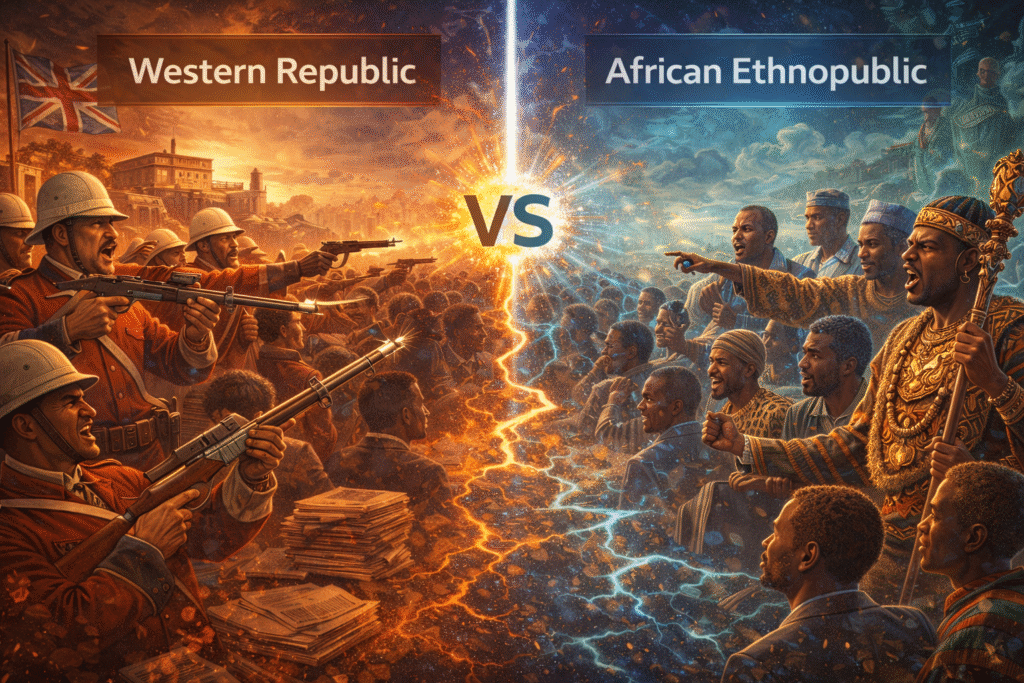
Western Republic and African Ethnopublic: The Conflict Between Bureaucracy and Commicracy
BY: OMOLAJA MAKINEE
Modern Western States often present themselves as finished models of political and economic success—republics governed by democratic institutions, regulated markets, rule-of-law bureaucracies, and sophisticated public administrations. These models are aggressively exported to Africa as universal prescriptions for development. Yet this export rests on a profound historical distortion.
The systems currently used by developed Western States—corporate lobbying, donor-led political parties, neoliberal market governance, technocratic bureaucracies, and complex regulatory institutions—are not the systems that produced their development. They are systems that emerged after wealth had already been accumulated, after industrialisation had taken root, after colonial extraction had transferred trillions in material value to Europe and North America, and after domestic economies had matured into surplus-producing engines.
To impose these late-stage political structures on African societies that are still in the process of foundational macro-State development is not merely misguided—it is structurally destructive.
1. Development Did Not Begin with Liberal Democracy
Western prosperity did not arise from free markets, pluralistic politics, or donor-funded civil institutions. It arose through centuries of protectionism, heavy State intervention, forced labour systems, and monopolistic control over global trade routes.
Britain industrialised behind tariffs and colonial monopolies. France consolidated wealth through imperial extraction. Germany industrialised through State-directed industrial planning. The United States grew through land seizures, slavery, protectionist tariffs, and State-backed industrial expansion. None of these societies developed through the systems they now preach to Africa.
What followed later—electoral republics, regulatory bureaucracies, constitutional liberalism—were stabilising mechanisms for already-developed economies, not engines of development themselves.
Africa, by contrast, is being asked to build a house starting from the roof.
2. The Western Calculation: Resources Without Sovereignty
The Western approach to Africa—both during and after colonialism—has always rested on a simple calculation: Africa is the most resource-abundant environment on Earth, endowed with immense mineral wealth and a vast reservoir of human potential.
Colonialism institutionalised this calculation through extraction without development. Post-colonial globalisation preserved it through structural neocolonial dependency. Western powers did not abandon control; they refined it—replacing governors with consultants, soldiers with trade agreements, and imperial administrators with donor agencies.
African States were left with political independence but denied economic sovereignty.
3. Bureaucracy as a Tool of Dependency
Modern African States operate under bureaucratic systems imported wholesale from Western republican traditions. These systems assume conditions that do not exist in Africa: stable capital accumulation, mature industrial bases, unified national identities, and low external interference.
Instead of empowering African societies, bureaucracy has become a mechanism of paralysis—centralising authority vertically while disconnecting it from the horizontal social structures that actually govern African life. Policies are written to satisfy donors, not citizens. Institutions answer upward to international standards, not outward to local realities.
This is the conflict at the heart of Africa’s developmental crisis: bureaucracy operating in a society that requires commicracy.
4. Commicracy versus Bureaucracy: Two Organisational Logics
Bureaucracy is a vertical system. Authority flows downward. Decisions are concentrated. Compliance is enforced. It thrives in societies where social order is already standardised and class hierarchies are accepted.
Commicracy, by contrast, is horizontal and interpeer-based. Authority emerges from shared commissioning-rules. Responsibility is distributed. Institutions exist to facilitate coordination, not to dominate it.
African societies historically functioned through commicratic systems—councils, guilds, age-grades, cooperative labour, and communal arbitration. These systems produced resilience, social cohesion, and collective responsibility long before Western bureaucratic models existed.
The tragedy is that Africa abandoned its own organisational intelligence in favour of systems designed for entirely different civilisational trajectories.
5. America and Africa: Different Outcomes, Same Trap
America offers a revealing parallel. Its early development relied on State intervention, labour extraction, and expansionist policy. But as its economy matured, it shifted into bureaucratic-republican governance.
Today, America is experiencing the internal contradictions of bureaucracy without commicracy: social polarisation, institutional mistrust, political gridlock, and economic inequality. Africa experiences the same dynamic—but at a far more devastating scale.
In America, bureaucracy produces social fragmentation. In Africa, it produces economic stagnation. This divergence is not accidental but structural. The American economy is functioning precisely as bureaucracy and capitalism were designed to function: a system that rewards accumulation, concentrates advantage, and legitimises inequality through procedure. Capitalism, as the economic expression of bureaucracy, is not a moral failure but a technical success—greed is incentivised, winners consolidate gains, and society stratifies into haves and have-nots as an expected outcome.
What escapes control, however, is the social consequence. As economic hierarchy deepens, social cohesion erodes, producing polarisation that no amount of administrative regulation can repair. Africa, by contrast, does not suffer social fragmentation at the grassroots level because social order is not manufactured by the State but maintained organically through ethnic bonds, kinship networks, and communal moral codes.
Africans are socially organised ethnopublically long before republican government appears, and internal cohesion within each ethnic group remains largely intact. Conflict emerges not from social breakdown but from the artificial compression of multiple ethnopublics into republican cartographies, where forced power-sharing triggers competition, inequality, and reactive power grabs between ethnic groups rather than within them. Even then, such tensions remain socially manageable because they are political, not cultural, in origin.
What Africa lacks is not social order but economic sovereignty. By importing bureaucratic republican systems unsuited to ethnopublic realities, African governments surrender economic coordination to impersonal frameworks they cannot control. The result is a paradox: Africa retains social stability without economic control, while America retains economic control without social stability. This inversion exposes a deeper truth—bureaucracy and republicanism can govern capital, but they cannot govern ethnopublic societies.
6. Why Western Advice Fails Africa
When Western institutions advise Africa to “strengthen democracy,” “reduce State intervention,” “impose tax regime on citizens,” or “liberalise markets,” they are prescribing post-development governance to underdevelopment societies.
This is not ignorance—it is convenience. A dependent Africa is predictable, extractable, and governable from afar.
But Africa’s future does not lie in copying Western republics. It lies in reclaiming ethnopublic governance—a system rooted in collective identity, horizontal authority, and commicratic organisation.
7. Ethnopublic versus Republic
The Western republic is built on individual competition mediated by bureaucratic institutions. The African ethnopublic is built on collective identity mediated by commicratic systems.
Republican bureaucracy fragments society into voters, consumers, and taxpayers. Ethnopublic commicracy integrates society into contributors, custodians, and co-builders.
One manages society. The other is society.
CONCLUSION: The Path Forward
Africa does not need weaker States. It needs different States. States that coordinate rather than command. States that commission rather than regulate. States that arise from the people rather than sit above them.
Commicracy is not anti-organisation; it is post-bureaucratic organisation. Ethnopublicanism is not anti-modern; it is structurally modern in a digital, interpeer, internetised world. The future belongs to systems that match the logic of human interaction in the 21st century—not the paperwork empires of the 18th.
Africa does not need to catch up to the West. Africa needs to move beyond it, and step back into itself.
Back to: 👇