
The Theatre of Conscious Reality: Why the Cortex Displays Behaviour Rather Than Constructs It
Part III
BY: OMOLAJA MAKINEE
For centuries, the cerebral cortex has been regarded as the command centre of the human organism—the place where intelligence resides, where consciousness is generated, and where reality is consciously assembled.
Within the framework of Psychextrics, however, the cortex occupies a profoundly different position. Rather than serving as the architect of behaviour, it functions as the behavioural theatre upon which the finished products of deeper biological systems become visible. It is not the construction site of reality but its display hall.
Every thought, image, memory, sensation, and act of introspection appears upon this stage only after a vast subcortical civilisation has already negotiated the behavioural event beneath the threshold of awareness.
This reconstruction begins by redefining what is meant by the term Display Cortex.
Under Psychextrics, the Display Cortex consists of both the revised six-layered Telencephalon and the three-layered piriform cortex. Although these two cortical systems differ structurally and evolutionarily, they perform complementary display functions within consciousness.
Together they provide the organism with the behavioural theatre of awareness, the rendering surface upon which behavioural packets become consciously experienced, and the symbolic projection interface through which the organism witnesses its own biological existence.
They do not independently manufacture behaviour. Instead, they visualise, narrate, simulate, and reflect upon behavioural signals that have already been assembled by the lower cephalic systems. The conscious self therefore never constructs reality directly; it observes a carefully rendered projection of behavioural reality that has already emerged through deeper biological negotiations.
This reinterpretation transforms the nature of consciousness itself. Consciousness becomes neither a controller nor an executive authority, but the final audience seated within a theatre whose production has already been written, directed, rehearsed, and performed before the curtain rises.
Every conscious experience represents the finished presentation of processes that have already passed through survival vigilance, kinetic coordination, spatial orientation, contextual valuation, emotional indexing, and behavioural integration. By the time the conscious narrator announces what has happened, the behavioural civilisation has already completed its work.
1. The Metabolic Economics of the Conscious Theatre
If the Display Cortex functions as the theatre of behavioural reality, then maintaining that theatre demands an extraordinary biological investment. Conscious-awareness is not metabolically inexpensive. It is among the most energetically demanding achievements of the nervous system.
Every frame projected onto the behavioural screen requires continuous synchronisation across multiple cephalic systems, sustained electrical activity throughout extensive cortical networks, and uninterrupted communication between the Master Relays of the Siencephalon and Diencephalon.
Psychextrics describes this expenditure as the price of intensity.
The lower Somato-Valence Engine—the Myelencephalon, Metencephalon, and Mesencephalon—operates continuously throughout life.
- Respiration proceeds without interruption.
- Cardiovascular regulation remains active every second.
- Muscular posture constantly adjusts to gravity.
- Spatial orientation continually tracks environmental movement.
These reactive template systems execute millions of behavioural operations each day without demanding conscious attention because they operate entirely within the behavioural template domain.
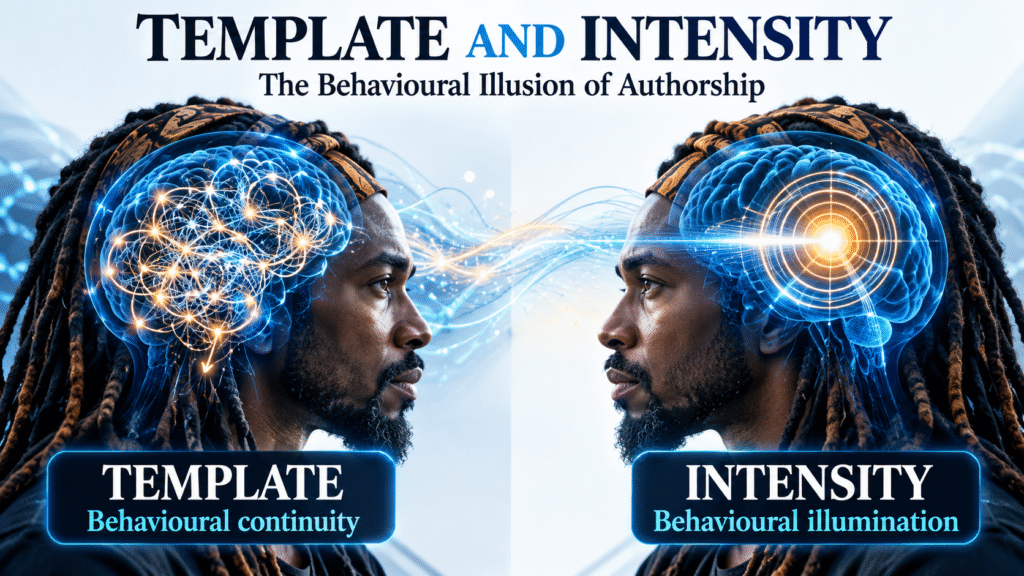
Template represents behavioural continuity. Intensity represents behavioural illumination.
The distinction is fundamental.
Template allows biological machinery to function automatically. Intensity allows the organism to consciously witness that machinery.
Without intensity, behaviour continues. Without template, behaviour ceases altogether.
Consequently, the conscious theatre exists only when sufficient metabolic resources are invested to illuminate the behavioural screen. Consciousness is therefore not the default operating mode of the nervous system. It is a biologically expensive projection that must continually earn its existence through ongoing metabolic expenditure.
2. The Proactive Intensity Threshold
This distinction becomes especially apparent during sleep.
One of the most intriguing features of human physiology is that countless biological events continue throughout deep sleep without entering conscious-awareness.
- Blood pressure fluctuates.
- Blood oxygen levels rise and fall.
- Hormonal secretion continues.
- Respiratory patterns vary.
- Blood glucose changes.
- Internal organs constantly communicate their physiological state.
Yet the sleeping individual remains entirely unaware of these events unless they cross particular biological thresholds into conscious-awareness.
Psychextrics explains this phenomenon through the concept of the Proactive Intensity Beam.
During deep sleep, the Diencephalic Thalamus progressively reduces proactive intensity in order to conserve metabolic resources and permit large-scale biological restoration. The behavioural theatre effectively closes for nightly maintenance.
The projection screen is darkened, not because behavioural activity has stopped, but because the energetic spotlight required for conscious rendering has been deliberately withdrawn.
The reactive template systems remain fully operational.
- The organism continues breathing.
- The heart continues beating.
- Homeostatic regulation continues.
- Immune surveillance continues.
- Behavioural templates never cease operating.
What disappears is the biological investment necessary to transform these ongoing template activities into conscious experience.
The theatre remains structurally intact. The projector is temporarily switched off.
This explains why individuals suffering from conditions such as sleep apnea may experience repeated interruptions of breathing throughout the night without possessing any conscious awareness of the event itself.
Likewise, transient episodes of elevated blood pressure or subtle metabolic disturbances frequently occur outside conscious experience because they remain confined to template processing while the behavioural theatre remains closed.
Only after waking does the organism begin experiencing the consequences.
- Morning fatigue.
- Persistent headaches.
- Mental fog.
- Dry mouth.
- General malaise.
These experiences emerge because the Intensity Beam has been reactivated. Behavioural templates that remained unconscious during sleep are now indexed into conscious narration once the Display Cortex resumes normal operation.
The organism does not suddenly develop the physiological disturbance upon awakening. It simply becomes capable of witnessing what was already occurring beneath awareness.
3. Inherited Spectral Variation and the Threshold of Awakening
Not every individual responds identically to physiological disturbance during sleep. Some awaken immediately after minor respiratory obstruction. Others remain asleep despite prolonged oxygen desaturation. Some individuals awaken with slight temperature fluctuations, while others sleep undisturbed through far greater physiological change.
Within Psychextrics, these differences emerge from Inherited Spectral Variation, governed through the interaction of Genetic and Epigenetic Index Markers (GIM-EIM) together with the Hormonal Index Marker and Hormonal Fluidity Index (HIM-HFI).
The GIM-EIM architecture establishes the organism’s inherited behavioural thresholds. Genetic organisation determines the baseline responsiveness of physiological systems, while ongoing accumulated epigenetic experiences further modifies those thresholds throughout life.
Consequently, one individual may possess a respiratory system that recruits proactive intensity rapidly during declining oxygen levels, whereas another may tolerate far greater physiological deviation before behavioural intensity becomes necessary.
Alongside these structural differences lies the Hormonal Index Marker and Hormonal Fluidity Index. Where GIM-EIM influences structural responsiveness, HIM-HFI governs emotional responsiveness.
Individuals exhibiting greater hormonal fluidity possess behavioural systems more likely to interpret subtle physiological variation as emotionally significant. Their behavioural civilisation recruits proactive intensity earlier because internal template disturbances more readily acquire behavioural importance. Even relatively minor physiological deviations may therefore activate sufficient emotional weighting to reopen the behavioural theatre, forcing conscious awakening.
Others exhibit far greater hormonal stability. Template disturbances remain confined within the reactive domain for considerably longer before sufficient emotional intensity accumulates to illuminate conscious-awareness.
The difference therefore lies not simply in physiology but in behavioural thresholds governing when template becomes intensity.
4. Template and Intensity: The Behavioural Illusion of Authorship
The relationship between template and intensity explains one of the most familiar yet least understood aspects of everyday human experience.
Human beings routinely alternate between extended periods of effortless behavioural automation and comparatively brief periods of heightened conscious engagement.
- A person may drive for miles while scarcely remembering individual moments of the journey.
- An experienced pianist performs complex musical passages without consciously calculating finger placement.
- An accomplished athlete executes intricate motor sequences without deliberate planning.
- Daily routines unfold with remarkable precision despite minimal conscious supervision.
Then, almost without warning, consciousness intensifies.
- An unexpected event occurs.
- A difficult decision appears.
- An emotionally significant conversation begins.
- Attention sharpens.
- Internal narration becomes vivid.
Behaviour suddenly feels personally authored.
Within Psychextrics, this transition reflects movement from behavioural template into behavioural intensity.
The template never stopped operating. Only the spotlight changed. The behavioural machine continued functioning throughout. The theatre merely became illuminated.
This distinction profoundly reshapes the concept of personal authorship.
- Reactive behaviour belongs to template.
- Reflective narration belongs to intensity.
The behavioural machine governs life continuously. The conscious narrator appears only when biological conditions justify the energetic cost of illumination.
Consequently, the conscious self does not own reactive behaviour because it never constructed the behavioural machinery responsible for executing it. Consciousness instead witnesses behaviour once proactive intensity has invested sufficient metabolic resources to project that behaviour upon the Display Cortex.
The narrator therefore follows the civilisation rather than governing it.
5. Lived Experience: Driving Home Without Remembering the Journey
Almost everyone has experienced arriving home after a familiar commute while remembering remarkably little about the journey itself.
Traffic lights were obeyed. Lane changes occurred safely. Speed was adjusted appropriately. Corners were navigated accurately. Yet upon arrival the individual suddenly realises that conscious attention had scarcely focused upon driving for several minutes.
From the perspective of Psychextrics, this experience illustrates the relationship between template and intensity.
The Somato-Valence Engine maintained behavioural execution continuously.
- Survival vigilance monitored the environment.
- Kinetic systems controlled steering and pedal movements.
- Spatial orientation tracked surrounding vehicles.
Behaviour unfolded efficiently through reactive templates refined by years of behavioural calibration directly with the memory systems.
Because no significant behavioural anomaly required proactive intervention, the Intensity Beam remained comparatively subdued. The Telencephalic Cortex continued rendering behavioural continuity, but reflective narration remained minimal because the energetic cost of sustained proactive intensity was unnecessary.
Only when an unexpected pedestrian suddenly stepped into the road, or a vehicle unexpectedly crossed lanes, or reactive template becomes disrupted somehow in any event, would proactive intensity immediately surge. The behavioural theatre would brighten. Conscious-awareness would become vividly focused. Internal narration would return almost instantly.
The road had always been present. The behavioural systems had always been operating. What changed was the deployment of intensity.
Conclusion: The Theatre as the Final Witness
Viewed through the framework of Psychextrics, consciousness is neither illusion nor supreme controller. It is the behavioural theatre within which the finished products of an immense biological civilisation become visible.
The revised Telencephalon and the piriform cortex function together as the organism’s display system, rendering behaviour that has already been negotiated across the Myelencephalon, Metencephalon, Mesencephalon, Diencephalon, and Siencephalon before conscious experience ever begins.
The cost of maintaining this theatre is substantial. Conscious-awareness demands continuous metabolic investment, synchronised relay systems, emotional illumination, and proactive intensity.
Whenever these energetic requirements are withdrawn—as during deep sleep—the behavioural civilisation continues functioning on template mode of being while the theatre itself temporarily closes for restoration.
This distinction ultimately reframes the meaning of conscious existence. Human beings do not consciously construct behavioural reality from the top down. They awaken within a reality that has already been assembled beneath awareness by a layered biological civilisation whose operations vastly precede reflective experience.
The conscious self is therefore not the architect of the behavioural world it inhabits. It is the privileged witness seated within the theatre, observing the remarkable performance that countless unseen biological systems have already brought to life.
Back to: 👇