
The House-of-StateLords: Assembly, Court, and Tribunal in an Ethnopublican State
BY: OMOLAJA MAKINEE
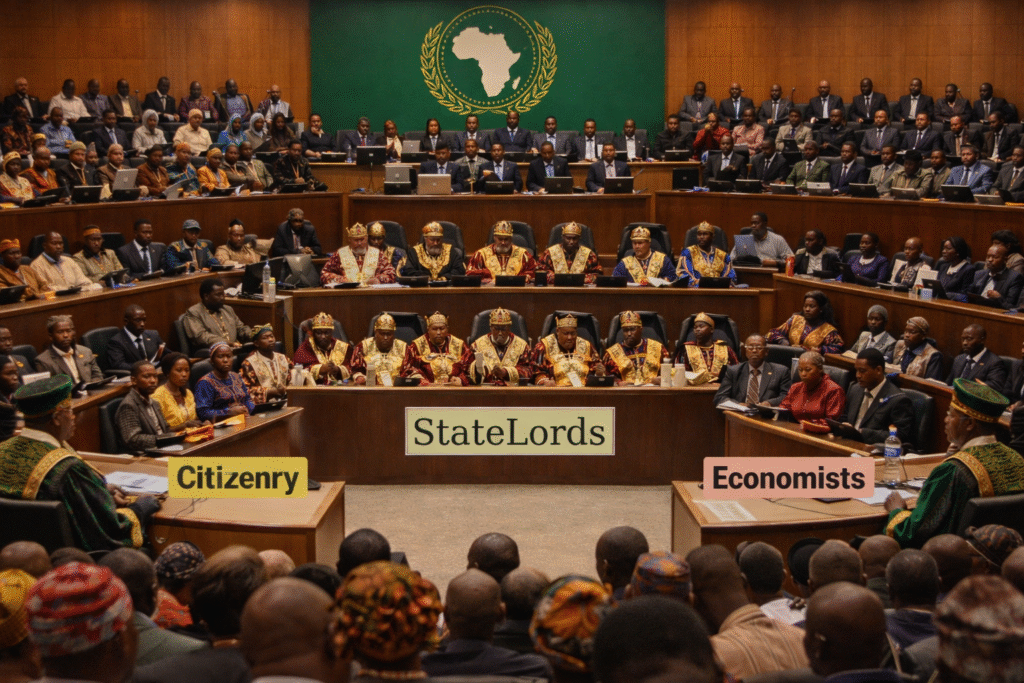
In the proposed ethnopublican order of a united African governance, the House-of-StateLords constitutes the judicial spine of the State, but it is not a monolithic institution. It is a tripartite structure whose components are deliberately differentiated in function, authority, composition, and jurisdiction.
To understand the operational clarity of ethnopublican governance, one must understand how the House-of-StateLords’ Assembly differs fundamentally from the House-of-StateLords’ Court and the House-of-StateLords’ Tribunal, and why this separation is indispensable to populocratic stability.
Unlike imported constitutional models—where courts often drift into political arbitration or legislatures encroach upon judicial independence—the ethnopublican system restores moral geometry, placing each State authority precisely where it belongs.
1. The StateLord as Moral Custodian, Not Executive Ruler
In the African ethnopublican model, each Head of State occupies the position of StateLord. This role is neither ceremonial nor autocratic. It is judicial and supervisory by design. The StateLord is not the manager of government, not the architect of policy, and not the commander of legislative outcomes. Instead, the StateLord is the custodian of constitutional conscience, charged with safeguarding coherence between the governed and the institutions that administer governance on their behalf.
This immediately distinguishes the ethnopublican StateLord from presidents and monarchs under inherited systems. The StateLord does not rule the people; the people rule themselves. The StateLord ensures that this self-rule remains lawful, balanced, and immune to administrative capture.
2. The House-of-StateLords’ Assembly: The Supervisory Conscience of the State
The House-of-StateLords’ Assembly is the only forum within the State where the StateLord personally sits. Representation is strictly prohibited. No proxy, delegate, or judicial substitute may act in place of the StateLord in this Assembly. This rule is absolute and intentional.
Jurisdiction and Function
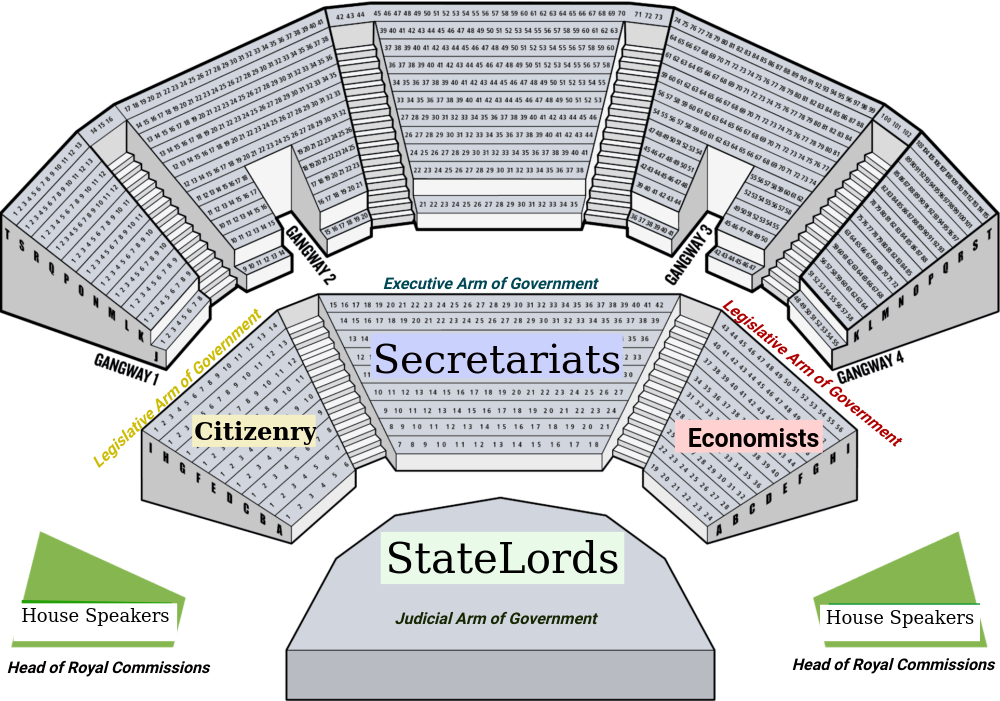
The Assembly, acting as the Supervisory-Division of and over government, deals exclusively with State-centred matters arising from the Administrative-Division of government, where the Executive-Arm, Economy-Arm, and Citizenry-Arm operate. It does not adjudicate private disputes. It does not function as a trial court. Instead, it presides over:
- Constitutional disputes between administrative arms.
- Allegations of overreach by executive or commicratic offices.
- Conflicts between administrative implementation and populocratic mandate.
- Formal invitations to interpret constitutional coherence.
- Questions concerning the lawful execution of citizenry-ratified policy.
In short, the Assembly exists to supervise the administrators.
Why the StateLord Must Sit Personally
The presence of the Head of State in the Assembly is not symbolic; it is ethical. The Assembly embodies State accountability at the highest moral altitude. Since administrative power affects the entire govity, the one entrusted with constitutional guardianship must personally shoulder the burden of judgment. Delegation here would dilute responsibility—and ethnopublicanism does not permit diluted responsibility at the apex of the State.
Crucially, the StateLord in the Assembly does not impose will. The role is not to command but to preserve alignment: alignment between citizenry law, populocratic decision-making, and administrative execution.
3. The House-of-StateLords’ Court: The State Court of Appeal
Distinct from the Assembly is the House-of-StateLords’ Court, which operates as the highest court of appeal within each individual State.
Composition and Representation
Here, judges sit on behalf of the StateLord, not in place of them. At least one judge presides over the StateLord’s Court in each State, though this number may evolve in practice as caseloads and legal complexity increase.
The StateLord does not sit in this court. This separation preserves judicial professionalism and prevents the politicisation of legal adjudication.
Jurisdiction
The StateLords’ Court handles:
- Appeals from its lower State courts.
- Constitutional challenges arising from State-level law.
- Disputes involving public authorities within the State.
- Interpretation of citizenry law as applied to individual cases.
This court ensures that law is applied uniformly and fairly, without dragging the Head of State into routine adjudication.
4. The House-of-StateLords’ Tribunal: The National Supreme Court
At the apex of the judicial hierarchy sits the House-of-StateLords’ Tribunal, the national supreme court of the ethnopublican State.
Composition
Unlike the StateLords’ Court, the Tribunal is collective and inter-State in character. At least three judges representing each State sit on supreme cases. These judges act on behalf of their respective StateLords, ensuring that national judgments reflect the federated moral consciousness of the ethnopublic, not the dominance of any single State or office.
Jurisdiction
The Tribunal adjudicates:
- Supreme constitutional questions.
- Disputes between States.
- Conflicts between national citizenry law and administrative practice.
- Matters of national legal precedent.
- Appeals escalated beyond State jurisdiction.
This structure prevents judicial centralisation and ensures that national law emerges from collective State legitimacy, not elite insulation.
5. Why the Assembly Is Not a Court—and Must Never Become One
A defining strength of this system lies in what it refuses to conflate.
The House-of-StateLords’ Assembly is not a court, and it must never adjudicate private or criminal matters. Likewise, courts and tribunals must never drift into supervisory governance. This separation ensures:
- Judicial neutrality in courts.
- Moral accountability in the Assembly.
- Absence of executive interference in legal rulings.
- Absence of judicial overreach into administration.
Where many African States inherited systems that fused executive dominance with judicial vulnerability, ethnopublicanism disentangles these errors with surgical precision.
6. Ethnopublican Balance: Supervision Without Domination
Taken together, the Assembly, Court, and Tribunal form a triangular equilibrium:
- The Assembly supervises the Administrative-Division of government.
- The Courts adjudicate law.
- The Tribunal harmonises national jurisprudence.
The StateLord appears only where moral accountability is required, and remains absent where neutrality must be preserved. This design ensures that no office accumulates unchecked power, and no institution can weaponise ambiguity to dominate the governed.
Conclusion: Judicial Architecture for a Populocratic Age
The House-of-StateLords system is not an ornamental structure. It is the institutional expression of a deeper philosophical truth embedded throughout the manifesto series: that governance must be supervised by conscience, executed by function, and decided by the people.
In an ethnopublican State, the StateLord does not reign over citizens; they stand guard over the social covenant. Courts do not legislate morality; they apply law. Tribunals do not centralise power; they federate justice.
This is how African governance escapes the colonial inheritance of vertical domination and enters a future of horizontal legitimacy, shared authority, and populocratic permanence.
It is not merely a new structure—it is a restored order.
Back to: 👇