
The Paradigm Divergence of Emotional-Memory: From Psychological Feeling to Subcortical Infrastructure
The Great Misunderstanding of Emotional-Memory
BY: OMOLAJA MAKINEE
Few concepts in Behavioural science have generated more confusion than emotional-memory.
The phrase appears deceptively simple. Most people intuitively assume they understand its meaning.
- A joyful childhood event.
- A painful breakup.
- A frightening accident.
- An embarrassing social encounter.
These experiences appear to leave emotional traces that influence future thoughts, feelings, and behaviours.
For more than a century, mainstream Psychology has largely interpreted emotional-memory through this lens. Emotion is treated as an affective layer attached to experience. A colouring process. A subjective feeling-state that enhances, distorts, strengthens, weakens, or modifies the recollection of events.
Under this framework, emotional-memory is fundamentally reconstructive.
- The organism recalls an event.
- Emotion influences the recollection.
- The memory is experienced.
- The behaviour follows.
Psychextrics rejects this interpretation entirely. It proposes that emotional-memory is not a psychological colouring mechanism.
- It is not a feeling attached to memory.
- It is not a reconstructive mental event.
- It is not a secondary property added onto experience.
Emotional-memory is infrastructure.
- It is a physical subcortical sorting system.
- It is a biological prioritisation engine.
- It is the mechanism that determines whether behavioural-memory reaches conscious display at all.
This distinction creates one of the largest paradigm divergences between traditional Behavioural science and the Psychextrics model.
1. The Hard-Drive Model and the Recovery of Mechanical Behaviour
The Psychextrics hard-drive model emerged to solve several longstanding problems that conventional theories struggle to explain adequately.
- Why does memory alter behaviour automatically?
- Why do traumatic experiences continue influencing behaviour decades later?
- Why does familiarity emerge immediately?
- Why do habits develop without conscious participation?
- Why does consciousness appear reactive rather than executive?
These questions become difficult when memory is viewed merely as historical storage.
A passive archive cannot actively guide behaviour. A recollection cannot continuously shape reality unless it possesses an active mechanism.
Psychextrics therefore redefines memory itself. Memory is not historical residue. Memory is active architecture. Memory continuously participates in behavioural positioning. The organism does not occasionally consult memory. The organism continuously operates through memory.
Behavioural continuity becomes mechanically grounded because memory functions as living infrastructure rather than historical storage.
Within this framework, emotional-memory becomes one of the primary mechanisms through which continuity is maintained.
2. The Memory Trinity
The first major departure from mainstream thought lies in the rejection of isolated memory systems.
Traditional approaches often discuss emotional-memory independently. Behavioural-memory is studied separately. Biological processes are frequently placed within entirely different disciplines. Psychextrics views this separation as artificial.
Three memory systems operate together as a unified trinity.
- Biological-Memory.
- Behavioural-Memory.
- Emotional-Memory.
Each system performs a distinct function. Yet none can be understood in isolation.
- Biological-Memory supplies the Feedline.
- Behavioural-Memory supplies the Guideline.
- Emotional-Memory supplies the Serviceline.
Conscious experience emerges only when all three interact.
The organism therefore never expresses emotional-memory alone. It never expresses behavioural-memory alone. It never expresses biological-memory alone. Every visible behaviour is the product of their continuous convergence.
3. The Mainstream Interpretation of Emotional-Memory
Within mainstream Behavioural science, emotional-memory is typically viewed as an affective modification process.
- An event occurs.
- The event is stored.
- Emotion increases or decreases its significance.
The emotional component becomes attached to the memory trace. Later recall reproduces some portion of that emotional state.
Under this model, emotional-memory acts almost like a coloured filter placed over historical information. The underlying memory exists independently. Emotion simply changes how vividly it is experienced.
- Fear makes the memory stronger.
- Joy makes the memory pleasant.
- Shame makes the memory painful.
The emotional component modifies the recall process. Consequently, emotion is treated as secondary. The memory exists first. Emotion arrives afterward.
Psychextrics reverses this relationship.
4. The Psychextrics Interpretation of Emotional-Memory
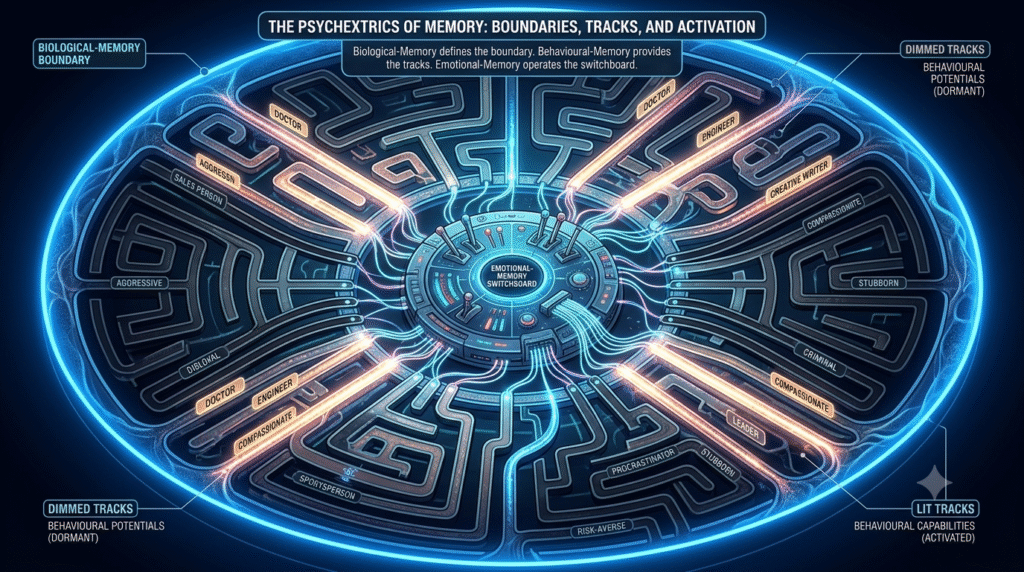
Under Psychextrics, emotional-memory is not attached to behavioural-memory. It governs behavioural-memory.
The Amygdala does not merely decorate behavioural traces with emotional colouring. It determines which behavioural traces gain access to conscious reality. This transforms emotional-memory from a passive modifier into an active gatekeeper.
Behavioural-memory may contain thousands of behavioural possibilities.
- Strategies.
- Skills.
- Languages.
- Motor routines.
- Professional competencies.
- Social behaviours.
- Cognitive structures.
None possess independent executive authority. They remain inert blueprints. Emotional-memory determines which blueprint becomes operational.
The Amygdala functions as a subcortical switchboard. It evaluates behavioural possibilities against biological conditions.
- It assigns valence.
- It allocates saliency.
- It determines urgency.
- It controls expression.
The question therefore shifts.
Traditional psychology asks: “What emotional meaning is attached to this memory?“
Psychextrics asks: “Which behavioural blueprint is the emotional system permitting to reach conscious display?“
5. Memory Is Created Below Consciousness
The divergence becomes even more pronounced when examining anatomical localisation.
Traditional models frequently place memory creation and memory experience within overlapping cortical systems. The cortex is often treated as both archive and interpreter. Psychextrics separates these functions.
Behavioural-memory is assembled and indexed beneath consciousness. Emotional-memory is regulated beneath consciousness. Consciousness receives only the final broadcast.
The revised Telencephalon does not create emotional-memory. It displays the consequences of emotional-memory.
The Telencephalon does not decide which behavioural track becomes active. It witnesses the outcome of that decision.
The display screen is therefore the last participant in the process. Not the first.
This distinction transforms emotional-memory from a psychological event into a subcortical operating mechanism.
6. The Indissoluble Trinity in Action
The practical implications become clearer when examining how the three memory systems cooperate.
Biological-Memory continuously tracks the state of the organism.
- Metabolic status.
- Hormonal conditions.
- Nutritional availability.
- Inflammatory burden.
- Physiological readiness.
Behavioural-Memory contains the available behavioural tracks.
- Problem solving.
- Social engagement.
- Professional execution.
- Habitual routines.
- Capability potentials.
Emotional-Memory evaluates both.
It asks: Which behavioural pattern should be prioritised under these biological conditions?
The resulting output becomes conscious experience.
The organism therefore never behaves because emotional-memory creates behaviour. Nor does the organism behave because behavioural-memory independently executes itself.
Behaviour emerges when emotional-memory selects one behavioural blueprint from among many possibilities and permits it expression.
7. Why the Mainstream Separation Creates Diagnostic Errors
The separation of emotional processes from biological and behavioural systems creates a major diagnostic problem.
Traditional approaches frequently interpret emotional suffering as a psychological phenomenon occurring primarily at the level of conscious experience.
- The visible symptoms become the focus.
- The symbolic narrative becomes the focus.
- The emotional report becomes the focus.
Yet the deeper architecture remains largely invisible.
Psychextrics argues that this approach often mistakes output for origin. A person may appear depressed. The visible display suggests a psychological condition. Yet the behavioural architecture may remain completely intact.
- Their strategic capabilities remain present.
- Their social competencies remain present.
- Their intellectual abilities remain present.
What has changed is the gating system.
Biological distress alters emotional-memory. Emotional-memory restricts behavioural access. The display screen reflects the resulting bottleneck.
The behavioural potential was never lost. Access to it was interrupted.
8. The Desynchronisation of the Memory Trinity
One of the most important consequences of the Psychextrics model is the concept of trinitarian desynchronisation.
Pathology emerges when Biological-Memory, Behavioural-Memory, and Emotional-Memory lose synchrony.
The biological feedline changes. The behavioural architecture remains unchanged. The emotional gate adjusts accordingly. A mismatch develops.
The person appears fundamentally altered. Yet the underlying behavioural templates may remain exactly as they were.
- Anxiety emerges.
- Depression emerges.
- Avoidance emerges.
- Behavioural paralysis emerges.
Not because behaviour itself has disappeared. Not because personality has collapsed. But because the emotional switchboard has shifted its prioritisation profile.
The behavioural tracks remain available. The emotional gate refuses access.
9. Reframing the Nature of Emotion
Perhaps the most radical contribution of Psychextrics is the removal of emotion from the realm of subjective abstraction.
Emotion ceases to be merely something felt. Emotion becomes something operational. It becomes a regulatory system.
- A sorting system.
- A prioritisation system.
- A behavioural deployment system.
Fear is no longer merely a feeling. Fear becomes a gating configuration.
- Attraction becomes a gating configuration.
- Curiosity becomes a gating configuration.
- Avoidance becomes a gating configuration.
Emotion transforms from experience into infrastructure.
Conclusion: From Feeling-State to Switchboard
The fundamental divergence between mainstream Behavioural science and Psychextrics lies in the definition of emotional-memory itself.
Traditional models interpret emotional-memory as an affective addition to experience. A psychological colouring process attached to historical events.
Psychextrics redefines emotional-memory as a physical, subcortical gating architecture embedded within a larger memory trinity.
- Biological-Memory provides the fuel.
- Behavioural-Memory provides the tracks.
- Emotional-Memory operates the switchboard.
Consciousness receives only the final broadcast.
When viewed through this lens, emotional-memory ceases to be a mysterious psychological phenomenon and becomes a visible component of behavioural mechanics.
The organism is no longer understood as a collection of disconnected thoughts and feelings. Instead, it becomes a coordinated behavioural infrastructure in which biology supplies the conditions, behaviour supplies the possibilities, and emotion determines which possibilities are allowed to become reality within the limitation of the conditions.
The result is a profound shift in perspective. Emotion is not what we remember. Emotion is the mechanism that decides what becomes behaviour.
And until emotional-memory is understood as part of an indivisible trinity with biological-memory and behavioural-memory, the deepest mechanics of human behaviour remain hidden behind the illusion that feelings are merely things we experience rather than systems that continuously organise who we become.
Back to: 👇