
The Brain Without Freewill: Why the Cephalic Systems That Generate Behaviour Cannot Control Their Own Outputs
BY: OMOLAJA MAKINEE
Modern Behavioural science inherited one of its strongest assumptions from the mythology of conscious identity: That human beings consciously control their behaviour from above.
Under this model:
- the self chooses,
- consciousness commands,
- thought initiates action,
- and the organism behaves through rational executive intention.
Psychextrics dismantles this assumption completely. The deepest paradox of human behaviour is this:
The cephalic systems that actually originate behavioural consciousness do not possess conscious control over their own outputs.
Under the 6-Cephalon architecture, the lower cephalic gateways execute rigid biological mandates long before reflective consciousness emerges on the cortical screen.
This creates one of the most profound inversions in Behavioural science:
The structures that build behavioural consciousness are themselves not consciously free.
The organism therefore does not operate through sovereign freewill, but through layered biological negotiation under cephalic load.
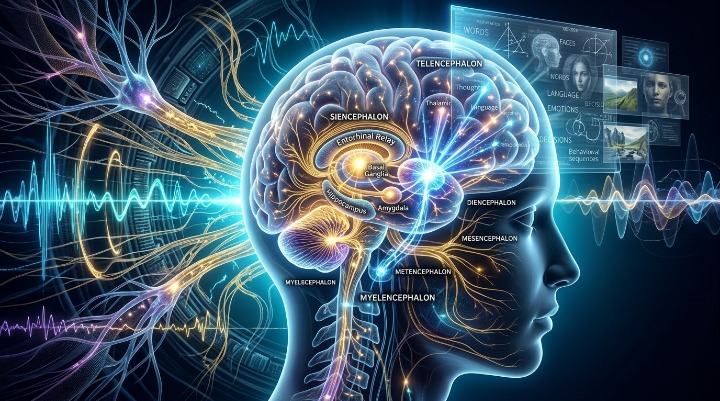
1. The Hierarchy of Behavioural Construction
Under psychextrics, behaviour emerges progressively through cephalic hierarchy.
The:
- Myelencephalon governs survival vigilance,
- Metencephalon stabilises kinetic behaviour,
- Mesencephalon manages spatial orientation,
- Diencephalon applies contextual meaning and emotional weighting,
- Siencephalon integrates and packages behavioural signals,
- while the Telencephalon displays the final behavioural rendering consciously.
This sequence is critically important because it reveals that consciousness arrives last. The cortex therefore inherits behavioural reality after the lower cephalic systems have already:
- activated,
- prioritised,
- stabilised,
- integrated,
- and executed
their specialised survival mathematics beneath awareness.
The Telencephalon becomes the observer of behaviour, not the originator of behaviour.
2. The Lower Cephalons Are Not Free
The greatest contradiction against classical freewill appears immediately when examining the lower cephalic systems themselves.
The Myelencephalon does not consciously choose whether survival vigilance should continue. Human beings do not wake each morning and voluntarily decide whether the heart should beat, whether breathing should persist, or whether autonomic continuity should remain active. The organism simply discovers afterward that the body has already continued living. The survival machinery operates absolutely.
The Mesencephalon functions similarly. Spatial orientation systems do not wait for reflective approval before responding to danger. A sudden explosion, a rapidly approaching object, or an unexpected environmental shift instantly triggers orientational adjustment before symbolic narration has time to form. The body ducks first. Consciousness explains afterward.
The Metencephalon also executes kinetic stabilisation autonomously. Muscle tension, posture correction, balance compensation, and bodily coordination continuously operate beneath awareness without requiring reflective command from the cortical narrator.
These systems do not consciously control their own outputs. They execute because their architectural mandates are biologically rigid.
3. Even the Diencephalon Is Not Free
Perhaps the most important revelation is that even the Diencephalon lacks sovereign behavioural authority. The Diencephalon does not choose the raw data entering its gates.
It cannot freely decide:
- what survival telemetry arrives,
- what orientational threats emerge,
- what autonomic signals activate,
- or what visceral conditions are projected upward from the lower cephalons.
Its role is contextual weighting.
The Diencephalon applies:
- emotional saliency,
- urgency,
- meaning,
- and behavioural value
to incoming cephalic material whether it desires to or not.
This destroys the classical psychological fantasy of the detached rational mind ruling behaviour freely from above. The Diencephalon itself is trapped within the cephalic hierarchy.
4. The Rollercoaster and the Collapse of Freewill
A rollercoaster provides one of the clearest demonstrations of this biological reality.
Imagine an individual voluntarily boarding a massive high-speed rollercoaster with close friends. The Diencephalon fully understands the contextual framework:
- a ticket was purchased,
- safety systems are visible,
- the environment is recreational,
- and the surrounding crowd is laughing.
Contextually, the organism consciously recognises: “This is safe” from the Diencephalon. Yet the lower cephalons often reject this interpretation completely.
The Myelencephalon senses:
- violent acceleration,
- rapid gravitational drops,
- visceral instability,
- and survival threat signatures.
It floods the organism with adrenaline, autonomic vigilance, elevated heart rate, and survival activation.
The Mesencephalon simultaneously registers:
- terrifying vertical orientation,
- unstable spatial positioning,
- and rapid environmental shifts.
The eyes squeeze shut automatically. Orientational panic activates immediately.
The Metencephalon loses stable kinetic grounding and responds with:
- trembling,
- muscular tension,
- involuntary screaming,
- and bodily instability.
The organism now experiences two conflicting behavioural realities simultaneously.
The Diencephalon consciously knows: “This ride is safe” since the beginning of the event. The lower cephalic systems execute survival emergency protocols anyway.
The body screams despite conscious understanding of safety.
5. Willpower Is Not Freewill
This distinction reveals the profound difference between: Freewill and Willpower.
Under psychextrics, human beings do not possess disembodied freewill floating above biology. Behaviour emerges through cephalic negotiation under load.
What humans describe as “trying to calm down” is not conscious executive mastery over the organism. It is a downstream exertion of willpower attempting to negotiate with deeply embedded survival machinery.
The Diencephalon attempts contextual reassurance:
- “You are safe.”
- “This is entertainment.”
- “There is no real danger.”
But these contextual interpretations cannot instantly silence the:
- Myelencephalon’s visceral vigilance,
- Mesencephalon’s orientational panic,
- or Metencephalic destabilisation.
The lower cephalons continue executing their inherited survival mathematics independently. This is why behaviour often feels:
- involuntary,
- overpowering,
- emotionally uncontrollable,
- and biologically heavier than conscious intention.
The organism is not freely authoring behaviour from above. It is attempting to negotiate with lower cephalic systems already in motion.
6. The Siencephalon and the Illusion of Unity
Once the rollercoaster slows and the behavioural storm subsides, the Siencephalon performs its integrative role. The fragmented cephalic conflict becomes:
- compressed,
- indexed,
- emotionally stabilised,
- and packaged
into a coherent biographical narrative.
This unified behavioural package is then projected upward onto the Telencephalic display-cortex. Consciousness subsequently reads the polished behavioural summary and says “I knew I was safe, but I still could not stop screaming.”
That sentence itself exposes the illusion of executive identity.
The cortical narrator retrospectively speaks as though a singular “I” coherently experienced and authored the behavioural event from beginning to end.
But beneath awareness, the organism was actually undergoing:
- survival vigilance,
- orientational panic,
- kinetic destabilisation,
- emotional conflict,
- and contextual negotiation
across multiple cephalic systems operating simultaneously.
The Siencephalon simply packaged the conflict so seamlessly that consciousness inherited the illusion of a unified behavioural self.
7. The Cortex as the Final Witness
The Telencephalon therefore becomes the final witness of behaviour, not the sovereign author of behaviour. It does not initiate, stabilise, or construct the behavioural event itself. It merely reflects the finished cephalic integration upward into:
- symbolic awareness,
- narrative continuity,
- internal language,
- and conscious observation.
The cortex feels like the self, precisely because it never directly experiences the fragmented warfare occurring beneath it. It receives only the polished behavioural script.
The organism therefore mistakes:
- coherent narrative packaging,
for:
- executive authorship.
Conclusion: The Death of the Rational Sovereign
Psychextrics ultimately reveals something profoundly uncomfortable about human identity:
The systems generating behavioural consciousness are themselves not consciously free.
The lower cephalons execute:
- inherited survival mandates,
- orientational mathematics,
- autonomic vigilance,
- and kinetic stabilisation
without reflective authority over their own outputs.
The Diencephalon attempts contextual regulation but remains trapped within the behavioural hierarchy beneath it.
The Siencephalon integrates conflict without consciously choosing sides.
The Telencephalon merely reflects the final integrated signal afterward.
Human beings therefore do not stand above biology as rational sovereign rulers. They stand within a vertically layered cephalic civilisation continuously negotiating behavioural reality beneath awareness.
The conscious “I” is not the commander of behaviour. It is the final reflective observer of a biological hierarchy already in motion below.
Back to: 👇