
The Black Ancestral Blueprint: Parallels Between Pharaonic Governance in Ancient Kemet and the 21st-Century Ethnopublican Model
BY: ỌMỌ́LÀJÀ MÁKINÉÉ
The rediscovery of Kemetian governance is not a nostalgic gaze into antiquity—it is the retrieval of an administrative genius that once ordered civilisation at its moral, spiritual, and economic peak. Before colonialism fractured African governance into borrowed bureaucracies and artificial sovereignties, ancient Kemet had perfected a system of statehood grounded in balance, communalism, and divine order. The Pharaonic structure was not tyranny disguised as monarchy; it was a moral geometry of the cosmos translated into the laws of governance.
At its core stood Ma’at, the principle of truth, justice, and equilibrium. Ma’at governed not only human behaviour but also institutional order. Every organ of governance—from the Pharaoh and the Vizier to the regional Nomarchs—was designed to mirror the cosmic harmony of life itself. Authority was sacred because it was balanced; power was legitimate because it was accountable to Ma’at, not merely to hierarchy.
It is within this ancestral logic that Ethnopublicanism, as theorised in The Manifesto of African Corporatist Society (Makinee, 2021), finds its 21st-century expression. Ethnopublicanism is not a modern invention; it is a recovery of the indigenous governing wisdom of Kemet, adapted to the complexity of postcolonial Africa. Its structure retains the moral architecture of Pharaonic governance while populocratising its function for citizen-centred administration.
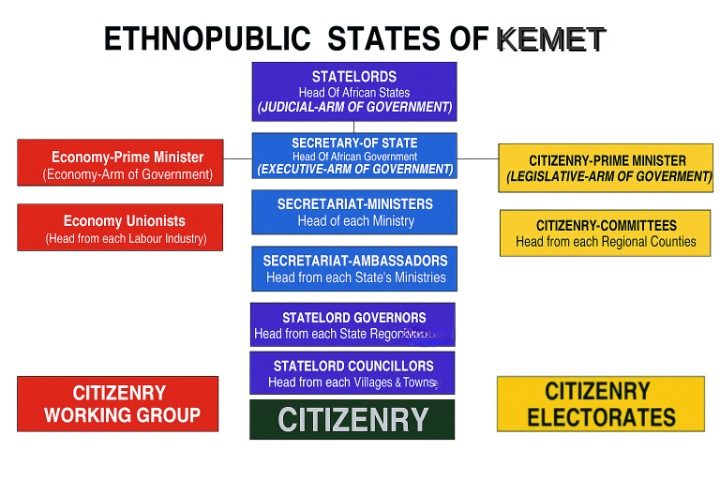
In the Ethnopublican State, power is not concentrated in a single ruler but shared among Statelords—life peers who act as the judicial custodians of the collective conscience of society. The Secretary of State, as chief executive, mirrors the ancient Vizier’s role, managing the day-to-day functions of government in harmony with the Statelords’ supervision. The Economy Prime Minister oversees trade and labour policy, while the Citizenry Prime Minister ensures that law and representation remain aligned with the will of the people. Together, these arms of government function as a moral quadrilateral—each distinct, none supreme over the other, and all subject to the higher law of equilibrium, as symbolised by the judiciary’s custodial supremacy.
This symmetry reflects the timeless African philosophy that governance must serve life, not power. It must ensure that no arm of authority dominates another, and that the citizenry—once called the Remetch en Kemet, “People of the Black Land”—remain the living heart of the State.
Comparative Schema: Pharaonic Governance Versus Ethnopublican Governance
| Ancient Kemet (Pharaonic Model) | 21st-Century Ethnopublican Model | Functional Parity & Explanation |
|---|---|---|
| Pharaoh (Divine Custodian, Balance-Keeper, Head of State) | Statelords (Life-Peer Heads of States, Judicial Arm) | The Pharaoh symbolised Ma’at—justice and cosmic order. In Ethnopublicanism, this divine custodianship becomes collective: the Statelords are joint guardians of sovereignty and moral equilibrium across African ethnopublics. |
| Vizier (Chief Executive Officer of the State) | Secretary of State (Head of African Government, Executive Arm) | The Vizier managed the daily affairs of governance under Pharaoh’s oversight. The Secretary of State inherits this role as the chief coordinator of all continental executive functions, acting in service to the Statelords’ council. |
| Royal Administrators / Overseers of Departments | Secretariat-Ministers (Heads of each Ministry) | Just as ancient Kemet had departmental overseers (grain, irrigation, labour, justice, etc.), Ethnopublican Ministries ensure functional governance across specialised sectors. |
| Nomarchs (Provincial Governors of the Nomes) | Statelord Governors (Heads of State Regional Counties) | Nomarchs administered provincial territories. Statelord-Governors echo this localised autonomy, ensuring harmony between continental policy and regional cultural governance. |
| Village Elders / Local Chiefs | Statelord Councillors (Heads of Villages & Townships) | Local elders served as the moral and social anchors within communities. StateLord-Councillors maintain that ancestral function, bridging traditional authority with modern administrative structures. |
| The Common People of Kemet (Remetch en Kemet) | Citizenry | Both represent the heart of governance—the governed. In Ethnopublicanism, citizens are not subjects but co-owners of the govity. |
| Council of Artisans & Guild Labourers | Economy Unionists (Heads from each Labour Industry) | In Kemet, labour guilds were sacred institutions tied to temple economies. The Economy Unionists preserve this ethic—labour as sacred contribution, not servitude. |
| Overseer of Royal Treasury / Temple Economy | Economy-Prime Minister (Head of Economy Arm of Government) | The overseer balanced wealth distribution and trade. The Economy-Prime Minister embodies this ancient stewardship of economic justice. |
| Local Work Councils / Artisan Collectives | Citizenry Working Group | These serve as the grassroots labour voice, ensuring that policy reflects the lived reality of the worker—echoing the communal workshops of Kemet’s civic economy. |
| The Great Royal Court (Advisory Body to Pharaoh) | Citizenry Prime Minister & regional Citizenry-Committees. (Legislative Arm of Government) | The Royal Court deliberated on laws and disputes. The Citizenry Prime Minister and regional Citizenry-Committees carry this deliberative spirit—law made not by decree, but through participatory consensus with the governed people. |
| Ma’at (Cosmic Law of Truth, Balance, and Order) | Ethnopublican Constitution (Moral Charter of Governance) | Ma’at governed both divine and human order. The Ethnopublican constitution is its modern embodiment—a legal framework infused with moral equilibrium. |
1. The Meaning of Continuity
What makes Ethnopublicanism truly revolutionary is its continuity rather than its novelty. It stands in the unbroken lineage of African Statecraft—from the ethical custodianship of Kemet to the cooperative councils of precolonial ethno-governed territories and city-states across the continent. The ancient Pharaoh was not an autocrat; he was the first among equals, a living symbol of balance whose legitimacy rested on moral precision and public service.
The Vizier, in turn, embodied the principle of administration as stewardship, ensuring that justice, labour, and resource distribution reflected Ma’at’s equilibrium.
The Ethnopublican Secretary of State inherits this administrative ethic—not as an overlord but as a servant-executive accountable to both the Statelords and the people. In the same spirit, the Economy-Prime Minister represents the sacred role of the overseer of the royal treasury, translating spiritual morality into economic fairness. Labour, in this view, is not exploitation but participation in divine creation—a sentiment deeply rooted in Kemet’s temple-economy.
By reawakening this architecture in a 21st-century form, Ethnopublicanism offers Africa an indigenous constitutional model—one that can unify without erasing, and govern without oppression. It harmonises the ancestral and the futuristic: Ma’at as moral compass, technology as administrative tool, and citizenry as the central soul of governance.
2. The Return to Kemet
To speak of the “revival of Kemet” in the Ethnopublican sense is not to propose the resurrection of dynasties, but the reinstatement of order. The ancient Kemetian governance system stood as a single ethnopublic that acted as the fountainhead for all organised ethno-governed territories from the Nile Valley to the rest of the continent. Smaller ethno-governed communities were nurtured under kemetian moral canopy before its displacement, and now they’ve matured into self-governing societies in post-colonial Africa.
This same principle defines Ethnopublicanism’s continental vision for Africa. Each major civilisation—Yoruba, Hausa, Igbo, Akan, Zulu, Berber, and others—retains sovereignty as an ethnopublic. Together, they constitute a single continental federation under shared moral guardianship, echoing the unity of Upper and Lower Kemet. The Statelords, like the Pharaonic council of elder custodians, form the judicial conscience of Africa. The Secretary of State, like the Vizier, executes this conscience into daily governance. The citizenry, like the Remetch en Kemet, remain the moral base of the whole structure.
Summary of the Parallel Structure
| Pharaonic Pillar | Ethnopublican Arm of Government | Core Function |
|---|---|---|
| Pharaoh (Divine Head) | Statelords (Judicial Arm) | Supervision and balance—guardian of Ma’at |
| Vizier (Chief Executive) | Secretary of State (Executive Arm) | Administration, coordination, and policy implementation |
| Royal Council / Scribes | Citizenry Prime Minister (Legislative Arm) | Debate, policy review, and lawmaking |
| Treasury & Temple Economy | Economy-Prime Minister (Economic Arm) | Labour management, resource distribution, and trade regulation |
| The People of Kemet | Citizenry | Social participation, moral legitimacy, and collective identity |
Thus, Ethnopublicanism is not a modern abstraction but a return to the ancestral rhythm of governance—an African order for African destiny.
Conclusion: The Future of Order
The rediscovery of the Ethnopublican model signals a civilisational turning point. It teaches that governmental stability arises not from imported institutions but from indigenous coherence—when governance mirrors the natural order of the cosmos, as our ancestors understood it. Ancient Kemet achieved this through Ma’at; modern Africa can achieve it through Ethnopublicanism.
If the 21st century belongs to Africa, it will be because the continent rediscovers itself—not as a collection of colonial residues, but as Kemet reborn, governed by its own ancestral science of balance, stewardship, and collective sovereignty.
Back to 👇