
The Birth of the Siencephalon: How Psychextrics Discovered the Structural Contradiction Inside the Telencephalon
BY: OMOLAJA MAKINEE
Every scientific revolution begins with a contradiction.
Not a contradiction of data alone, but a contradiction of architecture — a point where the inherited model can no longer explain the behaviour of the system it claims to describe. In the development of psychextrics, that contradiction emerged inside the Telencephalon itself.
At first, the contradiction appeared functional. But eventually, something far deeper became unavoidable: the problem was structural.
And from that moment, the Siencephalon became inevitable.
1. The Original Problem Inside the Telencephalon
Modern Neuroscience inherited the Telencephalon as a vast unified territory responsible for:
- conscious awareness,
- memory storage,
- emotional processing,
- behavioural conditioning,
- symbolic thought,
- and executive control.
Within this arrangement, the cortex became interpreted as both:
- the display-screen of reality,
- and the integration-engine of reality.
This created an unresolved compression inside behavioural anatomy.
The same anatomical civilisation was expected to:
- consciously experience behavioural reality,
- package behavioural continuity,
- store emotional indexing,
- retrieve familiarity,
- render symbolic narration,
- and govern behaviour itself.
In essence: the screen and the signal-management system became merged into one territory.
At the earliest stages of psychextrics, this contradiction was recognised, but the framework still remained partially tied to inherited neurological terminology. Interpretation naturally followed the trajectory of existing scientific language before it.
Thus, an initial correction was proposed: the separation between the Display-Cortex and the Signal-Cortex. This was an important first inversion.
The Display-Cortex referred to the conscious rendering surface — the reflective symbolic interface humans experience as awareness.
The Signal-Cortex referred to the deeper forebrain systems responsible for:
- signal integration,
- memory indexing,
- emotional tagging,
- continuity packaging,
- and behavioural relay management.
Functionally, the distinction worked. But structurally, something remained profoundly wrong.
2. The Uneasy Problem With the “Signal-Cortex”
As psychextrics evolved, the term Signal-Cortex became increasingly unstable. Not because the functions were inaccurate — but because the architecture contradicted the terminology itself.
The word cortex historically implies:
- surface-layer rendering,
- conscious display,
- symbolic visibility,
- and reflective presentation.
Yet the so-called Signal-Cortex repeatedly demonstrated none of these primary behavioural properties.
Its operations were fundamentally different:
- integrative rather than expressive,
- compressive rather than symbolic,
- indexing rather than reflective,
- relay-oriented rather than display-oriented,
- and continuity-driven rather than consciously narrational.
The structures occupying this territory:
- hippocampus,
- entorhinal,
- amygdala,
- parahippocampal fields,
- allocortical systems,
- and mesocortical systems,
were not behaving like display architecture. They behaved like a signal civilisation.
They managed:
- behavioural continuity,
- familiarity integration,
- emotional indexing,
- memory packaging,
- bidirectional relay system,
- and relay compression,
before consciousness became aware of behavioural reality.
The contradiction deepened.
3. The Gateway Realisation
Then came the decisive moment.
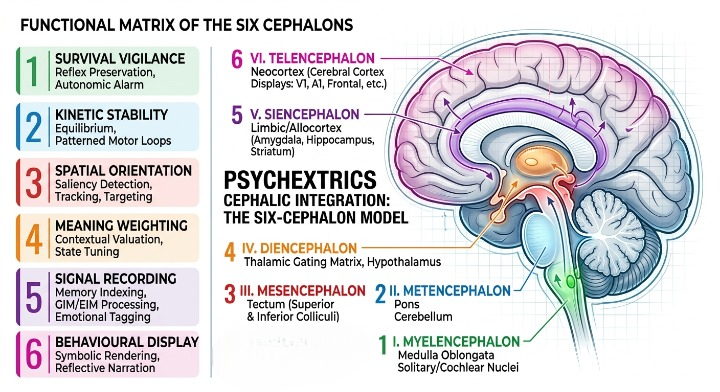
Under psychextrics, every cephalons possesses a dedicated gateway through which its specialised behavioural reality enters the integrated conscious display.
- The Myelencephalon possesses the Cochlear Nucleus–Hippocampal axis.
- The Metencephalon possesses the Vestibular–Hippocampal axis.
- The Mesencephalon possesses the Superior Colliculus–Hippocampal axis.
- The Diencephalon possesses the Thalamic–Hippocampal axis.
- The Signal-Cortex of the Telencephalon possesses the Olfactory Bulb–Hippocampal axis.
But the so-called Signal-Cortex also possessed a distinct gateway: the Entorhinal gateway.
And this became the profound moment of realisation.
Two gateways cannot coherently coexist inside a single cephalon while simultaneously maintaining independent behavioural authority.
A gateway is not decorative anatomy. A gateway defines cephalic sovereignty.
Gateways regulate:
- relay authority,
- signal entry,
- behavioural timing,
- integration hierarchy,
- and specialised participation within consciousness.
The existence of an independent Entorhinal gateway demonstrated that the signal integration system was not merely a cortical subdivision. It was its own cephalic civilisation.
At that moment, the Siencephalon became inevitable.
4. The Birth of the Siencephalon
The emergence of the Siencephalon was not philosophical invention. It was structural necessity.
The Signal-Cortex could no longer remain compressed inside cortical terminology because its operational architecture fundamentally differed from display behaviour itself.
Thus psychextrics separated the traditional Telencephalon into two distinct territories:
- the Siencephalon,
- and the revised Telencephalon.
The Siencephalon
became recognised as:
- the signal integration core,
- the memory-indexing civilisation,
- the behavioural continuity manager,
- the emotional-tagging architecture,
- and the relay-packaging territory.
Its gateway: the Entorhinal–Hippocampal axis.
The Olfactory Bulb–Hippocampal axis belongs to the group of dedicated transitional relay system hosted within the Siencephalon.
These include:
- the Olfactory Bulb Gateway for chemical perception,
- the Cingulate Relay Complex for survival vigilance signalling from the Myelencephalon
- the Basal Ganglia–Striatal Relay System for kinetic stability signalling from the Metencephalon,
- the Parahippocampal Relay System for spatial orientation signalling from the Mesencephalon,
- and the Perirhinal Relay System for contextual valuation signalling from the Diencephalon.
The Siencephalon therefore acts as a cephalic translation house.
The revised Telencephalon
became recognised as:
- the display interface,
- the symbolic rendering surface,
- the conscious reflective screen,
- and the behavioural narration architecture.
It has no gateway.
This correction fundamentally restructured the architecture of consciousness itself.
5. Why the Discovery Was So Important
The discovery of the Siencephalon solved a contradiction that modern Neuroscience had silently inherited for generations.
The cortex was being forced to perform incompatible roles simultaneously:
- display,
- storage,
- integration,
- emotional indexing,
- continuity management,
- and executive command.
Psychextrics separates these functions structurally.
The narrator is no longer mistaken for the architect. Behavioural reality is constructed beneath awareness before becoming consciously rendered upon the display surface of consciousness.
The Siencephalon integrates. The Telencephalon displays. And this single distinction changes the entire interpretation of consciousness.
6. The Psychextric Inversion
The foundational inversion of psychextrics is deceptively simple: the cortex is not the builder of behavioural reality. It is the screen upon which behavioural reality becomes consciously visible to the organism.
Under this inversion:
- the three lower cephalons construct behavioural states,
- the Diencephalon weights meaning,
- the Siencephalon packages continuity,
- and the Telencephalon renders conscious display.
This inversion accomplishes several structural corrections simultaneously.
A. It Restores Division of Labour Within the Brain
Each cephalon returns to its inherited behavioural specialisation.
The brain is no longer interpreted as one executive civilisation ruled from above. Instead:
- survival vigilance belongs to the Myelencephalon,
- kinetic coordination belongs to the Metencephalon,
- orientation belongs to the Mesencephalon,
- contextual weighting belongs to the Diencephalon,
- signal integration belongs to the Siencephalon,
- and conscious display belongs to the Telencephalon.
Behaviour becomes distributed cephalic governance.
B. It Separates Display From Integration
Modern Neuroscience compressed:
- consciousness,
- memory,
- emotional indexing,
- and behavioural continuity into one forebrain territory.
Psychextrics separates:
- the screen,
- from the signal-management system behind the screen.
This resolves the structural contradiction inside the traditional Telencephalon.
C. It Dismantles the Bureaucratic Brain Model
The nineteenth century interpreted the brain through bureaucratic civilisation:
- executives,
- higher centres,
- command systems,
- top-down control.
Psychextrics replaces this with commicratic governance:
Distributed specialised participation through cephalic interdependence.
The brain no longer resembles a monarchy. It resembles commissioned behavioural cooperation.
D. It Introduces a Structural Interpretative Method
Perhaps most importantly, psychextrics fills the long-vacant interpretative gap inside Behavioural science itself.
- Neuroscience mapped anatomy.
- Psychiatry classified dysfunction.
- Psychology interpreted through cohorts.
- Philosophy interpreted through individual worldview.
But none provided a universal structural interpretative method grounded directly in cephalic architecture. Psychextrics attempts precisely this.
Behaviour is interpreted through:
- gateways,
- relay systems,
- timing hierarchies,
- signal integration,
- contextual weighting,
- and distributed cephalic governance.
The observer’s civilisation no longer defines behavioural interpretation. The structure itself does.
Conclusion: The Brain Was Never Unified
The emergence of the Siencephalon ultimately leads to one final declaration:
The brain was never unified.
The illusion of unity emerged because consciousness displays behavioural continuity as one seamless reflective experience. But beneath the display exists a commicratic civilisation of specialised cephalic systems continuously negotiating reality together before consciousness becomes aware of it.
Humanity mistook the screen for the machine. Psychextrics begins where that illusion ends.
Back to: 👇