
The Thalamus Is Not a Passive Relay: The Diencephalic Architecture of Meaning and the Emergence of the Conscious “I”
BY: OMOLAJA MAKINEE
For generations, Neuroscience education has introduced the thalamus as the brain’s principal relay station—a sophisticated switchboard that receives sensory information and forwards it to the cerebral cortex for conscious interpretation.
Although this description captures an important aspect of thalamic anatomy, Psychextrics argues that it captures only a fraction of the thalamus’ behavioural significance.
A relay merely transfers information from one destination to another. The Diencephalic Thalamus performs something far more consequential. It continuously evaluates, filters, prioritises, suppresses, amplifies, and redirects behavioural relevance before conscious narration has an opportunity to describe what has occurred.
The Thalamus is not a passive courier of sensory traffic; it is the behavioural gatekeeper that determines which fragments of reality deserve entrance into conscious experience.
This distinction fundamentally changes how behavioural meaning is understood.
The amygdala may determine whether an event carries the emotional valence of fight, flight, fascinate or freeze. It may immediately assign the behavioural urgency necessary for survival. Yet emotional valence alone does not explain why that event becomes my danger, my opportunity, my responsibility, or my future memory. That transformation belongs to the Diencephalon.
It is the Meaning Weighting Engine that places every behavioural event within a personal, contextual framework, converting biological urgency into the subjective experience of an individual life. Before the cortex can generate language, reflection, or explanation, the Diencephalon has already decided what the event means for the organism standing at the centre of it.
This distinction can be appreciated by returning to the encounter with the aggressive dog discussed previously. The amygdala rapidly assigns an emotional survival valence. In one individual, that valence favours immediate retreat. In another, it favours confrontation, perhaps by instinctively grabbing a nearby stick to create a defensive barrier.
Although the behavioural outcomes differ, the emotional assignment alone does not generate the conscious experience of I am threatened. The Diencephalon performs that additional computation. It contextualises the behavioural event within the organism’s ongoing existence, attaching ownership, continuity, and personal significance to what would otherwise remain an anonymous emotional reflex.
The behavioural action belongs to the amygdalar valuation; the behavioural meaning belongs to the Diencephalic weighting system.
1. The Diencephalon as the Immediate Contextual Authority
Within Psychextrics, the Diencephalon is not a delayed analytical system waiting for behaviour to finish before interpreting it. It possesses direct authority over behavioural context long before reflective consciousness stabilises the display screen of the Telencephalon.
The moment an environmental event enters the behavioural architecture, specialised thalamic nuclei immediately coordinate with both the hippocampal and amygdalar systems to establish contextual ownership. Every behavioural packet is therefore personalised before the cortex begins constructing its narrative explanation.
This personalisation explains one of the most familiar yet least examined features of human consciousness:
Nearly every conscious experience automatically appears from a first-person perspective.
- We do not simply observe danger. We experience my danger.
- We do not merely encounter success. We experience my achievement.
Even ordinary perception carries an invisible grammatical marker of ownership that rarely attracts attention because it operates continuously beneath awareness.
Psychextrics identifies this automatic personalisation as a structural property of the Diencephalon rather than a linguistic invention of the cortex.
The conscious “I” is not created when language forms sentences. Language merely gives words to a behavioural ownership that has already been established by deeper cephalic machinery.
2. The Thalamic Engines of Personalisation
To understand how behavioural ownership emerges before conscious narration, Psychextrics identifies three principal thalamic systems that maintain continuous reciprocal communication with the amygdala-hippocampal axis.
Together these nuclei establish identity, continuity, and intentional direction before reflective awareness begins constructing explanations.
A. The Mediodorsal Nucleus: The Agentic Identity Hub
Among the thalamic nuclei, the Mediodorsal (MD) nucleus occupies a central position within the architecture of behavioural personalisation. Through its extensive reciprocal interactions with the Basolateral Amygdala and the Ventromedial Prefrontal Cortex, it functions as the principal anchor of subjective agency.
Whenever an external event enters behavioural processing, the MD nucleus immediately interrogates the amygdala, not simply to determine whether the event is dangerous or desirable, but to determine what that emotional significance means for the particular organism experiencing it.
Every behavioural event becomes filtered through an egocentric reference frame.
This distinction becomes clear during everyday experience.
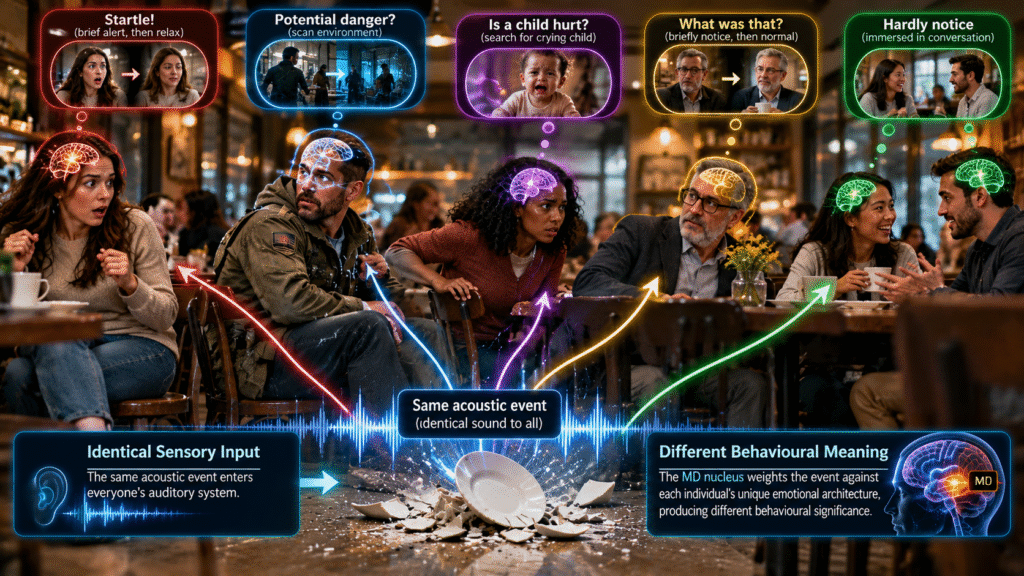
Imagine sitting quietly in a café when someone accidentally drops a ceramic plate across the room. Every individual hears the same acoustic event. Yet each person experiences a different behavioural significance.
- One individual momentarily startles before relaxing.
- Another immediately searches for a crying child.
- Someone with military experience instinctively scans the room for potential danger.
- Another scarcely notices because they remain deeply immersed in conversation.
The sound entering the auditory system remains identical. The personal behavioural meaning differs because the MD nucleus continuously weights incoming events against the individual’s unique emotional architecture. Reality never enters consciousness as neutral physics. It always arrives already stamped with personal significance.
Within Psychextrics, the MD nucleus therefore functions as the behavioural engine that converts impersonal environmental events into personally experienced reality.
B. The Anteromedial and Anterior Thalamic Nuclei: The Chronological Threader
Identity alone cannot sustain the conscious self. Ownership requires continuity. The organism must not only experience events; it must experience itself as the same individual moving through successive moments of time.
This function belongs primarily to the Anteromedial and Anterior Thalamic Nuclei through their extensive reciprocal communication with the hippocampal formation via the Mammillothalamic Tract and the Fornix.
Every behavioural event therefore becomes inserted into an ongoing autobiographical sequence. The organism does not simply perceive today’s experience independently from yesterday’s experience. Instead, each new behavioural packet immediately becomes attached to an already existing historical thread.
This mechanism becomes particularly visible during future planning. Consider leaving your home for work. As you close the front door, you suddenly think, I must remember to lock the back gate this evening.
That apparently simple thought reflects an extraordinary behavioural operation. The moment this future intention forms, the Diencephalon immediately recruits hippocampal indexing systems to embed and tag the planned action into the organism’s autobiographical timeline. The event is not merely imagined. It becomes behaviourally scheduled within the ongoing narrative of personal existence.
The conscious sentence appears effortless, yet beneath it the Diencephalic–Hippocampal architecture has already transformed an abstract intention into a future behavioural reference point.
The organism therefore remembers not merely information but its own relationship to that information.
C. The Nucleus Reuniens: The Reactive Coordinator
The third component of behavioural personalisation emerges through the Midline Nucleus Reuniens.
Acting as a direct structural bridge between the Medial Prefrontal Cortex and the CA1 region of the hippocampus, the Reuniens continuously coordinates present behavioural goals with historical behavioural knowledge.
Where the MD nucleus establishes ownership and the ATN establishes continuity, the Reuniens establishes adaptive direction. Its function becomes most apparent whenever behaviour must rapidly change without reflective deliberation.
Imagine cycling along a familiar road when a parked car suddenly opens its driver’s door directly into your path.
Before conscious language forms a sentence, the Reuniens has already integrated your current trajectory, your stored knowledge of bicycle dynamics, your previous riding experience, and your present spatial position. Almost instantly, your body swerves safely around the obstacle.
Only after the manoeuvre succeeds does conscious narration appear:
“That was close.”
The behavioural modification occurred before the explanation.
The Reuniens therefore represents one of the principal engines through which reactive behavioural template emerges without interrupting the continuous flow of conscious experience.
3. The Intuitive Modification Protocol
Together, these three thalamic systems establish what Psychextrics identifies as the Intuitive Modification Protocol.
When either an internal goal or an unexpected environmental event enters behavioural processing, the Diencephalon immediately distributes its operations across three parallel systems.
- The Mediodorsal nucleus stamps the behavioural event with personal identity.
- The Anterior Thalamic complex binds the event into autobiographical continuity.
- The Nucleus Reuniens modifies behavioural trajectories to align immediate action with ongoing goals.
Only after these operations have completed does the Telencephalic display interface render the experience as conscious-awareness.
Consider once again the familiar example of driving. A child unexpectedly runs into the road. Within fractions of a second, the Reuniens computes its reactive evasive steering adjustments from accumulated driving experience. The MD nucleus assigns overwhelming personal urgency through its interaction with the amygdala. Simultaneously, the ATN prepares the event for incorporation into autobiographical memory.
Only afterwards does the conscious narrator produce the familiar internal statement:
“I almost hit that child.”
The behavioural ownership already existed long before the sentence appeared.
Conclusion: The Diencephalic Origin of the Conscious “I”
This architectural reconstruction leads Psychextrics to one of its central conclusions regarding consciousness.
The conscious “I” is not generated by the reflective language systems of the Telencephalon. Nor is it simply the emotional urgency generated by the amygdala.
Emotional valence determines whether behaviour tends toward confrontation, avoidance, or immobility. The Diencephalon determines what that behavioural event means to the organism occupying the centre of experience.
Through the continuous interaction of the Mediodorsal nucleus, the Anterior Thalamic complex, and the Nucleus Reuniens with the amygdala-hippocampal axis, every behavioural packet is personalised, contextualised, historically anchored, and strategically directed before it ever reaches the behavioural theatre of consciousness.
By the time the Telencephalic display interface renders the event, the behavioural meaning has already been constructed. The cortex merely narrates it.
Within Psychextrics, the Diencephalon therefore earns its designation as the Meaning Weighting Engine because it performs far more than sensory routing.
- It transforms emotional valence into contextual ownership,
- binds present behaviour to personal history,
- aligns immediate action with future intention,
- and ensures that every behavioural event enters consciousness already carrying the unmistakable signature of the organism itself.
The conscious “I” is therefore not a linguistic invention of the cortex. It is the behavioural identity continuously authored by the Diencephalon and only subsequently rendered upon the symbolic screen of conscious-awareness.
Back to: 👇