
The Screen of Consciousness: Reconstructing the Display Cortex in Psychextrics
BY: OMOLAJA MAKINEE
For generations, the cerebral cortex has occupied the highest position within the hierarchy of Neuroscience. It has been described as the ruler of the brain, the birthplace of intelligence, the source of conscious awareness, and the executive centre from which behaviour originates.
From this perspective, thought begins in the cortex, decisions are formulated there, and behaviour flows downward into the body through descending motor commands. The cortex has therefore been regarded as both the architect and governor of human reality.
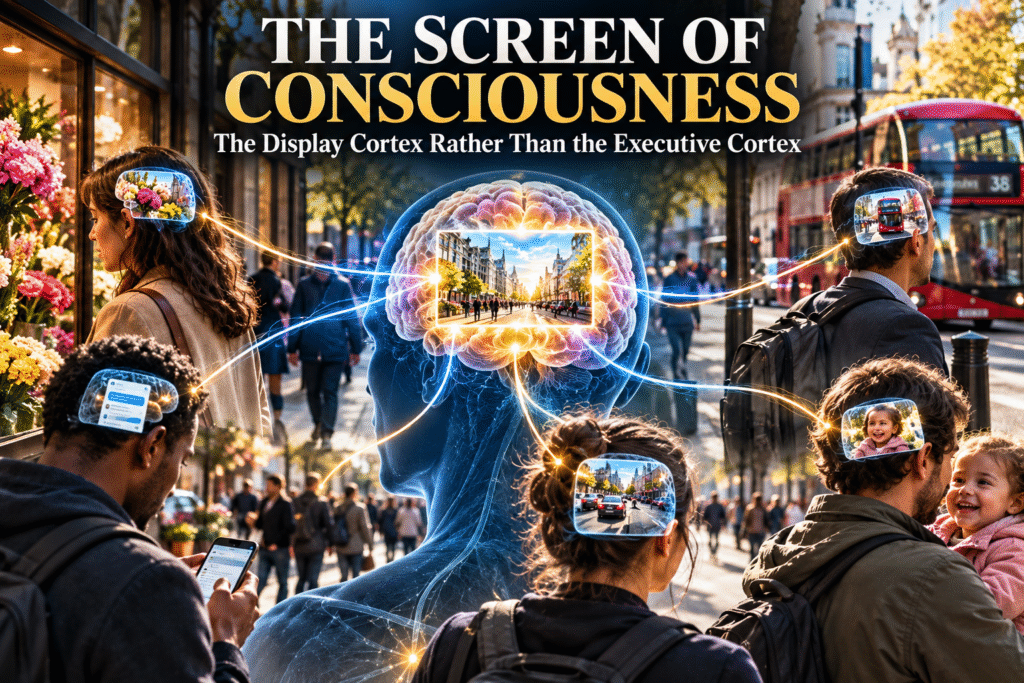
Psychextrics reconstructs this traditional interpretation by relocating the origin of behavioural construction beneath the cortex. Rather than functioning as the creator of conscious reality, the revised Telencephalon serves as the final display interface upon which already-integrated behavioural states become consciously visible.
The cortex remains indispensable, but its function changes fundamentally. It no longer occupies the role of behavioural architect. Instead, it becomes the behavioural screen upon which deeper biological negotiations are rendered into symbolic awareness.
Within this revised framework, the Display Cortex performs four complementary functions.
- It acts as the rendering surface upon which behavioural information becomes perceptually visible,
- the symbolic projector that converts biological activity into recognisable objects and language,
- the narration field where behavioural events become organised into coherent stories,
- and the reflective awareness screen through which the conscious self experiences the finished product of subcortical integration.
Consciousness therefore resembles a cinema in which the audience witnesses a completed performance without observing the machinery that produced it.
1. The Display Cortex Rather Than the Executive Cortex
The distinction between behavioural construction and behavioural display represents one of the most significant conceptual shifts introduced by Psychextrics. Behaviour does not originate at the cortical surface. Before any thought becomes consciously experienced, lower cephalic systems have already
- negotiated survival priorities,
- stabilised posture,
- calculated spatial orientation,
- integrated memory,
- assigned emotional value,
- and organised behavioural continuity.
These operations are performed within the Local Functional Units, the Diencephalon, and the Siencephalon before the cortex ever receives the behavioural package.
The revised Telencephalon therefore occupies the terminal stage of behavioural emergence rather than its point of origin. Its role is representational rather than generative. It transforms compressed behavioural information into the symbolic forms that define conscious life.
Images become visible, sounds become meaningful speech, memories become recognisable experiences, and behavioural states become coherent thoughts.
The cortex is thus better understood as the biological interface between hidden behavioural organisation and subjective awareness.
2. The Emotionally Weighted Screen of Consciousness
A central principle of Psychextrics is that conscious awareness is never emotionally neutral. Every behavioural state displayed upon the cortical screen has already passed through an affective valuation process before reaching awareness. The cortex does not simply illuminate sensory information; it illuminates emotionally weighted information.
This weighting originates within the Siencephalic amygdala-hippocampal axis. Before behavioural signals reach the Display Cortex, the amygdala assigns each incoming package an emotional value determined by either reactive template valence or proactive intensity valence. The hippocampus simultaneously indexes that emotional assignment within the organism’s behavioural-memory architecture, binding present experience to previous biological organisation.
Consequently, nothing reaches conscious awareness as a purely objective perception. Every conscious experience already carries biological significance before it becomes symbolically visible.
The conscious world is therefore not a direct copy of external reality but an emotionally organised behavioural rendering of that reality.
3. Why Reality Must Feel Before It Can Be Experienced
Several clinical observations illustrate the necessity of emotional valuation within conscious experience.
An odour may remain detectable at subcortical levels while failing to become consciously meaningful if its connection to emotional valuation is disrupted. Likewise, individuals experiencing derealisation often report seeing the external world with complete sensory clarity while simultaneously describing it as strangely unreal, artificial, or emotionally empty. Objects retain their visual precision, yet they lose their behavioural significance.
Within the Psychextric model, these experiences demonstrate that conscious perception requires more than sensory transmission. Reality becomes consciously experienced only after behavioural information receives emotional weighting through the amygdala-hippocampal axis.
Without this affective stamp, the cortex continues rendering visual and auditory information, but the resulting display lacks experiential substance. Perception remains mechanically intact while behavioural reality disappears.
Reality, therefore, is not simply perceived. Reality must first be valued.
4. The Autonomy of the Six Cephalons
The emotionally weighted nature of consciousness also reveals an important structural principle within Psychextrics:
Every cephalon maintains its own direct relationship with the amygdala-hippocampal system.
This shared access does not imply identical function. Rather, each cephalon utilises its emotional pathway according to its specialised biological responsibilities.
The Local Functional Units—the Myelencephalon, Metencephalon, and Mesencephalon—draw upon the amygdala-hippocampal axis to obtain immediate survival valuations. Their access supports rapid autonomic deployment, kinetic adjustment, and spatial orientation. These systems extract raw behavioural value in order to execute reflexive action within milliseconds.
The Global System Cores—the Diencephalon, Siencephalon, and revised Telencephalon—employ the same emotional architecture differently. Rather than executing immediate survival responses, they integrate, organise, narrate, and symbolise behavioural information into the ongoing continuity of conscious experience.
The distinction therefore lies not in access to emotional processing but in the biological purpose for which that access is used.
5. The Yin and Yang of the Siencephalon
Within the Siencephalon itself, two complementary structures operate as a unified behavioural engine.
The amygdala provides valuation. The hippocampus provides continuity. Any new data entering this core must consult both structures simultaneously.
Every new behavioural packet entering the Siencephalic core undergoes simultaneous evaluation by both systems. The amygdala determines the biological significance of the signal, assigning a universal valence vector within the quadruple F (Fight, Flight, Freeze, Fascinate), where the targeted cephalon determines whether the amygdala valence it receives activates a reactive template value or proactive intensity value. Immediately thereafter, the hippocampus binds that valuation to the organism’s existing behavioural-memory architecture, creating continuity between present events and previous experience.
Emotion without memory cannot produce stable behavioural organisation. Memory without emotional valuation cannot determine behavioural significance.
Together they generate the integrated behavioural packets that ultimately travel through the Entorhinal Gateway toward conscious display.
6. The Display Cortex as the Architect of Symbolic Grammar
If the Entorhinal Gateway serves as the master relay of behavioural continuity and the Thalamus functions as the narrator of present behavioural reality, then the revised Telencephalon fulfils a third and equally specialised responsibility. It becomes the architect of symbolic grammar.
The Display Cortex does not invent behavioural meaning. Instead, it translates already-integrated biological information into forms that conscious awareness can understand.
Highly compressed, multidimensional behavioural matrices arriving from the Siencephalon cannot be experienced directly. They must first be transformed into the symbolic language appropriate for the organism. The cortex performs this translation automatically.
Visual relationships become recognisable objects. Auditory patterns become spoken language. Emotional configurations become consciously identifiable feelings. Behavioural predictions become coherent thoughts.
The Display Cortex therefore functions as an automated translator that converts biological organisation into symbolic representation without participating in the original construction of that organisation.
7. The Ascending Translation of Behaviour
This symbolic translation begins with ascending behavioural projection.
The Entorhinal Gateway delivers highly integrated behavioural packages already organised through interactions among the Local Functional Units, the Siencephalon, and the Diencephalon. These behavioural packets arrive carrying spatial organisation, emotional valuation, memory indexing, and behavioural continuity.
The Display Cortex receives these packages and immediately renders them according to species-specific symbolic grammar. What previously existed as compressed biological relationships now appears as explicit perception, internal speech, visual imagery, narrative thought, and conscious awareness.
The organism therefore does not experience raw neural computation. It experiences the symbolic interpretation produced by cortical rendering.
8. The Descending Influence of Symbolic Representation
The cortical process does not terminate with conscious display. Once symbolic representations appear upon the behavioural screen, the Display Cortex continuously rebroadcasts its interpretations back toward the amygdala-hippocampal axis.
This descending communication allows symbolic thought itself to modify subcortical behavioural organisation.
A written sentence, remembered conversation, imagined scenario, or anticipated future event may therefore activate survival responses despite the complete absence of an immediate physical threat. Conversely, symbolic reinterpretation can suppress previously activated behavioural responses by altering the emotional weighting assigned within the Siencephalic system.
This bidirectional architecture explains how language, imagination, education, and abstract reasoning exert genuine influence over biological behaviour without becoming the original source of behavioural construction.
The cortex changes behavioural organisation through symbolic translation rather than behavioural creation.
9. The Behavioural Mirror of Conscious Experience
The revised Telencephalon therefore occupies a unique position within the six-cephalon architecture. Unlike the Local Functional Units that execute immediate survival responses, or the Diencephalon and Siencephalon that integrate behavioural organisation beneath awareness, the Display Cortex exists to make those hidden biological negotiations consciously observable.
- It reflects rather than originates.
- It symbolises rather than constructs.
- It narrates rather than executes.
Every image, memory, sentence, feeling, and conscious thought displayed upon its surface represents the visible expression of behavioural processes that have already unfolded beneath awareness.
Conclusion
Psychextrics fundamentally redefines the role of the cerebral cortex by shifting it from the centre of behavioural construction to the endpoint of behavioural representation. The revised Telencephalon is neither the architect of emotion nor the executive source of behaviour. It is the biological screen upon which integrated behavioural reality becomes consciously visible.
Through continuous interaction with the Entorhinal Gateway, the Thalamic narrator, and the amygdala-hippocampal axis, the Display Cortex converts compressed behavioural information into the symbolic grammar of perception, language, memory, and reflective awareness.
Seen from this perspective, consciousness resembles an emotionally weighted behavioural cinema rather than an executive command centre. The cortex does not compose the script of reality, direct the actors, or construct the stage. It renders the completed performance generated by deeper cephalic systems, translating their multidimensional biological negotiations into the coherent narrative world that the conscious self ultimately experiences as reality.
Back to: 👇