
Re-seeing the World: Echoic Sighting and the Architecture of Photographic Memory
BY: OMOLAJA MAKINEE
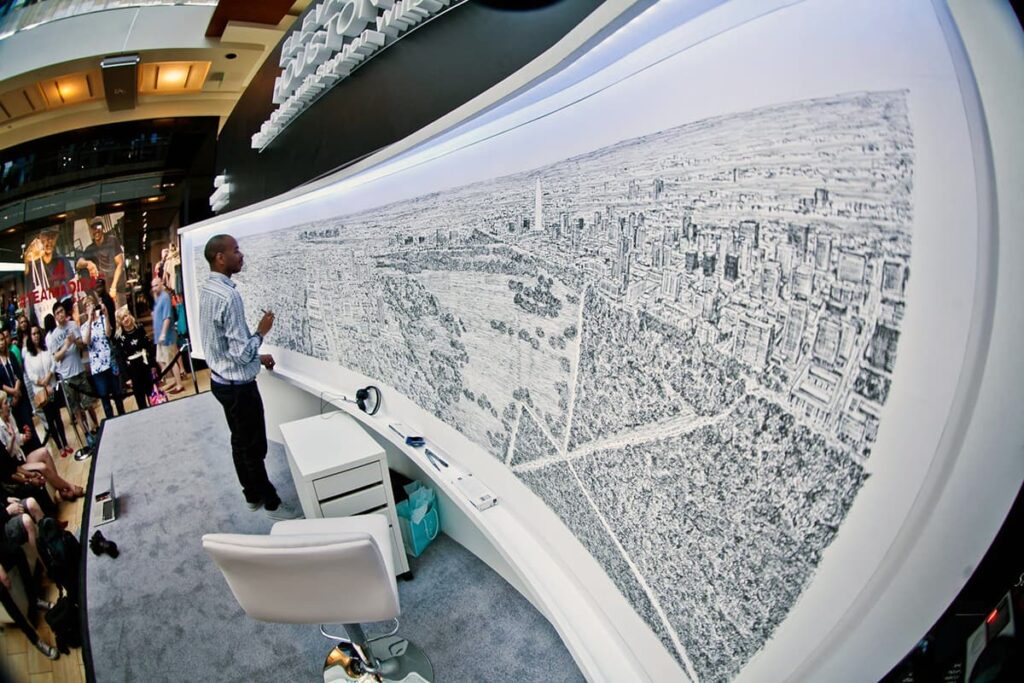
When Echoic Sighting becomes a dominant perceptual orientation, it produces behavioural patterns associated with reflection, insight, and conceptual vision. In rare instances, however, this dominance does not merely produce insight—it produces extraordinary perceptual recall that borders on photographic reconstruction. One of the most compelling real-world illustrations of this phenomenon can be observed in Stephen Wiltshire MBE.
Wiltshire is widely recognised for his ability to observe a complex urban landscape—often from a brief aerial view—and then reproduce it in astonishing detail entirely from memory. Buildings, windows, spatial proportions, and architectural relationships are rendered with such precision that they appear almost identical to the original scene. Within the framework of Psychextrics, this is not a mysterious anomaly, but the result of a rare convergence of high spectral variations across multiple sighting systems, operating in co-morbidity.
1. Echoic Dominance: The Power of Re-seeing
At the core of Wiltshire’s ability is an exceptionally high spectral range in Echoic Sighting. If Echoic Sighting is defined as the act of recall—the re-sighting of stored perceptual experience—then in his case, recall is not abstract or symbolic. It is visually concrete, continuous, and structurally intact.
Where the average individual recalls fragments—general shapes, impressions, or emotionally weighted highlights—Wiltshire appears to recall full visual fields, preserving:
- Spatial relationships,
- Proportional accuracy,
- Structural continuity across large scenes.
This suggests that his Echoic system does not merely retrieve memory; it reconstructs it with minimal loss of Reflective fidelity and minimal Resonant distortion. The internal image remains stable enough to be externally reproduced.
2. Precision Sighting: The Structural Extractor
This level of recall cannot occur through Echoic dominance alone. It requires an equally elevated spectral variation in Precision Sighting.
Precision Sighting governs:
- Fine detail extraction,
- Edge detection,
- Structural clarity,
- Proportional mapping.
In Wiltshire’s case, Precision Sighting operates at an unusually high level during initial perception. This means that when the scene is first encountered, it is encoded not as a general impression, but as a densely detailed structural map.
Every window, line, and alignment is captured with high fidelity. The ocular system—particularly the foveal region responsible for sharp central vision—likely operates with heightened efficiency, allowing micro-detail acquisition at scale.
Thus, what is stored in Echoic memory is not a simplified version of reality, but a rich, high-resolution perceptual dataset.
3. Luminance and Photopic Stability: The Visual Field Enhancer
Another critical component lies in Luminance Sighting, particularly within the photopic (well-lit) visual system.
High spectral variation here allows:
- Enhanced contrast sensitivity,
- Stable illumination mapping,
- Accurate differentiation of light and shadow across complex scenes.
This contributes to the clarity and depth of the encoded image. Architectural environments, which rely heavily on light, shadow, and geometric contrast, are therefore captured with remarkable consistency.
The result is not just detail, but visual coherence across the entire scene—a necessary condition for large-scale reconstruction.
4. Orientation Sighting: The Spatial Architect
Wiltshire’s ability to reproduce entire cityscapes also points to exceptional functioning in Orientation Sighting.
This system governs:
- Spatial positioning,
- Environmental mapping,
- Relative placement of objects within a field.
High spectral variation here enables the brain to construct a stable internal map of large environments, preserving the relationships between structures across distance.
This is why his drawings are not merely detailed—they are accurately proportioned across scale. Buildings align correctly, streets flow logically, and the overall composition mirrors the original spatial layout.
5. Reflective Stability: The Anchor Against Distortion
Equally important is the role of Reflective Sighting. In most individuals, Reflective and Resonant systems interact in ways that gradually reshape memory. Emotional weighting, narrative reconstruction, and symbolic reinterpretation introduce variability into recall.
In Wiltshire’s case, Reflective Sighting appears to maintain high structural authority over Resonant influence. This results in:
- Minimal emotional reinterpretation of visual data,
- Preservation of literal structure over symbolic transformation,
- Stability across repeated recall cycles.
This balance is crucial. Without it, the detailed input captured by Precision and stored by Echoic systems would be gradually altered. Instead, his memory remains anchored to literal truth.
6. Resonant Modulation: Reduced Narrative Interference
While Resonant Sighting is always present, its influence in this configuration appears to be selectively attenuated in relation to visual reconstruction.
This does not imply absence of emotion, but rather a reduced interference of emotional narrative in the encoding and recall of structural data. The memory is not reshaped into story—it remains as image.
This distinction is critical in understanding why context-specific memory, which typically evolves into symbolic narrative, remains in this case visually exact and structurally preserved.
7. Context-Specific Memory at High Resolution
This brings us to the central question: If memory is context-specific, how can it produce photographic-level accuracy?
The answer lies in the density and balance of the encoded context.
In the average brain:
- Contextual binding includes strong emotional weighting,
- Recall prioritises meaning over detail,
- Structural elements are simplified over time.
In Wiltshire’s case:
- Contextual binding remains visually dominant,
- Emotional weighting does not override structural encoding,
- Pattern separation preserves distinct details without blending.
Thus, the hippocampus still binds:
- The “what” (buildings),
- The “where” (spatial layout),
- The “when” (moment of observation),
- The “how” (internal state),
—but the visual component remains primary and undistorted.
The result is a form of context-specific memory where the visual field itself becomes the central organising principle, rather than emotional narrative.
8. The Behavioural Expression of Photographic Recall
When these systems converge—high Echoic retention, high Precision extraction, strong Orientation mapping, stable Reflective control, and moderated Resonant influence—the behavioural outcome is extraordinary.
It manifests as:
- The ability to recall entire scenes after minimal exposure,
- The capacity to reproduce them with architectural accuracy,
- A form of internal “visual replay” that can be externally translated into art.
This is not simply memory. It is perceptual re-experiencing with structural fidelity.
9. What Is Absent in the Average System
By contrast, the average human perceptual system exhibits:
- Greater Resonant influence, leading to narrative reconstruction,
- Lower Precision capture, resulting in simplified encoding,
- Reduced Echoic spectral range, limiting retention capacity,
- Continuous reinterpretation across recall cycles.
This leads to memory that is:
- Emotionally rich,
- Conceptually meaningful,
- But structurally approximate.
Wiltshire’s uniqueness lies not in possessing an entirely different system, but in the extreme calibration of the same system—where certain spectral ranges are amplified while others are constrained.
Conclusion: Seeing Memory, Not Just Remembering It
The case of Stephen Wiltshire reveals a profound truth within Psychextrics: Echoic Sighting, when operating at exceptional spectral capacity and in alignment with other high-functioning sighting nodes, can transform memory into a visual reality that is re-experienced rather than merely recalled.
It demonstrates that the boundary between perception and memory is not fixed. Under certain configurations, memory does not degrade into abstraction—it retains the clarity of sight itself.
In such cases, the individual does not simply remember the world. They see it again.
Back to: 👇