
Re-Imagining Justice: Beyond the Civil–Criminal Divide and the Future of the CPS
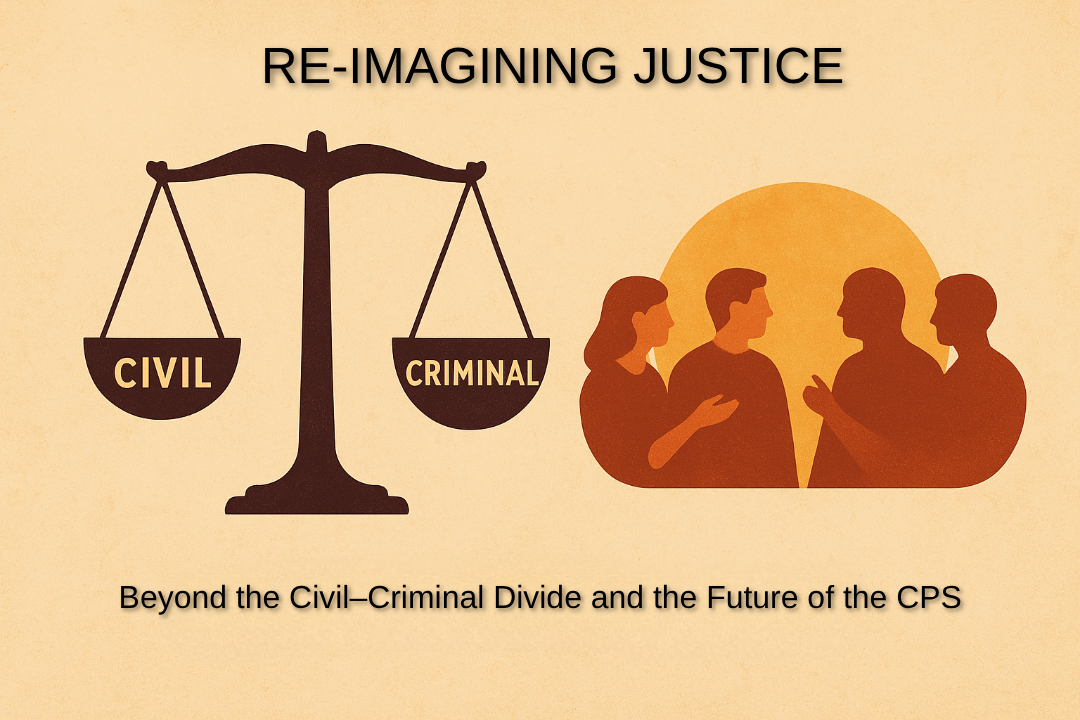
BY: OMOLAJA MAKINEE
Human conduct is never absolute. Every act, whether deemed right or wrong, exists along a continuum of grey—shaped by emotion, perception, and circumstance. Yet, our justice system insists on dividing this complex spectrum into black and white categories: civil or criminal, guilty or innocent, victim or offender. This artificial division has come to define the way we legislate, prosecute, and punish.
But what if justice itself were not divided, but whole? What if law reflected the complexity of human behaviour instead of forcing it into oppositional boxes?
This question forms the foundation of the participatory justice model—an emerging framework that challenges the centuries-old civil-criminal divide and calls for a unified, context-sensitive architecture of justice.
From Division to Participation
In the current system, two binaries dominate legal reasoning:
- State versus Individual (the realm of criminal law), and
- Individual versus Individual (the realm of civil law).
These binaries presuppose a conflict—someone must win, and someone must lose. Justice, therefore, becomes a contest of positions rather than a pursuit of truth or restoration.
Participatory justice dismantles this adversarial structure. It replaces it with a triangulated framework of involvement: the individual harmed, the individual accused, and the community affected.
In this model, law is not merely an arbiter of competing claims—it is a process of collective reasoning. Adjudicators serve as facilitators of resolution, guiding the dialogue between parties rather than enforcing rules from above. Every participant has a voice. Every harm is contextualised. Every outcome is shaped not by legal categorisation, but by the needs of those directly affected.
The Role of Adjudicators in a Participatory System
In traditional courts, adjudicators are custodians of formalism. They guard the boundaries of procedure, ensuring that the adversarial process is followed—even when it obscures the truth it seeks to uncover.
Participatory justice redefines this role. Adjudicators become architects of understanding, not mere referees of contest. They guide the parties through a structured but dialogical process, one that privileges truth-construction over rule-enforcement.
The emphasis shifts from winning to resolving, from punishment to repair. Outcomes may include compensation, rehabilitation, community service, or structured mediation—all determined within a single unified forum rather than divided across jurisdictions.
This approach transforms justice into a living, educative process. It teaches empathy, transparency, and shared responsibility. It encourages society to view wrongdoing not as a matter for retribution, but as an opportunity for learning and reintegration.
Re-Imagining the CPS: From Prosecutor to Public Facilitator
Perhaps the most radical implication of participatory justice lies in how it re-imagines the Crown Prosecution Service (CPS)—an institution that currently embodies the State’s monopoly over punishment.
In today’s system, the CPS operates as a gatekeeper of prosecution, tasked with protecting complainants but not defendants. This role reveals the adversarial DNA of the criminal process: it assumes opposition between the accused and the State, between guilt and innocence.
Under a participatory model, this premise collapses. The CPS, as presently constituted, would either be abolished or fundamentally transformed. Its re-imagined function would no longer be to prosecute in the name of the State, but to facilitate justice in the name of all parties.
Key changes include:
- Consent-Based Engagement: The CPS (or its successor) could only take up a case with the explicit consent of the complainant or harmed party.
- Universal Accessibility: If the service declines a case, individuals retain the right to self-representation or to appoint private counsel through public legal aid.
- Non-Adversarial Conduct: Prosecutors no longer “win” or “lose” cases—they participate in structured harm assessments that prioritise resolution and repair.
- Public Accountability: The CPS can no longer selectively pursue cases for political or institutional reasons. Its mandate becomes transparent and reviewable, with decisions made under public oversight.
These reforms would rebalance power between the citizen and the State. The prosecution’s role would no longer be that of a weapon, but a bridge—a means of restoring trust and achieving fair outcomes without coercion or partisanship.
Toward a Contextual Justice System
At the heart of this transformation lies a simple truth: context matters.
Verdicts of “guilty” or “innocent” reveal responsibility but hide context. The media amplifies this distortion by publicising only the prosecution’s narrative, often reducing complex realities to moral absolutes. The result is public misunderstanding, division, and stigma.
Participatory justice restores shared context as a core principle. Both victim and defendant have the right to present their stories directly—unedited by legal representatives or filtered by State institutions. Public media, in turn, must publish both sides of the context before any narrative can be deemed credible.
This shift is not merely procedural; it is cultural. It challenges citizens to reject one-sided truths and to seek a fuller understanding of human behaviour. Justice thus becomes an instrument of public education—a mirror of societal empathy rather than State propaganda.
The Philosophical Imperative
Re-imagining the CPS and the justice system as a whole requires a philosophical leap. It demands that we abandon the illusion of certainty that “guilty” and “innocent” imply. Human conduct is inherently subjective; intent and perception can never be wholly verified by external observation.
A participatory system acknowledges this complexity. It replaces the finality of verdicts with the openness of dialogue. It transforms justice from a mechanism of judgment into a process of understanding.
This is not leniency—it is maturity. It is a recognition that justice, to be just, must not only punish harm but also explain it, contextualise it, and heal it.
Conclusion: The Future Beyond Division
The participatory model envisions a justice system that is not bifurcated, but integrated—a continuum where harm, context, and accountability coexist without artificial borders.
Re-imagining the CPS within this model represents more than institutional reform; it symbolises a moral awakening. It calls for a society that no longer defines justice by the severity of punishment but by the depth of understanding it cultivates.
When justice becomes participatory, it ceases to be a weapon of division and becomes a forum of restoration.
It stops speaking for the people—and begins speaking with them.
Back to 👇