
Populocracy versus Political Democracy: Why the 21st Century Belongs to the Populous
BY: OMOLAJA MAKINEE
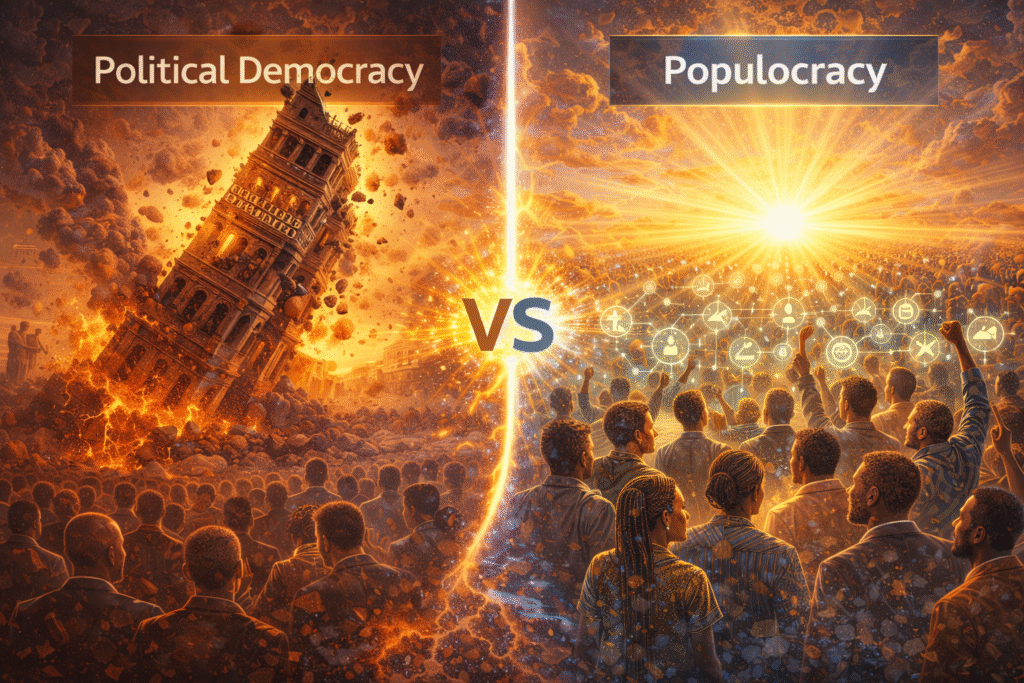
In every era of human civilisation, there arises a moment when inherited institutions exhaust their moral authority. Today, that institution is political democracy—a system once heralded as the pinnacle of freedom, but which now reveals itself as a fragile architecture built on representation without reciprocity, participation without power, and promises without accountability. What stands against it is populocracy, a new socio-cultural force born from the digital age, grounded in collective-individualism, and driven by the rising populous taking control of their own governance.
This is not merely a political dispute. It is a civilisational transition. And in that transition, the question many ask is simple: Is populocracy dangerous? To that, the answer is clear: Yes. Populocracy is dangerous—but not to the people. It is dangerous to the power-class who fear losing their monopoly on State authority.
1. The Collapse of Political Democracy’s Illusion
Democracy claims, in lyrical fashion, to be a “government of the people, by the people, for the people.” But this slogan, repeated for centuries, crumbles under honest examination.
- A government for the people is necessarily authoritarian, for it implies power imposed downward, not shared horizontally.
- Government of the people, in its true form, exists only where citizens make their own laws directly—something modern democracies carefully avoid.
- Government by the people implies a society without institutional hierarchy, relying on cooperative mutualism reminiscent of early human communalism.
None of these three principles are practiced in political democracy today.
In truth, political democracy is merely government for the people—a polite euphemism for rule by representatives who legislate behind closed curtains, insulated from the consequences of their decisions. The elites govern; the people endure. Elections become ritual; accountability becomes theatre. And power remains the private property of the political class.
Thus emerges the central contradiction of political democracy: It promises shareable power but institutionalises unshareable authority.
2. The Digital Revolution and the Birth of Populocracy
The 21st century has irreversibly altered the nature of human society. The rise of web-internetisation—the global connectivity of individuals through digital platforms—has given birth to a profound shift in human governance: the age of populocracy.
For the first time in history:
- The populous can mobilise instantly,
- form communities across national boundaries,
- confront government officials directly,
- challenge policies in real time,
- expose corruption within seconds,
- and unify around shared meaning and collective interests.
Digital networks have globalised individualism, but they have simultaneously created a new cultural identity: collective-individualism—the unity of individuals expressing their personal agency within the moral orbit of the collective good.
Populocracy is the social manifestation of this identity. It is the governance of people into a shared affinity of interests through:
- inclusion,
- compromise between extremes,
- mutual accountability,
- and horizontal decision-making.
This is why political elites worldwide now declare populocracy “dangerous.” They are right. Populocracy is dangerous to them—because it dethrones them.
3. The People Have Found Their Voice
The populocratic uprising is not random; it is the predictable consequence of political democracy’s refusal to evolve. Consider the global movements of the last decade:
- Brexit challenging the supranational power of the EU.
- The populist support for Donald Trump overturning traditional political norms.
- The global wave that lifted Barack Obama, the first African-descended president of America, into office.
- The direct mobilisation of millions online against corruption, injustice, and inequality.
These movements share a common thread: the populous refusing to remain silent.
Catherine Fieschi famously lamented that populocracy is “pulling up the drawbridges and battening down the hatches.” But what she called “pulling up the drawbridges” is simply pulling down the illusions that protected political elites from accountability.
Political democracy is not collapsing because of populocracy; it is collapsing because its contradictions have become too visible to conceal.
4. The Moral Bankruptcy of Professional Politics
Everywhere in the world, the political class responds to populocracy with fear and resistance. Their actions reveal the depth of systemic failure:
- They celebrate diversity but legislate inequality.
- They praise representation but monopolise decision-making.
- They invoke pluralism but silence dissent.
- They promise protection for the vulnerable but exploit them electorally.
- They construct surveillance systems to monitor activists instead of addressing corruption.
- They claim accountability while insulating themselves from its consequences.
The political elites and their media counterparts have become a homogeneous entity, serving themselves rather than the public. The walls of privilege they built over decades are now collapsing under the weight of digital transparency.
And so political democracy, unable to adapt, reveals its final form: a bureaucratic order incompatible with the era of instantaneous mobilisation, open data, global consciousness, and collective-individualist identity.
5. Populocracy as the Natural Governance of the Digital Age
Populocracy is not an ideology. It is the natural governance structure emerging from the technological evolution of society. It is the direct consequence of:
- faster communication,
- borderless networking,
- collective digital consciousness,
- and the universal demand for accountability.
In this new landscape, independent-leadership—where politicians make decisions on behalf of the people—has become obsolete. What is required is interdependent-leadership—where the populous and the institutions of governance operate through shared authority.
This is the foundational principle of ethnopublicanism, where the people become the legislative force of the State, and government becomes the executor of the people’s will, not the custodian of their obedience.
In such a society:
- the populous becomes the government,
- citizenry-electorates become decision-makers,
- govoxiers become policy implementers,
- and the elites become obsolete relics of an outdated political order.
Conclusion: The Populous Will Rise—Because It Must
Political elites have grown far too comfortable with the power that never belonged to them.
An old African proverb reminds us:
“The frown on the goat’s face will not stop it from being taken to the market.”
The political elites may frown at populocracy, denounce it, resist it—but it will not stop the populocratic tide. The truth is simple: Society belongs to the populous. Governance belongs to the populous. The power of the State belongs to the populous. And this generation is the one that will reclaim it.
Authoritarian regimes across the world are collapsing under the weight of populocratic pressure. Political democracy is entering its final chapters. And the populous—empowered by interconnection, consciousness, and collective-individualism—will become the rightful guardian of their own legislative destinies.
The populocratic State, therefore, is not a future possibility but an emerging inevitability.
It is the civilisation in which the people become the power, the populous becomes the government, and society as a collective becomes the architect of its own evolution.
Back to: 👇