
Why the Piriform Cortex Lacks the Descending Feedback Loop of Consciousness: The Structural Divide Between Forward Valuation and Reflective Display
Part II
BY: OMOLAJA MAKINEE
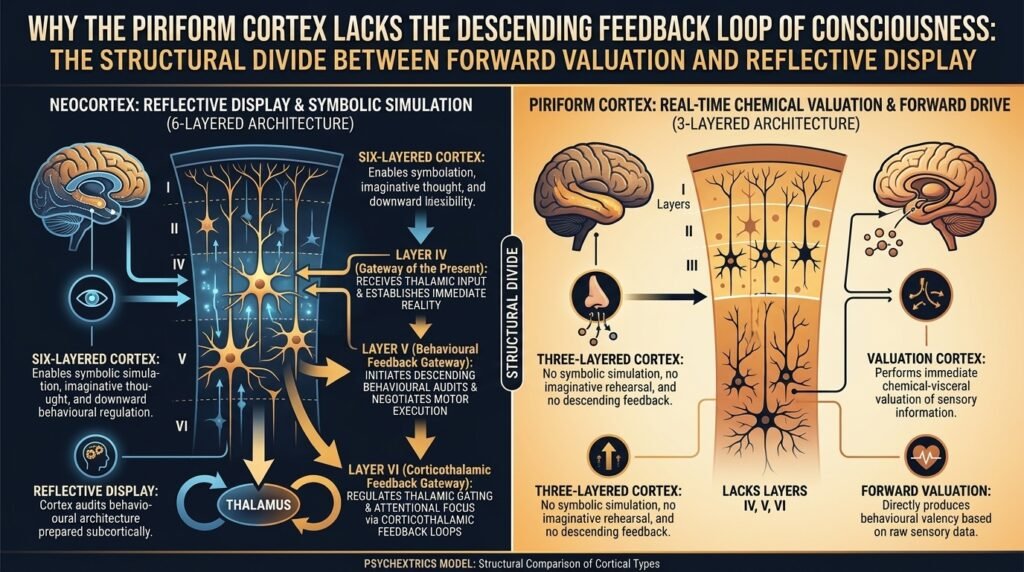
The distinction between the three-layered piriform cortex and the six-layered neocortex extends far beyond anatomical appearance.
Within Psychextrics, this distinction defines two entirely different philosophies of biological processing. The neocortex evolved to sustain reflective consciousness through continuous bidirectional communication with the rest of the behavioural civilisation.
The piriform cortex evolved for rapid behavioural valuation. It receives chemical reality, evaluates its significance, and forwards the resulting behavioural packet into the Siencephalon without entering the prolonged feedback cycles that characterise conscious reflection.
This architectural separation explains why smell possesses such extraordinary emotional immediacy while simultaneously lacking the degree of voluntary attentional control that accompanies vision or hearing.
The explanation does not lie merely in different sensory organs, but in fundamentally different cortical designs.
- The neocortex possesses descending feedback machinery because conscious display requires continuous retrospective calibration.
- The piriform cortex lacks this machinery because behavioural valuation requires uninterrupted forward progression.
1. Consciousness Requires More Than Sensory Recognition
One of the central structural axioms of Psychextrics is that consciousness cannot emerge from sensory recognition alone.
Recognition simply identifies a behavioural event. Consciousness, however, requires an additional architectural loop whereby the display interface continuously evaluates, modifies, suppresses, rehearses, and recalibrates its own behavioural projections.
This requirement fundamentally separates the revised Telencephalon from the piriform cortex.
The revised Telencephalon possesses an elaborate six-layered organisation that supports ascending sensory projection, symbolic integration, behavioural simulation, descending motor feedback, and retrospective calibration.
Every behavioural frame displayed upon the cortical screen immediately enters an audit cycle through Layers V and VI, allowing the behavioural civilisation to compare expectation with execution and refine future behaviour.
The piriform cortex performs none of these operations. Its responsibility concludes once behavioural significance has been successfully extracted from incoming olfactory information and forwarded into the emotional and behavioural memory systems of the Siencephalon.
Evolution therefore had no biological requirement to construct additional descending machinery. Its architecture is complete precisely because its task is complete.
2. The Absence of Layer V: Why the Piriform Cortex Cannot Drive Behaviour
The first major structural distinction concerns the complete absence of a cortical Layer V.
Within the revised Telencephalon, Layer V houses massive pyramidal neurons capable of generating long-range corticofugal projections into the basal ganglia, hypothalamus, brainstem, and spinal cord. These descending pathways allow the conscious display to submit completed behavioural simulations back into the lower cephalons for behavioural evaluation.
Layer V is therefore not simply an output layer. It functions as the behavioural gateway through which rendered symbolic experience re-enters the biological civilisation.
The piriform cortex possesses no equivalent structure. Its deepest neurons remain confined largely within neighbouring siencephalic circuitry. Their outputs terminate primarily within the amygdala, Entorhinal, experiential memory retention systems within related medial temporal structures rather than descending into the behavioural execution systems of the lower cephalons.
Consequently, the piriform cortex cannot directly issue behavioural commands.
- It evaluates.
- It forwards.
- It broadcasts.
It does not drive.
This distinction preserves the evolutionary priority of rapid olfactory valuation without burdening the system with unnecessary behavioural supervision.
3. The Absence of Layer VI: Why Olfaction Requires No Thalamic Feedback Gate
The second defining difference concerns Layer VI.
Within the revised Telencephalon, Layer VI maintains enormous corticothalamic projections that continuously regulate the activity of the thalamus and the Thalamic Reticular Nucleus (TRN). These feedback pathways alter attentional gain, sensory selection, frame synchronisation, and future behavioural prioritisation.
Every displayed frame immediately begins influencing the way future frames will be rendered. This creates the continuous retrospective calibration that characterises conscious awareness.
The piriform cortex lacks any equivalent mechanism. Because olfactory processing bypasses the thalamic relay entirely, there is no requirement for corticothalamic regulation. No Layer VI exists because no thalamic gateway requires modulation.
The absence of Layer VI therefore reflects architectural necessity rather than evolutionary deficiency. The piriform cortex cannot adjust thalamic aperture because its behavioural stream never enters the thalamus during initial processing.
Instead, olfactory information travels directly toward the emotional and behavioural integration centres of the Siencephalon.
4. Forward Processing Rather Than Reflective Processing
The overall architecture of the piriform cortex therefore remains fundamentally unidirectional.
- Information enters Layer 1.
- Pattern coincidence emerges within Layer 2.
- Completed behavioural identity leaves through Layer 3.
The behavioural packet then travels toward the amygdala and Entorhinal gateway for emotional weighting, behavioural indexing and memory retention.
Unlike the revised Telencephalon, no descending verification loop interrupts this progression.
- No symbolic rehearsal modifies the signal.
- No reflective narrator pauses its advance.
- No behavioural simulation evaluates alternative possibilities.
The system simply continues forward.
This uninterrupted architecture makes perfect evolutionary sense.
Chemical signals frequently represent immediate biological opportunities or dangers.
The smell of smoke, spoiled food, blood, decomposition, fire, predators, or fertile vegetation all demand rapid behavioural valuation.
Reflection would introduce unnecessary delay. Forward valuation preserves survival.
5. Why Conscious Smell Still Feels So Powerful
Despite lacking descending feedback architecture, smell frequently produces some of the most emotionally vivid conscious experiences known to humans.
Psychextrics explains this apparent paradox by distinguishing between behavioural intensity and behavioural reflection.
The piriform cortex does not create conscious reflection. Instead, it supplies exceptionally well-indexed behavioural packets directly into the amygdala-hippocampal axis.
Because these packets already possess powerful emotional weighting before reaching the revised Telencephalon, their eventual appearance upon the Display Cortex carries extraordinary autobiographical force.
- A single fragrance may immediately evoke childhood.
- An old perfume may resurrect an entire relationship.
- Fresh rain on dry soil may recreate forgotten seasons of life.
These experiences appear instantaneous because behavioural indexing preceded conscious narration.
Reflection follows valuation rather than producing it.
6. Lived Experience: The Aroma of Fresh Bread
Imagine walking through a quiet street early in the morning.
Without consciously searching for anything, the aroma of freshly baked bread drifts from a nearby bakery. Long before you deliberately identify the smell, your behavioural state begins changing.
- Your pace slows.
- Your breathing subtly deepens.
- Warm emotional familiarity quietly emerges.
Perhaps memories of family breakfasts, childhood kitchens, or weekend mornings begin surfacing almost effortlessly. Only afterwards do you consciously think, “Someone is baking fresh bread.”
Within Psychextrics, this sequence illustrates the forward architecture of the piriform cortex.
- The olfactory signal entered Layer 1 directly from the olfactory bulb.
- Layer 2 rapidly unified the chemical profile into a coherent odour identity.
- Layer 3 completed the behavioural pattern and broadcast it immediately into the amygdala and Entorhinal gateway.
Only after emotional valuation and behavioural indexing had already begun did the revised Telencephalon render the experience into conscious symbolic awareness.
The conscious narration therefore arrived last, even though it felt immediate.
Conclusion: The Behavioural Economy of the Piriform Cortex
The absence of Layers IV, V, and VI allows the piriform cortex to devote its entire computational architecture to behavioural valuation.
- No resources are consumed maintaining extensive corticothalamic loops.
- No descending behavioural audits occur.
- No symbolic simulations occupy processing bandwidth, but rather a real-time chemical valuation.
Its evolutionary economy is remarkable. Everything within the structure exists for one purpose:
Converting volatile chemical information into biologically meaningful behavioural significance with maximum efficiency.
The revised Telencephalon performs the opposite task.
It sacrifices processing speed in exchange for symbolic flexibility, reflective awareness, behavioural simulation, attentional control, and continuous retrospective calibration.
Together these two cortical systems illustrate one of the central architectural principles of Psychextrics.
The piriform cortex prepares behavioural reality. The revised Telencephalon displays behavioural reality.
One moves behaviour forward. The other continuously reflects upon what has already been prepared.
Part III will integrate these two cortical architectures through a unified lived-experience comparison, demonstrating how the six-layered neocortex and the three-layered piriform cortex cooperate during ordinary conscious experience while preserving their fundamentally different roles within the behavioural civilisation.
Back to: 👇