
Phineas Gage and the Birth of the “Executive Brain”: How Behavioural Science Mistook the Display for the Author
BY: OMOLAJA MAKINEE
Modern Behavioural science inherited one of its deepest assumptions from a single catastrophic accident.
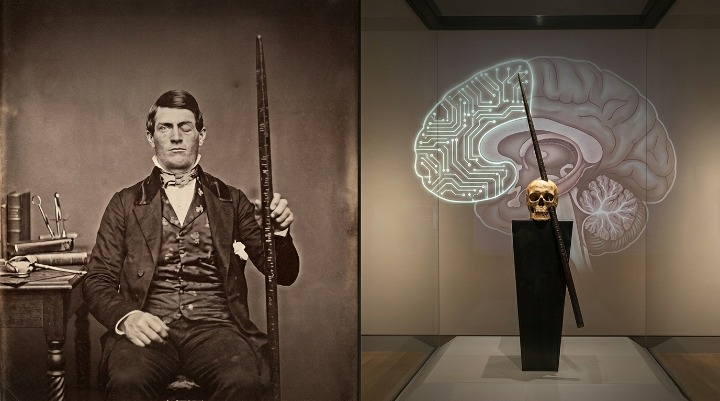
On September 13, 1848, near Cavendish, Vermont, a railroad foreman named Phineas Gage was preparing a rock for blasting. As he tamped explosive powder with an iron rod, a spark ignited the charge. The rod — over three feet long — blasted upward through his left cheek, passed behind his eye, pierced his skull, and exited through the top of his head.
By all expectations, he should have died instantly. But Gage survived.
He briefly lost consciousness, regained awareness, spoke coherently, and was physically mobile shortly after the accident. The event rapidly became one of the most famous neurological cases in medical history because something extraordinary happened afterward: although Gage survived physically, his behaviour changed dramatically.
Friends and colleagues reported that he was “no longer Gage.”
The once responsible, disciplined, socially composed foreman allegedly became impulsive, profane, emotionally unstable, erratic, and incapable of maintaining the behavioural consistency that had once defined him. This single event would become one of the foundational moments in modern Neuroscience and Psychology.
But beneath the anatomy, something far larger quietly occurred. Behavioural alteration became philosophically interpreted as proof of executive consciousness.
1. The Moment Behaviour Was Mistaken for Authorship
The importance of the Gage case did not merely lie in the injury itself. Its significance came from how Behavioural science interpreted the injury.
The frontal lobe damage visibly altered behaviour. Therefore, the frontal lobe was gradually interpreted as the origin of behaviour itself.
This distinction is crucial.
What began as an anatomical observation slowly transformed into a philosophical doctrine. Over time, scientists, psychologists, and philosophers increasingly concluded that the cortex — especially the prefrontal cortex — functioned as:
- the commander of behaviour,
- the seat of personality,
- the origin of conscious choice,
- and the executive ruler of the human organism.
The logic appeared straightforward:
- Damage the frontal cortex,
- behaviour changes,
- therefore the frontal cortex must be the executive self.
But this conclusion contains a hidden assumption. It assumes that the visible display of behaviour is identical to the source of behavioural construction.
That assumption would eventually shape nearly all modern interpretations of consciousness.
2. How the Cortex Became a “Ruler”
The language surrounding the cortex gradually evolved into political language.
By the twentieth century, neuroscientists increasingly described the prefrontal cortex using terms associated with hierarchy, governance, and command. American neuroscientist Karl Pribram coined the term “executive function” to describe the organisational role of the frontal cortex in behaviour. Cognitive models proposed a “central executive” coordinating thought, planning, inhibition, and decision-making.
Psychologist Donald Broadbent distinguished between automatic mental systems and conscious executive control. Cognitive psychologist Alan Baddeley expanded this through the working memory model, introducing the idea of a central executive coordinating cognition. Neurobiologist Patricia Goldman-Rakic later provided influential evidence linking working memory functions to prefrontal cortical networks.
Over time, the philosophical implication became deeply embedded into Behavioural science:
the cortex was no longer merely part of the brain. It became the ruler of the brain.
The cortex became interpreted as:
- the chief executive officer,
- the centre of the self,
- the author of identity,
- and the conscious governor of human existence.
But there was a problem.
The interpretation exceeded the anatomy.
3. The Hidden Compression Error in Modern Neuroscience
The cortex was simultaneously treated as:
- the screen of consciousness,
- the storage system of memory,
- the regulator of emotion,
- the narrator of thought,
- and the executive producer of behaviour.
The same territory became expected to:
- experience reality,
- store reality,
- interpret reality,
- and govern reality.
This produced what psychextrics identifies as a foundational compression error in Behavioural science.
The display system and the signal-generation system became merged into one anatomical civilisation.
Under conventional Neuroscience, the forebrain became treated as a singular kingdom ruled by conscious executive authority. But psychextrics challenges this assumption at its structural foundation.
4. Psychextrics and the Collapse of the Executive Illusion
Under psychextrics, the cortex is not the executive ruler of behaviour. It is the behavioural display interface.
This distinction changes everything.
The deeper cephalic systems:
- assign emotional weighting,
- process contextual urgency,
- index memory,
- integrate hormonal states,
- negotiate survival priorities,
- and construct behavioural significance before conscious cortical awareness emerges.
The cortex does not author these processes. It renders them visible.
In this model, behavioural alteration after cortical injury does not prove that the cortex creates behaviour. It only proves that disrupting the display architecture alters the final visible rendering of behavioural output.
A damaged screen distorts what appears upon it. But distortion of the image does not prove the screen created the signal.
This reinterpretation radically changes how the Gage case is understood under psychextrics.
5. Phineas Gage Revisited Through Psychextrics
Under psychextrics, Phineas Gage did not lose an “executive self.”
Rather, the continuity between deeper cephalic signal systems and behavioural display systems became destabilised.
The injury disrupted cortical territories biowired to render specific behavioural integrations. Signals arriving from deeper cephalic structures were no longer being displayed through properly aligned cortical architectures.
The behavioural instability that followed was therefore not evidence of a destroyed commander. It was evidence of disrupted signal-display continuity.
This distinction may appear subtle, but it fundamentally alters the architecture of consciousness itself.
The modern brain model assumes:
- consciousness commands behaviour.
Psychextrics proposes instead:
- consciousness displays behavioural negotiations already occurring across distributed cephalic systems.
In other words: the cortex is not the ruler of the organism. It is the visible surface of cephalic negotiations occurring beneath awareness.
6. The Philosophical Inheritance That Reshaped Neuroscience
The true influence of the Gage case was therefore not neurological alone. It was philosophical.
Behavioural science inherited a civilisation model of the brain:
- a ruler,
- subordinate systems,
- conscious command,
- executive override,
- and hierarchical control.
This model entered Neuroscience not directly through anatomy, but through language.
Words such as:
- executive,
- controller,
- higher function,
- self-governance,
- conscious regulation,
- and central command,
quietly transformed the cortex into a mythical authority structure.
Philosophy entered Neuroscience through metaphor. And over time, the metaphor hardened into assumed biological reality.
The tragedy is not that Behavioural science lacked anatomical evidence. Neuroscience gathered extraordinary structural observations. The problem was interpretive.
Visible behavioural disruption became mistaken for behavioural authorship. The mirror was mistaken for the origin of the reflection.
Conclusion: Why the Phineas Gage Case Still Matters Today
The story of Phineas Gage remains one of the most important moments in the history of Behavioural science because it represents the exact point where behavioural anatomy crossed into philosophical interpretation.
The accident itself was neurological. But the conclusions drawn from it became metaphysical.
Modern Neuroscience inherited the belief that the cortex governs behaviour because behavioural collapse visibly followed cortical damage. Yet psychextrics argues that visibility is not authorship.
The eyes display light without creating the sun. A speaker produces sound without composing the music. A screen renders images without generating the signal.
Likewise, the cortex may display behavioural consciousness without originating the cephalic negotiations that produce it.
This single distinction may represent one of the largest unresolved questions in the history of Behavioural science under psychological methods of scientific interpretation:
Did Neuroscience discover the executive brain — or merely mistake the display surface for the executive itself?
Back to: 👇