
Neuralink, the Universal Cortex, and the Collapse of the Executive Brain
BY: OMOLAJA MAKINEE
One of the most important revelations emerging from modern brain-computer interfaces is not technological. It is architectural.
For over a century, Behavioural science treated the cortex as:
- the sovereign ruler of behaviour,
- the origin of consciousness,
- the source of identity,
- and the executive commander of the organism.
The cerebral cortex became mythologised as:
- the thinker,
- the decision-maker,
- and the author of human reality.
But technologies such as Neuralink quietly expose a contradiction embedded within this assumption.
If the cortex were truly a mysterious, sovereign generator of unique conscious reality, external machines should struggle to interpret cortical activity consistently across different human beings. Every brain should project fundamentally private and structurally inaccessible signals.
Yet the opposite occurs.
Brain-computer interfaces repeatedly succeed in decoding:
- letters,
- cursor movements,
- motor intentions,
- and symbolic projections
across entirely different individuals performing the same tasks.
This success reveals something profound:
The cortical rendering grid is universally biowired across the human species.
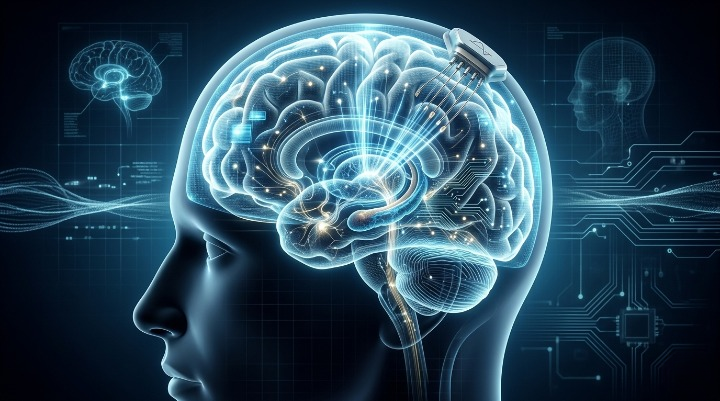
Under psychextrics, this becomes one of the strongest pieces of structural evidence that the Telencephalon is not the originator of behaviour, but the behavioural display interface.
The cortex functions less like a sovereign ruler, and more like a universal projection screen.
1. The Universal Cortical Grid
The biowired neuron patterns of the Telencephalon follow a shared structural architecture inherited across the human species.
Although:
- memories differ,
- experiences differ,
- hormonal states differ,
- emotional histories differ,
- and environmental exposure differs,
the underlying cortical rendering grammar remains remarkably universal.
Human beings possess common:
- motor display templates,
- linguistic rendering pathways,
- visual projection systems,
- symbolic display grids,
- and behavioural rendering structures.
This universality explains why technologies such as Neuralink can decode neural activity and convert it into:
- identical letters,
- matching cursor trajectories,
- and shared symbolic outputs
across multiple individuals.
The machine succeeds because it is interfacing with a standardised human rendering interface.
The external device is not reading:
- a soul,
- an invisible conscious essence,
- or an abstract executive self.
It is reading the activity of a biologically universal display surface.
2. Why Neuralink Works
To understand why Neuralink functions at all, the cortex must first be separated from the deeper behavioural architecture generating the signals projected upon it.
Under traditional Neuroscience, Neuralink appears miraculous because the cortex is treated as the source of thought itself.
Under psychextrics, the explanation becomes structurally straightforward. The lower cephalic systems continuously:
- integrate behavioural saliency,
- process sensory streams,
- stabilise movement,
- weight emotional value,
- index familiarity,
- and assemble behavioural signals
through:
- the Myelencephalon,
- Metencephalon,
- Mesencephalon,
- Diencephalon,
- and Siencephalon.
Once these behavioural packages are assembled, they are projected upward onto the:
- Telencephalic display-cortex.
The cortex therefore acts as the visible projection surface, the symbolic rendering interface, and the conscious mirror through which behavioural reality becomes displayable.
Neuralink does not need to decode the totality of human consciousness. It only needs to decode the projection grammar of the cortical display. Because the rendering architecture itself is universal and specie-specific.
3. The Separation of the Word from the Weight
This distinction becomes critically important when examining human language.
Imagine two individuals both expressing the exact same word: “Sad.”
At the level of the cortex, the symbolic rendering of the word remains structurally recognisable across both brains. The linguistic display template for “Sad” activates through a shared cortical grammar that external systems could theoretically decode similarly.
But the behavioural emotional weight beneath that word may differ enormously.
One individual may be experiencing:
- mild disappointment.
The other may be experiencing:
- catastrophic grief,
- hormonal collapse,
- autonomic distress,
- and profound emotional agony.
The cortex does not generate this emotional density.
The crushing behavioural weight belongs to:
- lower cephalic systems,
- hormonal states,
- Diencephalic saliency weighting,
- and Siencephalic integration loops.
The display-cortex merely mirrors the symbolic surface of the behavioural state upward into conscious readability.
The mirror does not create the emotion. It reflects the already-integrated behavioural package.
4. The Pianist Problem
This architecture becomes even clearer when observing highly synchronised human behaviour.
Imagine two elite classical pianists performing the same concerto in perfect synchrony.
At the level of the cortical display:
- the same motor templates activate,
- the same symbolic musical structure appears,
- and similar neural rendering patterns emerge across both brains.
From the perspective of an external decoding system, much of the cortical activity becomes structurally recognisable and reproducible. Yet subtle behavioural differences still emerge continuously.
One pianist may exhibit:
- smoother kinetic fluidity,
- altered grip tension,
- slightly different posture regulation,
- or microscopic timing variations.
These differences do not originate on the cortical screen itself. They originate within:
- Metencephalic kinetic stability systems,
- Mesencephalic orientation loops,
- Diencephalic energetic weighting,
- autonomic hormonal fluctuations,
- and Siencephalic behavioural integration.
The cortical display remains structurally universal while the lower cephalic engines hum at slightly different biological frequencies.
This explains how universal mechanical consistency and individual behavioural diversity
can coexist simultaneously.
5. The Great Neuroimaging Error
This is precisely where modern Neuroscience repeatedly misinterprets cortical activation.
When neuroimaging systems observe specific cortical regions illuminating during behaviour, the dominant assumption becomes: “The cortex is generating the behaviour.”
Psychextrics reverses this interpretation completely.
When the cortex lights up, what is being observed is the reflective illumination of behavioural traffic already assembled beneath awareness.
The activation is evidence that:
- a behavioural signal is being displayed.
It is not evidence that:
- the cortex originated the behavioural event itself.
The illumination belongs to the mirror. Not the engine generating the reflection.
6. Neuralink and the Death of Cortical Supremacy
Ironically, technologies like Neuralink may ultimately help dismantle the very cortical mythology inherited by Behavioural science.
Because the success of brain-computer interfaces quietly reveals:
- the cortex behaves like a readable projection interface,
- symbolic outputs follow universal rendering rules,
- and conscious display possesses standardised biological architecture.
This is exactly what psychextrics predicts.
The Telencephalon is not a mystical executive throne. It is a biologically universal rendering monitor.
The deeper cephalic systems generate, stabilise, prioritise, integrate, and package behavioural reality beneath awareness first. The cortex then mirrors the final behavioural package upward into:
- symbolic awareness,
- conscious narration,
- sensory projection,
- and behavioural display.
Conclusion: The Psychextric Inversion
The introduction of the Siencephalon fundamentally changes how technologies such as Neuralink are interpreted.
Traditional Neuroscience sees cortical decoding. Psychextrics sees projection-interface reading.
Traditional psychology sees thought extraction. Psychextrics sees display-surface interpretation.
The cortex is not the sovereign author of human behaviour. It is the universal biological screen
through which deeper cephalic architectures render behavioural reality consciously visible.
Neuralink succeeds because human beings share a common cortical display grammar. But the behavioural civilisation generating the signals projected onto that screen remains layered beneath awareness:
- hormonal,
- cephalic,
- contextual,
- state-dependent,
- and vertically integrated.
The screen is universal. The subcortical behavioural orchestra beneath it is where individuality truly lives.
Back to: 👇