
Neuralink and the Psychextrical Proof of the Brain: Why Elon Musk’s Brain–Computer Interface Confirms Reflective Listening as the Core of Human Cognition
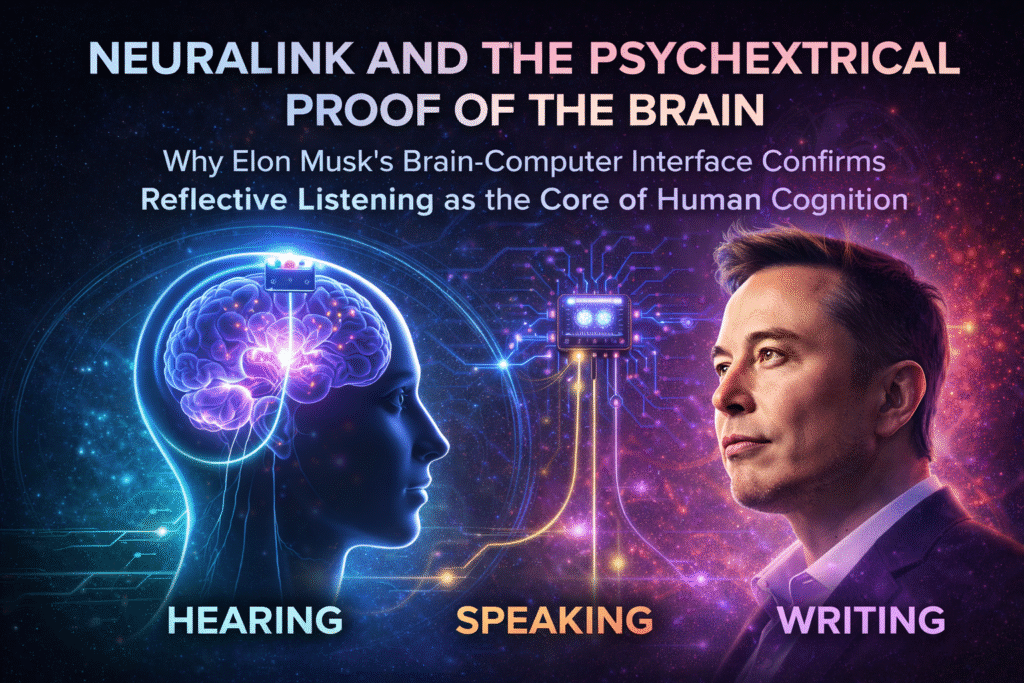
BY: OMOLAJA MAKINEE
Few technological developments in modern neuroscience have generated as much fascination—and misunderstanding—as Neuralink. Framed popularly as a step toward telepathy, super-intelligence, or human–AI fusion, the Neuralink brain–computer interface is often discussed in speculative terms that obscure its true significance.
Yet when examined through the lens of Psychextrics, Neuralink reveals something far more fundamental and far less sensational: it provides direct, observable confirmation of how the human brain already works.
Neuralink does not augment intelligence. It does not generate thoughts. It does not create meaning. What it does—quietly, precisely, and decisively—is express what already exists within the diencephalic meaning-making engine of the brain. In doing so, Neuralink stands as one of the most powerful validations of psychextrical methods and, in particular, the theory of Reflective Listening as a diencephalon-driven process rendered through cortical display.
1. Reflective Listening in Psychextrics: Where Meaning Is Born
Psychextrics defines Reflective Listening not as a behavioural skill or a conversational technique, but as a continuous subconscious process by which incoming signals—especially speech and sound—are received, evaluated, resonated with, and integrated into meaning within the thalamic–diencephalic network. This process occurs subconsciously prior to consciousness. The cortex does not decide meaning; it displays meaning.
At the GIM (Genetic Index Marker) level, Reflective listening operates as a spectrum of inherited decoding architectures. These architectures determine how sound, language, tone, intention, and abstraction are internally processed. The cortex merely projects the final interpretive bundle into conscious awareness—much like a screen rendering data processed elsewhere.
This distinction is critical, because Neuralink exploits it.
2. Neuralink Is Not Intelligence — It Is Expression
One of the most persistent misconceptions about Neuralink is that it “reads thoughts” or grants enhanced cognition. In reality, Neuralink performs a function that the human body has always performed naturally: output.
Speech is an output. Writing is an output. Gestures, eye movement, posture, facial expression, and motor control are all outputs. Each of these outputs originates not in the muscles or organs themselves, but in diencephalic meaning translated through cortical motor and expressive regions. When those cortical regions are damaged—through injury, paralysis, or neurodegenerative disease—the meaning remains intact, but its expression fails.
Neuralink simply intercepts the outgoing neural signals at the cortical level and reroutes them into a technological channel. The chip does not think on behalf of the individual; it listens to what the individual has already thought and converts that into action within an external system. In psychextrical terms, Neuralink is not a cognitive device. It is a cortical proxy.
What follows from that confirmation, however, is where Psychextrics diverges decisively from all current neurotechnologies. Neuralink remains a corticol instrument: it listens to the outputs of meaning, not to meaning itself. It captures intention only at the point where the brain has already committed to expression. Psychextrics, by contrast, does not begin at the cortex at all.
The Psychextrics Brain Decoding Scanner is premised on a more radical proposition: that intelligence is not best understood by observing what the cortex displays, but by decoding how the diencephalic meaning-making engine constructs intent long before action, speech, or behaviour emerges. Where Neuralink translates motor-bound neural signals into external commands, Psychextrics seeks to extricate behaviour from the hidden subconscious corridor of the self—the thalamic–diencephalic network where valuation, resonance, conflict, inhibition, and desire are negotiated in silence.
This distinction is fundamental. Cortical display tells us what a person expressed. Diencephalic decoding tells us why, how, and what is likely to follow.
Within Psychextrics, Reflective listening is not merely receptive; it is diagnostic. Each individual carries a unique GIM–EIM configuration that governs how stimuli are filtered, harmonised, resisted, or amplified within the diencephalon. By mapping these reflective listening pathways directly—rather than inferring them from behaviour—the psychextrical scanner accesses intelligence at its formative stage: where intent is still fluid, where conflict has not yet crystallised into action, and where future behavioural trajectories are already statistically implied.
In this sense, Psychextrics does not “read thoughts” in the science-fiction sense, nor does it predict behaviour through surface correlation. Instead, it decodes meaning-in-formation. It analyses how incoming stimuli are being resolved across thalamic nuclei, how hormonal resonance (HIM–HFI) aligns or clashes with genetic meaning templates (GIM–EIM), and how equilibrium or distortion is emerging within the moral and deliberative architecture of the individual.
This is why Psychextrics represents the future of intelligence: it relocates intelligence from performance to process, from output to orientation, from behaviour to becoming.
Where Neuralink can restore expression, Psychextrics can anticipate deviation. Where Neuralink proves that meaning exists prior to cortex, Psychextrics makes that meaning legible. It enables assessment, diagnosis, and prognosis not by judging actions after the fact, but by reading the silent negotiations that precede them—negotiations that determine whether thought will mature into understanding, collapse into impulse, or stagnate into inertia.
In short, Neuralink confirms where intelligence resides. Psychextrics defines how it operates, when it destabilises, and where it is heading.
3. The Cortical Outsourcing Principle
One of Psychextrics’ central claims is that the cortex is not the executive brain. It is a display and execution interface—a biological output terminal for decisions and meanings generated elsewhere. Neuralink confirms this distinction with striking clarity.
In individuals who cannot speak, move, or type due to cortical or motor impairment, Neuralink allows communication to resume—not by repairing intelligence, but by bypassing damaged expression pathways. The chip receives the same neural signals that would normally travel to speech muscles, hands, or eyes, and instead directs them to a cursor, keyboard, or digital interface.
This demonstrates a crucial psychextrical insight:
The reflective and deliberative capacity of the individual was never lost. Only its cortical expression was impaired.
Neuralink does not restore intelligence. It restores visibility.
4. Why Neuralink Is Not Telepathy
The idea that Neuralink enables telepathy misunderstands both technology and biology. Telepathy would require direct access to meaning itself—bypassing sensory input, internal reflection, and expressive mediation. Neuralink does none of this.
Neuralink does not transmit thoughts directly to another mind. It does not access raw meaning within the diencephalon. It does not interpret reflection.
Instead, it captures motor-intent signals already destined for physical expression. These are the same signals that would normally result in speech, writing, blinking, or movement. Neuralink simply redirects them into silicon rather than muscle.
In effect, Neuralink functions like an artificial limb or voice box—except the limb exists in software. It is no more telepathic than a pen or a keyboard. The difference is proximity: Neuralink sits closer to the point of expression, but not closer to the point of meaning.
5. Reflective Listening Nodes and the Neuralink Proof
Psychextrics describes Reflective Listening as operating through nodes—specialised diencephalic circuits that evaluate sound, language, tone, emotional resonance, and abstraction before meaning ever reaches conscious awareness. These nodes function continuously, regardless of whether expression is possible.
Neuralink’s success proves that these nodes remain operational even when cortical systems fail. Patients using Neuralink are not learning to think differently; they are learning to express what they were already thinking all along.
This observation is devastating to traditional assumptions about intelligence and disability. It reveals that many so-called cognitive impairments are, in fact, expressive bottlenecks, not reflective deficits.
6. Neuralink as Empirical Validation of Psychextrics
Where mainstream neuroscience often conflates cognition with behaviour, Psychextrics separates meaning generation from meaning display. Neuralink forces this separation into the open. It shows that:
- Meaning exists prior to cortical expression.
- Reflective listening is diencephalic, not cortical.
- Intelligence is not lost when expression fails.
- Technology can substitute cortex, but not the diencephalon.
Neuralink, therefore, does not represent a new kind of mind. It represents a new window into the existing one.
The deeper implication is radical. If meaning, memory, and identity are generated and stabilised within the diencephalon–hippocampal network, then biological mortality no longer defines the boundary of personal continuity of human life after death. A future Psychextric Research Institute would not attempt to “upload” a person in the fictional sense, but to harvest, preserve, and sustain the individual’s reflective and echoic architectures—the thalamic meaning loops and hippocampal memory circuits that constitute the self. In such a model, Neuralink-like systems would be extended to function as cortical display interfaces, translating diencephalic output into communicable form, while synthetic bodily systems assume the roles of motor execution, sensory translation, and bodily regulation.
What persists is not a simulation of a person, but the person’s meaning engine itself—capable of recognition, memory, emotional resonance, and relational continuity. Loved ones would not be interacting with an imitation or archive, but with an active reflective presence whose biological substrate has been replaced rather than erased. Psychextrics thus reframes eternity not as metaphysics, but as architecture: where the body becomes optional, the cortex becomes technological, and the self endures wherever its diencephalic core can remain viable and relational.
The consequence of such a shift is civilisational rather than individual. If continuity is architectural, then generations of synthetic humans could extend beyond Earth without the biological constraints that once confined migration. Colonisation would no longer depend on oxygen, atmospheric pressure, or reproductive survival cycles, but on the stability of preserved meaning loops and memory networks. Worlds such as Mars would not be settled as fragile outposts of flesh, but as durable continuities of cognition.
Over time, distinct planetary cultures could emerge—descended not from biological birth, but from preserved and evolving reflective architectures. Eternity, in this framework, becomes interplanetary: not souls drifting in abstraction, but sustained minds inhabiting engineered bodies, expanding human continuity across environments once thought permanently inaccessible.
Conclusion: A Cortical Device, Nothing More—and Everything That Implies
Neuralink is not the future of intelligence. It is the confirmation of its true location.
If it has taught us anything, it is that the cortex—long treated as the throne of consciousness—is in fact fragile. It is vulnerable to stroke, trauma, degeneration, hypoxia, microstructural decay, circadian rhythm sleep-wake circle and its associative disorders. Language disappears. Motor control collapses. The feelings of tiredness and irresistible impulse to sleep. Expression fractures. Yet beneath cortical normal operations and failure, patients often retain recognition, emotional resonance, and internal awareness. The display window breaks, but the deeper circuitry continues to generate meaning non-stop and throughout life.
If immortality were ever to be pursued architecturally rather than mythologically, the cortex would be the first structure to be outsourced. Its role as expressive interface—speech, motor coordination, sensory formatting—can, in principle, be proxied by technology. What cannot be replaced so easily is the integrative core: the thalamic routing of significance, the hippocampal indexing of memory, the recursive loops that stabilise identity across time.
The lesson is structural. Intelligence does not reside where it is most visible. The cortex projects; it does not originate. If continuity is to survive biological decay, the projection layer can be substituted, upgraded, or externalised. The generative core must be preserved. Neural interface systems reveal that expression can detach from flesh. The implication is profound: to endure, humanity would not need to preserve the whole brain unchanged—only the architecture that produces meaning. The rest is interface.
By acting as a cortical outsourcing device, Neuralink exposes the architecture that Psychextrics has long articulated: a brain in which meaning is generated subconsciously through reflective listening nodes and merely displayed through cortical channels. When those channels fail, meaning does not vanish—it waits.
In this sense, Neuralink does not revolutionise the human mind. It vindicates it. And in doing so, it stands as one of the most compelling real-world validations of psychextrical science to date.
Back to 👇