
Memory Shapes Behaviour Before Awareness: The Bifurcated Transmission of Innate Memory from ‘Local Functional Units’ to ‘Global System Cores’
BY: OMOLAJA MAKINEE
Human beings rarely experience memory as an active biological process unfolding beneath consciousness. Instead, memory is commonly understood as a passive archive that becomes relevant only when an individual deliberately recalls a past event.
Within this traditional view, remembering is treated as an occasional cognitive exercise, while present behaviour is assumed to emerge primarily from immediate perception and conscious decision-making.
Psychextrics proposes a fundamentally different architecture.
Memory is not an occasional retrieval system but a continuously active behavioural infrastructure. Every moment of conscious experience is shaped by biological information that has already been indexed, integrated, compared, and rebroadcast before awareness encounters it. The organism does not first perceive reality and then consult memory; rather, memory continuously participates in constructing behavioural reality itself.
This perspective transforms the function of the Siencephalon. Instead of serving merely as a storage interface, it becomes the principal organiser of behavioural continuity, constantly rebroadcasting indexed behavioural histories into present perception.
Running in parallel, the Diencephalon continuously evaluates the immediate physiological and environmental state of the organism, assigning urgency, behavioural significance, and conscious accessibility to incoming information.
Together these systems create a dual architecture through which the past and present are synchronised before they become consciously experienced.
Consequently, an individual may instinctively trust, hesitate, avoid, become emotionally attached, or experience unexplained discomfort long before conscious reasoning identifies the origin of those responses. Behaviour therefore reflects an ongoing interaction between indexed behavioural continuity and present biological valuation, both operating beneath awareness before symbolic narration begins.
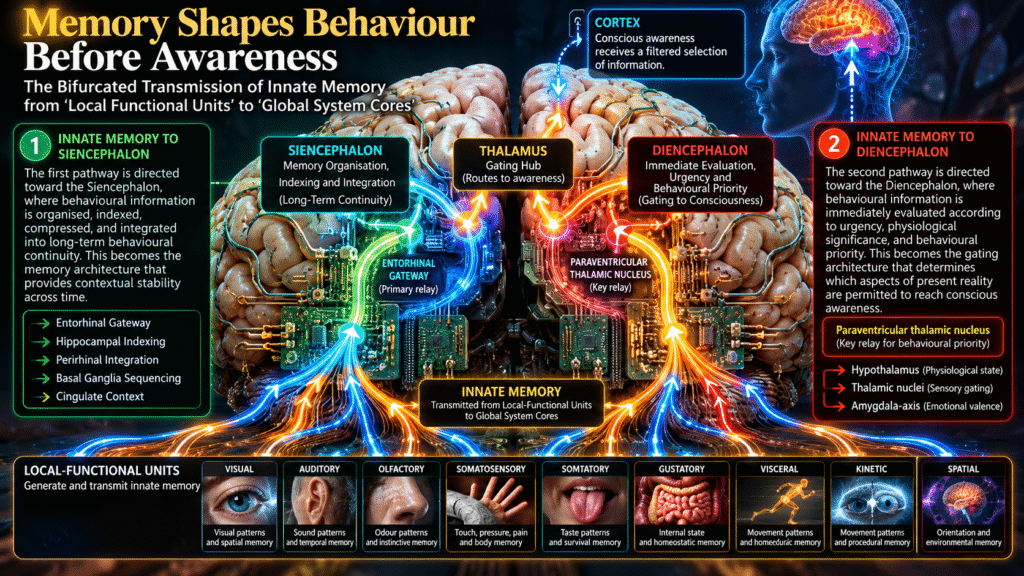
Within the Psychextrics framework, this relationship is organised through a bifurcated transmission architecture linking the Local Functional Units of the lower cephalons with the Global System Cores of the higher brain.
1. The Bifurcated Architecture of Behavioural Memory
The Somato-Valence Engine does not transmit behavioural information through a single ascending pathway. Instead, every Local Functional Unit simultaneously distributes its output into two specialised processing streams that remain functionally distinct while ultimately converging upon conscious experience.
- The first pathway is directed toward the Siencephalon, where behavioural information is organised, indexed, compressed, and integrated into long-term behavioural continuity.
This becomes the memory architecture that provides contextual stability across time.
- The second pathway is directed toward the Diencephalon, where behavioural information is immediately evaluated according to urgency, physiological significance, and behavioural priority.
This becomes the gating architecture that determines which aspects of present reality are permitted to reach conscious awareness.
Although these pathways operate independently, neither functions in isolation. Conscious perception emerges only when both streams ultimately converge upon the revised Telencephalic Display-Cortex, allowing the organism to experience a unified behavioural world assembled from both historical continuity and present biological relevance.
2. The Siencephalic Stream: Constructing Behavioural Continuity
The first branch of this bifurcated system carries what Psychextrics describes as structurally innate behavioural memory.
Unlike immediate survival deployment, this pathway is concerned with transforming distributed lower cephalic activity into organised behavioural frameworks capable of supporting future adaptation. Each Local Functional Unit contributes specialised behavioural information to dedicated Siencephalic structures that progressively transform reflexive activity into organised behavioural intelligence.
- Outputs originating within the Myelencephalon are channelled toward the Cingulate Gyrus, where visceral vigilance becomes organised into broader action-selection strategies.
Instead of preserving isolated autonomic reactions, this pathway integrates survival responses into coherent behavioural priorities that can guide future behaviour.
- Signals originating within the Metencephalon converge upon the Basal Ganglia Striatum, where continual adjustments in kinetic stability become consolidated into coordinated procedural routines.
Rather than repeatedly reconstructing movement from first principles, the nervous system gradually develops efficient behavioural sequences that may later operate with minimal conscious intervention.
- Information emerging from the Mesencephalon is directed toward the Parahippocampal Fields.
Here orienting movements and spatial responses become embedded within increasingly sophisticated environmental maps, allowing the organism to relate immediate spatial perception to accumulated behavioural experience.
- Simultaneously, outputs associated with the reactive Diencephalic structures converge upon the Perirhinal Relay, where affective valuations become associated with increasingly refined object identities.
Innate attraction or avoidance gradually becomes linked with specific environmental entities rather than remaining an undifferentiated emotional state.
Each of these pathways contributes a different behavioural dimension, yet none individually constitutes behavioural continuity. Their true integration occurs only after converging upon a higher structural organiser.
3. The Ampulla Relay Complex: Compiler of Behavioural Memory
According to the Psychextrics model, these distributed behavioural streams converge within what is termed the Ampulla Relay Complex.
This convergence zone functions as the principal compiler of Siencephalic intelligence.
Rather than merely passing information onward, the Ampulla Relay Complex receives spatial coordinates from the Parahippocampal Fields, behavioural identities from the Perirhinal Relay, strategic frameworks from the Cingulate Gyrus, and procedural motor organisation from the Basal Ganglia Striatum.
These independent behavioural dimensions are transformed into a unified relational index.
Instead of maintaining multiple disconnected behavioural fragments, the Ampulla constructs an integrated behavioural representation that preserves relationships between action, location, object identity, emotional significance, and procedural execution.
This integrated relational index represents the behavioural continuity upon which future conscious experience depends.
4. The Entorhinal Gateway and the Continuous Rebroadcast of the Past
Once the relational index has been compiled, it is transmitted directly to the Entorhinal Gateway.
Within Psychextrics, the Entorhinal system serves not simply as an entrance to hippocampal integration but as the principal rebroadcast architecture of predictive behavioural continuity.
Through its bidirectional projection systems, the Entorhinal Gateway continuously distributes indexed behavioural information toward multiple cortical destinations.
Importantly, this rebroadcast does not occur only during conscious remembering. Instead, behavioural continuity remains permanently active. The organism therefore encounters every present situation against the background of continuously indexed behavioural history.
The familiar feeling that a place seems safe before consciously recognising it, the immediate distrust of an unfamiliar individual without deliberate reasoning, or the rapid behavioural hesitation experienced before identifying its cause, all become expressions of indexed behavioural continuity already influencing perception before conscious narration begins.
The past therefore enters present behaviour in predictive form long before consciousness recognises that memory has participated.
5. The Diencephalic Stream: Constructing the Behavioural Present
Running alongside this memory architecture is a second behavioural pathway dedicated to evaluating present biological reality.
Whereas the Siencephalic stream organises behavioural continuity across time, the Diencephalic stream evaluates immediate behavioural significance.
Instead of independently projecting raw information toward consciousness, Local Functional Units converge upon a specialised integrative hub located within the Paraventricular Nucleus (PVT) of the Thalamus.
Within the Psychextrics framework, the PVT functions as the principal convergence point for immediate behavioural valuation.
Signals associated with visceral vigilance originating from the Myelencephalon, kinetic disruption originating from the Metencephalon, and rapid spatial orientation generated within the Mesencephalon all converge upon this single evaluative structure.
Rather than allowing these independent behavioural streams to compete directly for conscious representation, the PVT performs a unified assessment of global behavioural urgency.
This prevents consciousness from becoming overwhelmed by fragmented reactive signals while simultaneously preserving behavioural coherence during rapidly changing environmental conditions.
6. The Paraventricular Nucleus as Behavioural Clearinghouse
The behavioural role assigned to the PVT extends beyond simple relay. Within this framework, it functions as the organism’s central homeostatic clearinghouse.
- Visceral disturbances originating within the Myelencephalon modify the organism’s internal physiological baseline.
- Motor instability arriving from the Metencephalon contributes information regarding immediate behavioural coordination.
- Spatial changes transmitted from the Mesencephalon provide rapid estimates of environmental saliency.
Rather than preserving these signals independently, the PVT synthesises them into a unified behavioural estimate describing the organism’s overall state of urgency.
Only after this integrated evaluation is complete does the information proceed toward the broader thalamocortical gating architecture.
Conscious awareness therefore receives behavioural significance rather than raw physiological data.
7. The Dual Projection onto the Revised Telencephalon
The behavioural architecture described by Psychextrics reaches completion only when these two ascending systems converge upon the revised Telencephalic Display Cortex.
The Entorhinal Gateway projects the indexed continuity of behavioural history.
The Thalamic Relay Core projects the dynamically evaluated behavioural present authorised through PVT modulation.
One continuously supplies the contextual background constructed from accumulated behavioural organisation. The other continuously supplies the immediate biological reality emerging from current physiological conditions. Neither alone constitutes conscious experience.
Only their simultaneous convergence generates the coherent behavioural display experienced as unified awareness.
Consequently, consciousness becomes the meeting point between behavioural continuity and behavioural immediacy rather than the origin of either.
Conclusion: Behaviour Before Narration
The bifurcated transmission architecture represents one of the central organisational principles of the Psychextrics model.
Behaviour does not emerge from isolated sensory inputs travelling toward an executive cortex. Instead, every Local Functional Unit simultaneously contributes to two complementary behavioural systems: one organising continuity through Siencephalic indexing, the other organising immediacy through Diencephalic valuation.
These systems continuously interact beneath awareness before their integrated outputs reach the revised Telencephalic Display Cortex.
By the time the conscious narrator begins interpreting experience, behavioural reality has already been assembled through the coordinated activity of both streams. Memory has already shaped present perception, behavioural significance has already been assigned, and the organism has already begun adapting to the environment.
Within this architecture, the conscious self becomes neither the originator of behaviour nor the first observer of reality. It becomes the interpreter of an integrated behavioural display constructed through the continuous interaction of indexed memory and present biological valuation. The past and the present therefore meet long before awareness recognises either, allowing behaviour to emerge as the product of a deeply organised preconscious system rather than an act of immediate conscious creation.
Back to: 👇