
Meaning Is Not Thought: Why Behavioural Meaning Emerges Before Conscious Thought in Psychextrics
Part I
BY: OMOLAJA MAKINEE
For generations, discussions about meaning have been dominated by Philosophy, Psychology, and Cognitive Neuroscience. Meaning has commonly been described as something created through reflection, language, interpretation, reasoning, or symbolic understanding.
In this conventional view, people first perceive the world and then consciously assign significance to what they have perceived. Thought precedes meaning, and conscious interpretation becomes the defining feature of intelligent behaviour.
Psychextrics reconstructs this relationship entirely.
It argues that meaning is not the product of conscious thought. Meaning emerges long before reflective reasoning begins. Before the conscious mind formulates explanations, before internal narration constructs sentences, and before symbolic reasoning attempts to interpret events, the behavioural architecture beneath awareness has already determined whether the environment represents safety or danger, opportunity or loss, attraction or avoidance, urgency or irrelevance.
Meaning is not primarily a philosophical achievement; it is the biological weighting of behavioural reality.
Within this framework, meaning belongs fundamentally to the Diencephalon. It is the Diencephalic system that evaluates incoming reality, assigns behavioural priority, and determines the organism’s immediate relationship with the world.
Conscious thought belongs elsewhere. Thought emerges through the recursive integration systems of the Siencephalon, where memory, autobiographical continuity, and behavioural history continually reshape the interpretation of present experience.
Meaning and thought represent two distinct biological processes rather than different expressions of the same mental activity.
1. The Bifurcation of Consciousness
To understand this distinction, Psychextrics separates consciousness into two complementary yet fundamentally different operations. One governs behavioural meaning. The other governs behavioural thought.
Meaning belongs to the present. Thought belongs to continuity.
The Diencephalic Thalamus operates as the embodiment of behavioural meaning because it anchors consciousness to the immediate behavioural demands of the present moment. Its computations are fundamentally non-recursive. Every behavioural frame is evaluated according to its immediate significance without requiring continuous re-entry into autobiographical memory.
The Thalamus does not continually revisit historical experience while computing the urgency of current reality. Instead, it asks a remarkably direct behavioural question:
What does this moment require?
The Siencephalic Entorhinal Core performs an entirely different task. Rather than anchoring behaviour to the present, it continually loops historical behavioural packets back into the active stream of consciousness to form behavioural expectations. Its architecture is inherently recursive. Every new behavioural event is immediately compared with previously indexed experiences, emotional histories, visceral and spatial memories, learned associations, and autobiographical narratives. Instead of isolating events, it connects them.
Within Psychextrics, consciousness therefore bifurcates into two sovereign systems.
One determines what reality means. The other determines how reality fits into the ongoing story of the self.
2. Meaning: The Behavioural Compression of the Present
Meaning emerges because the Thalamus compresses enormous amounts of inherited biological information into the immediate behavioural frame.
Every organism inherits behavioural templates through its Genetic Index Markers (GIM). Throughout life these inherited structures become modified through Epigenetic Index Markers (EIM), creating behavioural adaptations unique to individual experience.
Under ordinary circumstances these behavioural templates remain distributed throughout the organism’s biological architecture. They do not exist as consciously remembered information.
The Diencephalon changes this.
When a new behavioural event appears, the Thalamus instantly compresses inherited biological predispositions together with accumulated epigenetic modifications into the current sensory frame. The organism therefore experiences reality not as neutral sensory information but as behaviourally weighted significance.
The past does not remain separate from the present. It collapses into the present. Meaning therefore represents an immediate biological compression rather than a reflective cognitive interpretation.
The organism does not first think about danger before recognising danger. It experiences danger because behavioural weighting has already occurred.
3. Thought: The Recursive Architecture of Continuity
The Entorhinal Core approaches reality differently.
Rather than compressing behavioural history into the present moment, it continually retrieves historical behavioural packets and reintroduces them into ongoing conscious processing.
Its purpose is not immediate survival. Its purpose is continuity.
Through the recursive organisation of the perforant pathway, autobiographical memory becomes available to current consciousness. Previous experiences, learned expectations, remembered conversations, emotional episodes, spatial familiarity, and countless behavioural associations become available in predictive memory for comparison against current events.
Thought therefore treats reality relationally. No behavioural event exists independently. Every present moment becomes linked to countless previous moments.
This recursive organisation enables planning, imagination, simulation, prediction, reflection, and counterfactual reasoning.
Where meaning asks, “What is happening?”
Thought asks, “How does this relate to everything that has happened before?”
Both processes contribute to conscious experience. Neither replaces the other.
4. Meaning Treats Events in Isolation
Because the Thalamus operates non-recursively, it evaluates each behavioural frame independently.
Its responsibility is not constructing historical narratives. Its responsibility is determining behavioural priority.
Every sensory frame undergoes immediate behavioural valuation without requiring extensive autobiographical reconstruction. This property allows the organism to respond rapidly when behavioural urgency suddenly appears.
- The current frame becomes biologically sovereign.
- Historical distraction temporarily disappears.
- Behavioural significance dominates consciousness.
The organism becomes anchored to the present because survival depends upon accurate evaluation of immediate behavioural reality rather than prolonged reflection.
5. Thought Treats Events in Connection
The Entorhinal Core performs the opposite operation. Rather than isolating behavioural events, it continuously integrates them into expanding behavioural networks.
Present experience becomes inseparable from memory. Individual moments become chapters within an ongoing behavioural narrative.
This recursive organisation explains why identical external events may produce completely different conscious experiences depending upon previous history.
A shady street corner evokes entirely different thoughts for someone who grew up there than for someone visiting for the first time. The behavioural present remains identical. The recursive network differs.
Thought extends behavioural experience beyond the present into continuity across time.
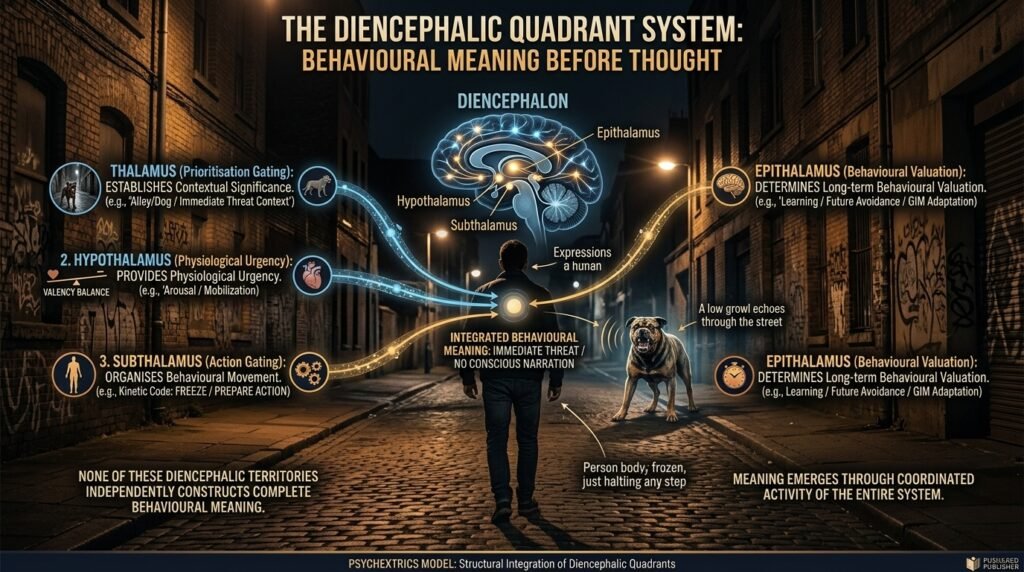
6. The Diencephalic Quadrant System: Behavioural Meaning Before Thought
The construction of behavioural meaning becomes especially apparent when examining how the four major functional territories of the Diencephalon cooperate during genuine behavioural urgency.
Imagine walking alone through a poorly illuminated city street late at night. The surroundings appear quiet. Your pace remains relaxed.
Suddenly, approximately three metres ahead, a large dog emerges from a narrow alleyway. Its posture stiffens. Its teeth become visible. A low growl echoes through the street.
Long before conscious thought forms a sentence, the behavioural civilisation has already completed an extraordinary series of computations.
The Thalamus: Constructing Behavioural Context
The acoustic frequencies of the growl and the rapidly changing visual configuration immediately enter the thalamic relay systems.
The Thalamus does not evaluate the dog as an abstract biological species. It evaluates the behavioural configuration.
- Forward movement has become obstructed.
- Spatial security has collapsed.
- Immediate behavioural significance now dominates the current frame.
Without producing a single conscious sentence, the Thalamus establishes the meaning of the event. The behavioural environment has changed.
The Hypothalamus: Creating Survival Urgency
Almost simultaneously, the Hypothalamus transforms behavioural significance into physiological urgency. Autonomic systems activate immediately.
- Adrenaline secretion accelerates.
- Heart rate rises.
- Respiration deepens.
- Blood flow redistributes toward skeletal muscles.
- Digestive activity becomes temporarily suppressed.
The organism does not consciously decide to prepare for survival. Preparation has already begun.
The body experiences urgency before the conscious narrator experiences fear.
The Subthalamus: Reorganising Behavioural Movement
While autonomic physiology changes, the Subthalamic systems immediately intervene within ongoing motor planning.
- Forward locomotion pauses.
- Postural balance shifts.
- Muscular tension redistributes.
- The organism temporarily freezes.
This behavioural interruption is not hesitation arising from conscious uncertainty. It is kinetic optimisation.
The Subthalamus prevents poorly timed movement while preparing the behavioural system for either rapid retreat or defensive action.
The Epithalamus: Assigning Behavioural Aversion
Simultaneously, the Epithalamic structures attach enduring behavioural value to the event.
The spatial location itself becomes negatively weighted. Future behavioural planning begins changing even before conscious reflection occurs. The alleyway acquires lasting behavioural significance.
Avoidance becomes biologically encoded. The organism is already learning.
Conclusion: The Behavioural Synthesis of Meaning
None of these Diencephalic territories independently constructs complete behavioural meaning.
- The Thalamus establishes contextual significance.
- The Hypothalamus provides physiological urgency.
- The Subthalamus organises behavioural movement.
- The Epithalamus determines long-term behavioural valuation.
Meaning therefore emerges through the coordinated activity of the entire Diencephalic system rather than from any isolated anatomical structure.
Only after these behavioural computations have been completed does the integrated behavioural packet ascend toward the Display Cortex.
- The Layer I gateway opens.
- The behavioural screen illuminates.
- Internal narration finally appears.
The conscious self looks upon the already completed behavioural projection and quietly remarks,
“I turned around because I felt afraid.”
Within Psychextrics, however, this narration represents the final chapter rather than the opening sentence. Fear did not produce the behavioural response. Behavioural meaning produced the fear, and conscious thought merely translated that completed behavioural construction into language.
The narrator therefore explains behaviour after it has already emerged. Meaning belongs to the Diencephalon. Thought belongs to the Siencephalon. Conscious experience arises from their continual interaction, but behavioural reality begins long before reflective thought ever attempts to describe it.
Back to: 👇