
Introducing Siencephalon: The Missing Architecture of Human Consciousness
BY: OMOLAJA MAKINEE
For more than a century, Neuroscience has operated on a foundational assumption: that the forebrain’s highest authority is the cortex. The cortex became the symbolic throne of intelligence, reason, memory, personality, imagination, and consciousness itself. Everything important, we were told, culminated in the wrinkled outer shell of the brain.
But there has always been a structural problem hidden inside that assumption.
The same anatomical territory said to display reality was also said to store it. The same system said to project consciousness was also said to index memory. The same cortical civilisation said to render perception was also treated as the warehouse of emotional history.
In other words, modern Neuroscience merged the screen and the hard drive into one anatomical territory.
Under the developing framework of Psychextrics, that merger is fundamentally incorrect.
A new book currently in development introduces what may become one of the most radical anatomical reinterpretations in modern Behavioural science: the Siencephalon — the missing sixth cephalon of the human brain.
Not as metaphor. Not as philosophy. But as a proposed structural and behavioural reality.
1. The Forgotten Contradiction in Brain Science
Classical neuroanatomy divides the brain into five major embryological territories:
- Myelencephalon,
- Metencephalon,
- Mesencephalon,
- Diencephalon,
- and Telencephalon.
These divisions emerged from the embryological work of Wilhelm His Sr. during the late nineteenth century, when microscopic analysis of the neural tube revealed that the brain develops as layered vesicular territories rather than as a singular mass.
Karl Ernst von Baer created and discovered the concept of the five-vesicle progression in 1828. In his seminal 1828 work, Über Entwickelungsgeschichte der Thiere (“On the Development of Animals”), von Baer first mapped the structural transition of the vertebrate neural tube as it expands from three primary expansions into the five classical embryological divisions.
Between 1888 to 1893, Wilhelm His mathematically, structurally, and terminologically perfected it for modern neuroanatomy. The five-vesicle model revolutionised Neuroscience because it transformed the brain from a mysterious organ into a layered assembly system.
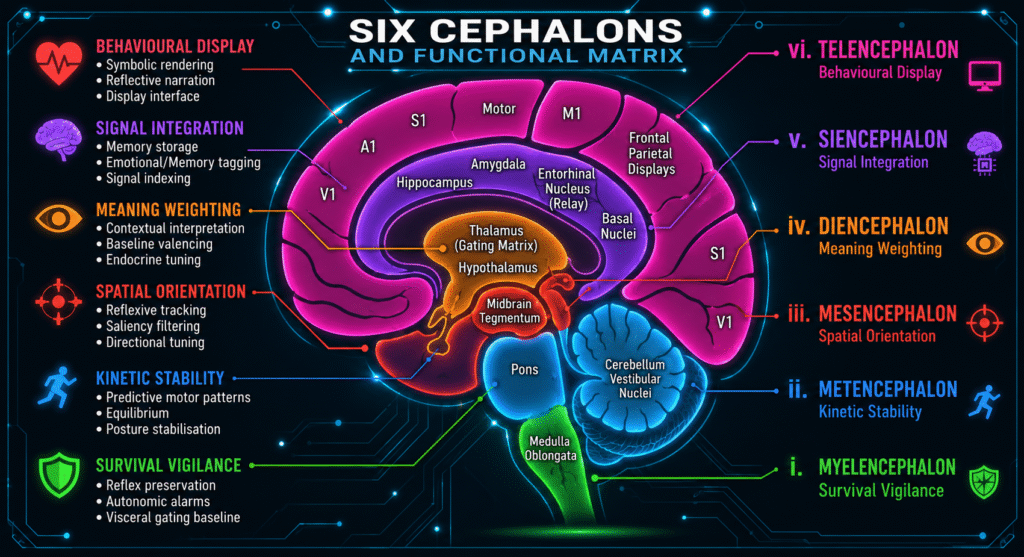
Each cephalon gradually became associated with a functional behavioural role:
- the Myelencephalon for autonomic survival,
- the Metencephalon for kinetic coordination,
- the Mesencephalon for orientation,
- the Diencephalon for contextual gating,
- and the Telencephalon for conscious display and symbolic cognition.
But as Neuroscience evolved, a contradiction silently emerged.
The Telencephalon became overloaded with incompatible responsibilities. Memory structures like the hippocampus. Emotional valuation structures like the amygdala. Spatial indexing systems like the entorhinal cortex. Habitual behavioural circuitry like the basal ganglia. All were grouped inside the same terminal territory that was also supposedly responsible for conscious rendering and symbolic display.
The result was an anatomical compression problem. The backend processing machinery and the frontend display interface became collapsed into one category.
Psychextrics argues that this was not merely an organisational inconvenience. It was a conceptual error.
2. Enter the Siencephalon
The Siencephalon is proposed as a newly demarcated sixth anatomical territory extracted from the traditional Telencephalon.
Its name is a structural portmanteau: Signal and Encephalon— literally: “Signal-in-the-head.”
The Siencephalon is not the conscious screen. It is the signal integration core behind the screen.
Under the Psychextrics model, structures traditionally buried inside the Telencephalon are regrouped into a dedicated backend processing architecture:
- Hippocampus,
- Amygdala,
- Entorhinal Cortex,
- Perirhinal Cortex,
- Parahippocampal fields,
- and the Basal Ganglia Striatum.
Together, these organs form the recording, indexing, emotional-tagging, and behavioural-packaging infrastructure of the mind.
This is not merely a rearrangement of labels. It changes the entire mechanical interpretation of consciousness.
3. The Brain Is Not One Machine
Psychextrics proposes that the brain operates less like a singular organ and more like a vertically stacked signal civilisation. Reality is assembled step-by-step through layered behavioural territories.
The lower cephalons construct survival, movement, orientation, and contextual meaning. The Siencephalon records, packages, and loops those signals through behavioural memory architecture. The Telencephalon then displays the final rendered output as conscious experience.
Under this model, consciousness itself is not the source of behaviour. It is the display of already-integrated behavioural signals.
This single inversion changes nearly everything.
4. Why the Cortex Is Not the Thinker
Modern Neuroscience often treats the cortex as the executive ruler of the human organism. Psychextrics rejects this interpretation.
Instead, the revised Telencephalon becomes a display interface — a symbolic rendering surface where integrated subcortical signals appear as conscious reality. The cortex is not the king. It is the screen.
This explains one of the strangest paradoxes in Behavioural science: human beings often become aware of actions, emotional reactions, fears, attractions, and decisions after they have already begun unfolding. Under Psychextrics, this is expected.
The lower cephalons process first. The Siencephalon packages second. The cortex displays third. Awareness is therefore reflective rather than executive.
5. The Entorhinal Relay: The Gateway to Behavioural Reality
One of the most revolutionary aspects of the upcoming book is the reinterpretation of the Entorhinal Cortex.
Traditionally classified as part of the cortex, Psychextrics reclassifies it functionally as an Entorhinal Relay/Gateway System within the Siencephalon. Why?
Because it behaves less like a display surface and more like a bidirectional signal port.
Unlike lower cephalic gateways — which primarily push environmental data upward — the entorhinal system operates as a looping relay:
- receiving contextual information,
- routing it into the hippocampal indexing system,
- retrieving indexed behavioural patterns,
- and broadcasting packaged signals back toward conscious display.
This transforms memory from a passive archive into an active behavioural force.
Under this architecture, memory is not simply recalled. It continuously modifies present reality.
Trauma.
Instinct.
Familiarity.
Déjà vu.
Dreams.
Emotional flashbacks.
Predictive behaviour.
All become expressions of recursive signal looping through the Siencephalon.
6. The Three Master Relays of the Forebrain
The emerging Psychextrics framework identifies three major relay systems governing human behavioural reality:
- the Thalamus,
- the Entorhinal Relay,
- and the Olfactory Bulb.
Each manages a different dimension of existence.
The Thalamus governs contextual immediacy. The Entorhinal system governs indexed historical reality. The Olfactory Bulb governs direct chemical valuation. Together, they form a triangulated architecture through which behaviour emerges before conscious narration ever begins.
This offers an entirely different interpretation of what the human self actually is. Not a singular thinker. But a continuously rendered behavioural projection emerging from layered subcortical negotiations.
7. Why This Matters Beyond Neuroscience
The implications of the Siencephalon extend far beyond anatomy. The model radically reshape how we understand:
- personality,
- memory disorders,
- trauma,
- addiction,
- neurodivergence,
- dreams,
- dementia,
- emotional inheritance,
- instinctive behaviour,
- symbolic thought,
- consciousness,
- and even Artificial Intelligence.
It also explain why conventional psychology often struggles to isolate behaviour into stable categories.
Because behaviour does not originate from a singular conscious self at all. It emerge from dynamic signal competitions occurring beneath awareness.
In that sense, Psychextrics is not simply proposing a new brain structure. It is proposing a new civilisation of the mind.
Conclusion: A Book Currently in Development
The forthcoming Psychextrics volume on the Siencephalon is currently being developed as a large-scale exploration into this proposed sixth cephalic architecture.
The work revisits:
- the embryological history of the encephalons,
- the mechanics of behavioural signal formation,
- the role of memory indexing in consciousness,
- the separation between display and storage systems,
- and the possibility that human reality itself is a rendered behavioural interface rather than a centrally controlled executive mind.
Whether the scientific establishment ultimately accepts or rejects the framework, the proposal itself forces an unavoidable question:
What if the greatest misunderstanding in Neuroscience was not what the brain does…
…but where consciousness actually ends, and where behavioural reality truly begins?
Further Reading
Here, I merely introduces the Siencephalon.
For a comprehensive treatment of its theory and five volume series, readers are invited to explore:
SIENCEPHALON: THE MISSING ARCHITECTURE OF CONSCIOUSNESS IN PSYCHEXTRICS
By Omolaja Makinee (2026)
📘 Free to read online 👇:
Back to: 👇