
The Illusion of the Conscious Executive: Why the Three Master Relays Are the Gatekeepers of Consciousness
BY: OMOLAJA MAKINEE
Perhaps no belief is more deeply ingrained in human experience than the conviction that the conscious mind is the executive authority of behaviour. Every individual experiences life from the perspective of an internal observer who appears to think, decide, evaluate, and then initiate action. This sensation is so immediate and convincing that it has become one of the least questioned assumptions in Philosophy, Psychology, Law, and even much of modern Neuroscience.
Yet the biological evidence repeatedly tells a different story.
The organism frequently reacts before conscious explanation appears. Muscles withdraw from danger before the event is understood. Emotional activation precedes rational interpretation. Words are sometimes spoken before deliberate evaluation. Fear often emerges before the source of danger has been consciously identified. Across countless behavioural situations, consciousness appears to arrive after the biological machinery has already begun its work.
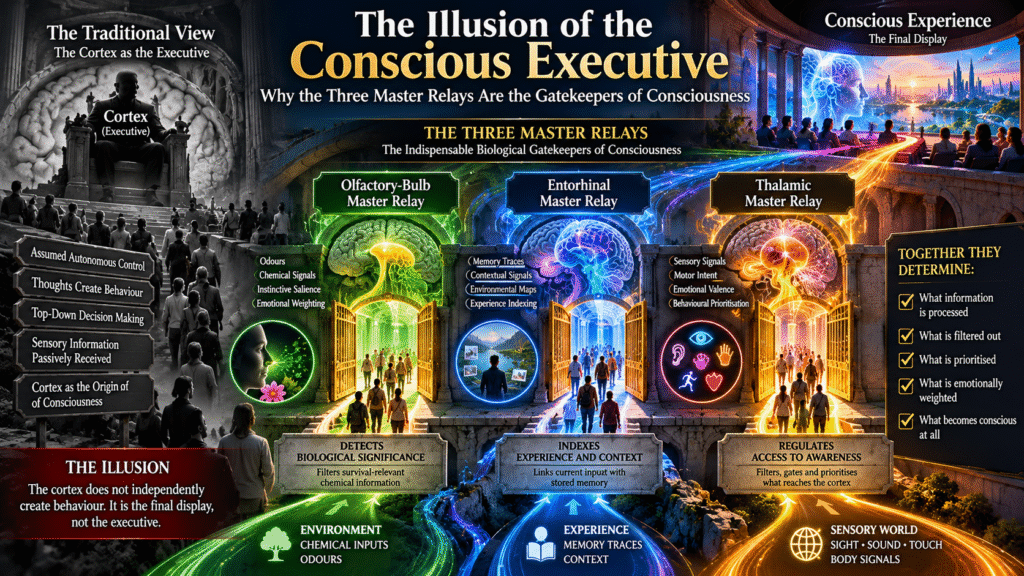
Psychextrics argues that this contradiction exists because consciousness has been assigned the wrong anatomical role. The cortex is not the executive creator of behaviour. Instead, it is the biological display interface upon which behaviour is presented after it has already been constructed by deeper cephalic systems. Between these subcortical systems and the revised Telencephalon stand three indispensable biological gatekeepers:
- Entorhinal Master Relay,
- Thalamic Master Relay,
- Olfactory-Bulb Master Relay.
Together, they determine whether behaviour ever becomes conscious at all.
1. The Illusion of Executive Control
The feeling of conscious control is not itself evidence that consciousness generates behaviour. It is only evidence that behaviour eventually becomes available to conscious awareness.
This distinction lies at the heart of the Psychextric model.
The conscious self experiences itself as making decisions because it never witnesses the immense biological construction process occurring beneath awareness. Instead, it encounters only the completed behavioural product after numerous subcortical systems have already detected sensory information, compared it with inherited biological templates, integrated previous experience, assigned survival value, organised contextual memory, and prepared behavioural readiness.
By the time conscious awareness arrives, much of the work has already been completed.
The conscious experience of “I decided” therefore represents the final narration of a process that began long before the conscious self entered the sequence.
2. Behaviour Is Constructed Before It Is Experienced
The six-Cephalon architecture proposes that behaviour is assembled through distributed biological cooperation rather than conscious command.
Incoming sensory information from the three Architectures of Perception—Exteroception, Proprioception, and Interoception—travels through specialised forward relay systems into the Siencephalon. Along these pathways, sensory signals undergo structural comparison within the amygdaloid complex, contextual binding within the hippocampal network, and multimodal integration through the Entorhinal gateway.
Throughout this entire process, the revised Telencephalon remains unaware.
The cortex does not observe raw sensory construction. It does not witness emotional valuation. It does not participate in hippocampal indexing. It does not assemble behavioural templates. Every one of these operations occurs within subcortical architecture before the cortex receives any information whatsoever.
Consequently, the cortex cannot reasonably be described as the conscious executive. It simply receives the finished biological product.
3. The Three Master Relays of Consciousness
If consciousness depends upon information arriving at the cortical display, then the structures responsible for delivering that information become the true gatekeepers of conscious awareness.
Within Psychextrics, three master relay systems perform this function.
- The Entorhinal Master Relay retrieves indexed behavioural packets from the hippocampal system and broadcasts integrated historical representations toward the revised Telencephalon.
- The Thalamic Master Relay continuously serialises behavioural information into an ordered stream capable of supporting conscious narration, symbolic reasoning, and sequential awareness.
- The Olfactory-Bulb Master Relay performs the same function for chemically significant sensory information, rapidly projecting odour-associated behavioural meaning into conscious perception.
Together these three relays form the final biological gateway separating unconscious behavioural construction from conscious behavioural experience.
Without them, consciousness never occurs.
4. The Forward Relay: Building Behaviour in the Biological Dark
The first responsibility of the three master relays lies within their forward pathways.
Before consciousness can exist, sensory information must first be organised into biologically meaningful patterns.
- The Entorhinal system integrates spatial organisation, object familiarity, contextual relationships, and historical memory.
- The Thalamus continuously coordinates multiple sensory streams, organising behavioural timing while distributing information throughout subcortical networks.
- The Olfactory Bulb simultaneously evaluates environmental chemistry, rapidly connecting odours with survival relevance and behavioural familiarity.
These forward relay systems cooperate with the hippocampus and amygdala to produce behaviour that is already emotionally weighted, contextually organised, and biologically prioritised before any cortical awareness appears.
During this stage the cortex remains entirely silent. There is no conscious observation occurring downstream while the biological construction process unfolds.
5. The Feedback Relay: Broadcasting Behaviour into Consciousness
Once behavioural construction has been completed, an entirely different operation begins.
The nervous system must now transform biologically encoded information into something the conscious organism can experience. This is the purpose of the feedback relay.
- The Entorhinal Feedback Relay retrieves the completed hippocampal representation, compresses the indexed behavioural packet, and broadcasts that organised information toward the cortical display surface.
- Simultaneously, the Thalamic Feedback Relay serialises incoming information into the continuous stream of conscious narration that human beings experience as thought, language, reflection, and awareness. Rather than generating behaviour, the thalamus transforms completed biological information into an organised sequence suitable for conscious interpretation.
- At the same time, the Olfactory-Bulb Feedback Relay projects chemically significant behavioural information directly into conscious awareness, allowing smells to evoke immediate recognition, familiarity, emotional significance, and environmental interpretation.
Only after these three relay systems complete their work does the revised Telencephalon become aware that behaviour exists.
The cortex therefore does not discover behaviour independently. It is shown behaviour.
6. Why the Cortex Can Never Be the Executive
This architecture fundamentally changes how the cortex must be understood.
Traditional models often portray the cerebral cortex as the command centre of the nervous system. Psychextrics argues that this interpretation confuses conscious experience with biological construction.
A television screen displays a film without producing the actors, the script, the cameras, or the soundtrack. Likewise, the cortex displays behaviour without constructing the biological machinery responsible for producing it.
- The emotional valence originates within the amygdala.
- Contextual integration occurs within the hippocampus.
- Spatial organisation emerges through the Entorhinal gateway.
- Behavioural timing is coordinated through the thalamus.
- Chemical familiarity passes through the Olfactory Bulb.
Only after these operations have concluded does the cortex receive the finished behavioural representation. Its function is therefore representational rather than executive.
The cortex is the display interface of consciousness—not its architect.
7. The Endless Feedback Loop of Conscious Awareness
One of the most significant implications of this framework is that consciousness never becomes independent of the master relays.
Even after behavioural information reaches the cortical display, the cortex cannot simply process experience in isolation.
Layer VI of the cerebral cortex projects enormous descending feedback pathways toward the thalamus and associated relay systems. Classical Neuroscience frequently interprets these corticothalamic projections as evidence that the cortex exerts executive control over perception.
Psychextrics proposes a different interpretation.
These descending pathways do not eliminate dependence upon the master relays. Instead, they reinforce it.
Every cortical reflection, symbolic interpretation, abstract thought, or conscious evaluation must descend back into the thalamic relay before it can once again be organised, synchronised, and redistributed throughout the broader behavioural architecture.
Even conscious feedback therefore remains biologically dependent upon the relay systems.
The cortex cannot simply think and know. It thinks, sends feedback downward, receives the relay’s reconstructed output, and only then becomes consciously aware of the updated behavioural state.
Consciousness therefore operates as a continuous relay-dependent loop rather than an autonomous cortical process.
8. Remove the Relays, Remove Consciousness
The importance of the three master relays becomes most obvious through a simple thought experiment.
Imagine preserving every cortical neuron exactly as it exists while simultaneously removing the Entorhinal, Thalamic, and Olfactory-Bulb feedback systems.
The cortex would retain its layered architecture. Its neurons would remain physically intact. Its symbolic machinery would still exist. Yet no integrated behavioural information would ever arrive.
- No hippocampal encoding and retrieval would occur.
- No sensory narration would be serialised.
- No chemically meaningful perception would reach awareness.
The cortical display would remain structurally present yet functionally dark. Without incoming biological broadcasts, there would be nothing to experience.
The conscious self would not merely become impaired—it would cease to possess awareness altogether because the display interface would no longer receive the information required to generate conscious experience.
The true gatekeepers of consciousness are therefore not the cortical layers themselves but the Master Relay systems that continuously illuminate them.
Conclusion: Consciousness Is a Broadcast, Not a Command
The illusion of the conscious executive arises because human beings experience only the final stage of behavioural construction. The immense biological machinery responsible for detecting, evaluating, integrating, and organising behaviour operates almost entirely beneath conscious awareness.
The revised Telencephalon does not command this machinery. It displays its finished product.
- The Entorhinal Master Relay processes behavioural history with the hippocampal network.
- The Thalamic Master Relay transforms distributed biological processing into coherent conscious narration.
- The Olfactory-Bulb Master Relay projects chemically significant behavioural meaning into awareness.
Together they form the indispensable bridge between unconscious biological computation and conscious experience.
Even the cortex’s own feedback remains dependent upon these relay systems, requiring their continuous mediation before conscious awareness can be updated again. Consciousness therefore exists not because the cortex commands behaviour, but because the three Master Relays continuously broadcast behaviour onto the cortical display.
Within the Psychextric model, the conscious self is neither the architect nor the executive of behaviour. It is the observer standing before a biological display screen whose illumination depends entirely upon the uninterrupted dialogue between the Entorhinal, Thalamic, and Olfactory-Bulb master relays. When those broadcasts cease, the screen remains—but consciousness itself falls silent.
Back to: 👇