
Habit, Automatic Behaviour, and the Reactive Thalamus: How the ‘Local Functional Units’ Govern Behaviour Before Conscious Choice
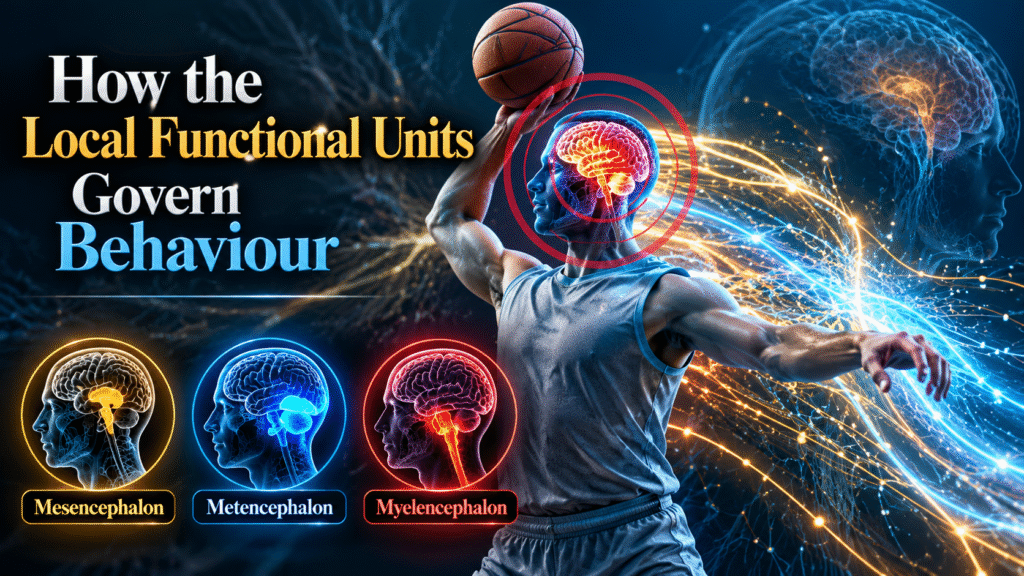
BY: OMOLAJA MAKINEE
Habits are often regarded as products of repetition. According to conventional Psychology, behaviours become automatic because they are practised frequently until conscious attention is no longer required for their execution.
While repetition undoubtedly refines behavioural efficiency, it does not fully explain why two individuals repeatedly exposed to the same environment develop dramatically different automatic responses. Some instinctively approach crowded social environments with excitement, while others immediately experience panic. Some individuals naturally seek novelty, whereas others automatically retreat toward familiarity despite equivalent life experiences.
Psychextrics proposes that automatic behaviour cannot be explained by repetition alone. Beneath every habit lies a deeper biological architecture in which Local Functional Units continuously compare incoming sensory information against innate behavioural templates. These templates, established through the interaction of Genetic Index Markers (GIM) and Hormonal Index Markers (HIM), are continuously evaluated through amygdaloid valence systems before conscious awareness becomes involved.
Habit therefore emerges not simply because behaviour has been repeated, but because behavioural execution has become structurally compatible with deeply organised innate memory systems.
Within this framework, automatic behaviour reflects the dominance of reactive thalamic pathways over proactive symbolic planning. Certain thalamic nuclei function as specialised relay structures serving the behavioural demands of lower cephalic systems rather than the conscious simulations generated by higher cognitive networks.
These reactive thalamic cores faithfully transmit already-constructed behavioural programs to the cortical display, allowing behaviour to unfold with remarkable speed while consciousness merely observes the completed execution.
1. Automatic Behaviour Without Continuous Consciousness
One of the most remarkable characteristics of human behaviour is that enormous amounts of daily activity occur with very little conscious effort.
People routinely walk while engaged in conversation, drive familiar routes while thinking about unrelated problems, type on keyboards without consciously locating individual letters, and navigate familiar environments while attention remains focused elsewhere. Behaviour continues despite fluctuations in conscious intensity.
This demonstrates an important behavioural principle within Psychextrics.
Conscious intensity is not a prerequisite for behavioural execution.
Instead, once behavioural programs have become structurally integrated within the lower cephalic architecture, they operate largely through reactive pathways designed for efficiency rather than conscious deliberation.
The conscious mind may supervise or modify behaviour when necessary, but it is no longer required to construct each movement individually. Behaviour has already been organised beneath awareness.
2. The Cerebello-Thalamo-Cortical Loop and Behavioural Automation
The biological infrastructure supporting this automation is represented by the cerebello-thalamo-cortical (CTC) pathway.
Within the Psychextrics framework, this pathway serves as one of the principal bidirectional communication systems connecting the Metencephalon with the revised Telencephalon through specialised thalamic relay nuclei.
Its function is not to create conscious intention but to preserve behavioural precision.
The ascending component of the pathway continuously delivers completed motor calculations from the Deep Cerebellar Nuclei toward the Ventral Lateral (VL) and Ventral Anterior (VA) nuclei of the Thalamus. These nuclei receive already-organised kinetic information containing timing, trajectory, coordination, and predictive motor adjustments calculated by cerebellar systems.
Rather than modifying these calculations, the VL and VA nuclei relay them efficiently toward the motor regions of the revised Telencephalon, allowing the completed behavioural program to appear upon the cortical display.
Running simultaneously, the descending pathway closes the behavioural loop.
Information displayed upon the cortical surface returns through the same thalamic relay nuclei toward the pontine systems of the Metencephalon, allowing ongoing movements to be refined continuously through cerebellar error correction.
The result is an uninterrupted feedback architecture in which movement is continually adjusted without requiring conscious reconstruction.
3. Throwing a Ball: Behaviour Before Calculation
The apparent simplicity of throwing a ball illustrates the sophistication of this architecture.
When preparing to throw, consciousness may experience only the intention to reach a target. Yet the enormous computational demands required for successful movement extend far beyond conscious calculation.
The organism must determine joint angles, muscular recruitment, force generation, timing, balance, gravitational compensation, rotational dynamics, and trajectory prediction within fractions of a second.
According to Psychextrics, these calculations occur within the Metencephalon before conscious awareness observes the movement.
The cerebellum constructs the complete kinetic solution and transmits it upward through the cerebello-thalamic pathway. The VL and VA nuclei faithfully relay this organised motor package toward the revised Telencephalic display.
Consciousness therefore experiences the movement after the lower behavioural systems have already solved the mechanical problem.
Should wind conditions shift or posture become unstable during the throw, continuous descending feedback returns through the same thalamic relay architecture, allowing cerebellar systems to refine muscular output in real time.
The conscious observer experiences a smooth movement without directly participating in its underlying calculations.
4. The Capture of Reactive Thalamic Real Estate
This organisation introduces an important distinction within the Psychextrics model.
Although the Thalamus contains nuclei capable of supporting prospective behavioural simulation, not every thalamic nucleus possesses equal behavioural autonomy.
Certain regions function as reactive relay territories permanently committed to serving lower behavioural systems.
The Ventral Lateral and Ventral Anterior nuclei represent this captured thalamic real estate. Rather than generating symbolic meaning or evaluating long-term behavioural possibilities, these nuclei remain anatomically integrated with Metencephalic and Basal Ganglia motor systems.
Their primary responsibility is faithful transmission. They operate as transparent behavioural conduits through which organised motor programs ascend toward conscious display. This structural arrangement allows behavioural automation to remain exceptionally fast while preserving the efficiency necessary for survival.
Walking, running, grasping objects, maintaining posture, or avoiding sudden obstacles cannot wait for prolonged symbolic reasoning. Reactive relay architecture ensures that behaviour remains biologically competitive.
5. Innate Memory and Amygdala Compatibility
The same architectural principle extends beyond movement into emotional and behavioural habits.
Within Psychextrics, behavioural automation depends upon compatibility between incoming sensory information and deeply organised innate-memory systems.
Every Local Functional Unit continuously compares environmental information against inherited behavioural templates organised through Genetic Index Markers (GIM) and modulated through Hormonal Index Markers (HIM).
These comparisons occur before conscious awareness.
Simultaneously, the amygdala evaluates whether incoming sensory configurations sufficiently resemble previously established survival patterns.
When a satisfactory compatibility exists, behavioural deployment proceeds automatically. The individual experiences the resulting behaviour as natural, effortless, or instinctive.
Importantly, this compatibility does not require extensive conscious learning. Rather, behavioural organisation emerges because incoming environmental patterns align efficiently with pre-existing biological architecture.
Habit therefore reflects compatibility more than repetition.
6. Why Crowds Produce Opposite Habits
The contrast becomes particularly evident during densely populated public celebrations such as New Year’s Eve gatherings.
Thousands of people occupy the same physical space. Noise levels rise dramatically. Physical movement becomes restricted. Visual stimulation increases continuously. Every participant receives broadly similar sensory information. Yet behavioural responses differ profoundly.
An extroverted participant may immediately experience excitement. The dense crowd becomes interpreted as social energy. Confetti symbolises celebration. Shouting becomes communal enthusiasm. Physical proximity represents belonging. The organism automatically approaches further engagement.
Standing beside this individual may be another person whose Local Functional Units possess entirely different innate compatibility.
- Perhaps inherited sensory thresholds differ substantially.
- Perhaps behavioural templates assign high biological salience to spatial restriction.
- Perhaps auditory intensity rapidly exceeds internally established tolerances.
- Perhaps previous behavioural indexing reinforces vigilance toward crowded environments.
Before conscious reasoning begins, lower behavioural systems have already initiated escape preparation.
Breathing accelerates. Muscles tense. Attention narrows toward possible exits. Heart rate rises. The individual experiences confinement rather than celebration.
Importantly, within the Psychextrics framework this reaction cannot be reduced simply to conscious interpretation or repeated experience.
The behavioural deployment reflects compatibility between incoming sensory information and deeply organised GIM-HIM behavioural architecture evaluated through reactive thalamic pathways and amygdaloid valence systems.
The organism behaves according to structural organisation before conscious explanation arrives.
7. Reactive Thalamic Dominance Over Proactive Planning
These situations illustrate an important behavioural hierarchy proposed by Psychextrics.
During conditions of high compatibility between incoming sensory information and reactive behavioural templates, reactive thalamic nuclei assume immediate control over behavioural deployment.
The proactive symbolic systems associated with higher-order thalamic processing remain active but become secondary. Conscious planning cannot easily override behavioural programs already authorised through lower compatibility systems.
The individual does not deliberately choose panic. Nor does the socially engaged participant consciously decide to experience excitement. Both behaviours emerge because reactive thalamic pathways have authorised different behavioural outputs according to different structural compatibilities.
The proactive mind subsequently attempts to explain behaviour that has already begun.
Conclusion: Habits as Expressions of Behavioural Architecture
Viewed through this framework, habits represent far more than learned routines. They become observable expressions of organised biological architecture operating beneath awareness.
Every automatic movement, emotional tendency, social preference, or behavioural bias reflects ongoing communication between Local Functional Units, reactive thalamic relay systems, amygdaloid valuation networks, and the revised Telencephalic display.
Consciousness witnesses these behavioural programs rather than constructing them from first principles. The efficiency of human behaviour therefore depends upon the existence of specialised reactive circuits capable of operating independently of continuous symbolic control.
Rather than diminishing consciousness, this architecture allows conscious resources to remain available for novel situations while deeply integrated behavioural systems manage familiar environmental demands.
Within the Psychextrics model, habits emerge because reactive thalamic cores faithfully relay behavioural programs whose structural compatibility has already been validated through innate-memory architecture and amygdala valence matching.
The proactive mind may later reflect upon these actions, modify them, or occasionally override them, but the initial momentum belongs to the lower behavioural systems. Automated behaviour therefore represents not the absence of intelligence but the expression of a deeply organised biological intelligence that operates before consciousness has an opportunity to speak.
Author’s Note: Concepts such as GIM-HIM compatibility, reactive versus proactive thalamic cores, and the proposed assignment of habitual behaviour to specific thalamic architectures are components of the Psychextrics model and should be distinguished from current mainstream Neuroscience models, where habit formation is generally explained through broader cortico-basal ganglia-cerebellar networks rather than the specific framework presented here.
Back to: 👇