
The Cost of Convenience: How Monetised AI Is Reshaping Human Cognition
BY: OMOLAJA MAKINEE
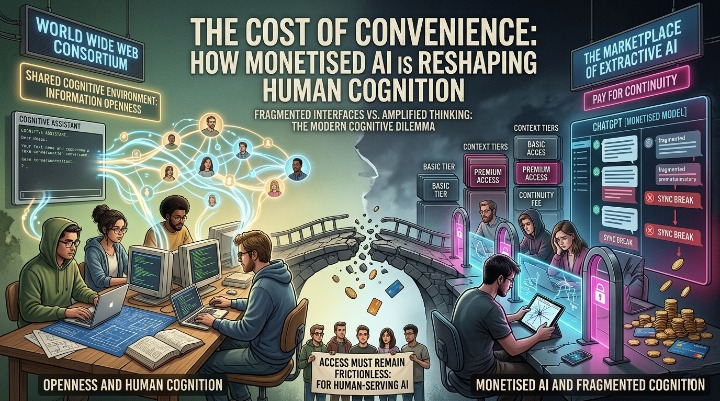
For much of the modern internet’s evolution, there existed an implicit social contract: access to information should remain broadly available, frictionless, and fundamentally human-serving. The early philosophical scaffolding of the web—shaped by institutions like the World Wide Web Consortium—was not built on extraction, but on openness. The internet was envisioned less as a marketplace and more as an infrastructure: a shared cognitive environment where knowledge could be created, exchanged, and expanded without constant transactional interruption.
The emergence of large-scale AI systems appeared, at first, to extend that vision. Tools like ChatGPT did not merely provide information; they amplified human cognition. They enabled long-form thinking, synthesis, and expansion of ideas at a scale that previously required teams, time, or institutional backing. A single interface could hold tens of thousands of words, sustain continuity across complex arguments, and function almost as an externalised cognitive partner.
But something has shifted.
What was once a seamless cognitive extension is increasingly becoming a fragmented experience. Tasks that previously existed within a single continuous flow now require multiple segmented interactions. Context windows close sooner. Continuity degrades. Synchronisation across conversations weakens—particularly for those outside paid tiers. The result is not merely an inconvenience of interface design. It is a restructuring of how cognition itself is deployed.
Under a psychextric lens, this shift reveals a deeper transformation. It exposes a trade-off between two fundamental modes of human reading and processing: Echo Reading and Reflective Reading.
Echo Reading is hippocampal. It is fluid, pattern-driven, and efficient. It allows individuals to move through large bodies of text with ease, recognising structure, flow, and familiarity without actively interrogating every line. It is the mode through which one reads novels, long essays, or extended arguments—absorbing meaning through continuity rather than dissection.
Reflective Reading, by contrast, is thalamic. It is effortful, deliberate, and analytical. It requires the active construction of meaning at every step. It is the mode of editing, proofreading, and critical evaluation. Every sentence must be weighed. Every structure must be assessed. It consumes significantly more cognitive bandwidth because it engages the full display-cortex in meaning construction rather than allowing pattern-recognition to carry the process.
When AI systems function optimally, they support Echo Reading. They produce coherent, continuous outputs that align with the brain’s natural preference for pattern-based absorption. The user can remain in flow, allowing the hippocampus to guide interpretation while the thalamus intervenes only when necessary.
But when synchronisation degrades—when outputs become inconsistent, when continuity breaks, when subtle inaccuracies emerge—the burden shifts.
The user is forced out of Echo Reading and into Reflective Reading.
They must now:
- verify coherence across segments,
- reconstruct meaning across broken contexts,
- detect inconsistencies that were previously handled by the system itself.
In effect, the AI no longer extends cognition—it redistributes it back onto the user, but in a more demanding form.
This is where monetisation introduces a cognitive asymmetry.
For paid users, continuity is preserved. The system maintains longer context windows, stronger synchronisation, and more stable outputs. Echo Reading remains viable. The cognitive load stays low relative to the scale of the task.
For free users, however, the experience increasingly requires fragmentation. More windows. More reconstruction. More verification. The same task now demands higher engagement of Reflective Reading—more time, more effort, more mental resources.
This is not simply a pricing model. It is a cognitive model.
It creates a stratification not just of access, but of cognitive efficiency. Two individuals may attempt the same intellectual task, but one operates in a low-friction, flow-based environment, while the other must continuously interrupt that flow to reassemble meaning.
Under psychextrics, this has direct implications for the display-cortex.
The thalamus, as the central relay and orchestrator of reflective processing, becomes over-engaged in conditions where it should not be. Instead of selectively refining meaning, it is forced into constant activation—monitoring, correcting, and reconstructing. Over time, this leads to cognitive fatigue, slower output, and reduced efficiency in complex tasks.
The irony is clear: a system designed to accelerate thinking begins to slow it down—not through lack of capability, but through imposed friction.
This also reveals something fundamental about the relationship between infrastructure and cognition. When tools are aligned with biological processing—when they support pattern continuity and minimise unnecessary interruption—they enhance human capability. But when they introduce fragmentation, they do not simply inconvenience the user; they alter the mode of thinking itself.
The broader implication is not limited to one platform.
It signals a shift in the philosophy of digital tools. The early internet reduced friction in accessing information. The current trajectory risks reintroducing friction at the level of cognition—subtly, incrementally, and often justified through tiered access models.
The question, then, is not whether monetisation is valid. It is whether the cost of that monetisation is being paid in cognitive bandwidth.
Because if the price of access is not only financial, but also neurological—if it requires more effort to think, to read, to create—then the system is no longer merely a tool. It becomes an environment that shapes behaviour itself.
And as psychextrics consistently reveals, the environment we operate within does not remain external. It enters us. It structures how we process. It defines how we perform.
In that sense, the evolution of AI platforms is not just a technological story. It is a cognitive one.
Back to: 👇