
The Philosophical Consequences: How Meaning Emerges from Behaviour Before Consciousness
BY: OMOLAJA MAKINEE
For centuries, Philosophy has treated consciousness as the beginning of behaviour. Thought was believed to precede action, intention was assumed to generate movement, and the conscious self was regarded as the supreme executive governing the organism. The ability to deliberate, choose, and reflect became the defining characteristic of human freedom, while behaviour was interpreted as the physical expression of conscious decisions.
Psychextrics reverses this traditional order. It proposes that behaviour is not constructed by consciousness but assembled beneath it. The cephalic hierarchy continuously negotiates survival, movement, memory, orientation, valuation, and behavioural continuity before any of these operations become consciously visible. By the time the conscious self experiences intention, the underlying behavioural architecture has already completed much of the work required for action.
Consciousness therefore functions primarily as a reflective system rather than an executive one.
This inversion carries profound philosophical consequences. If behaviour emerges before conscious awareness, then long-established assumptions about freewill, identity, agency, and meaning require fundamental reconsideration.
The human organism can no longer be understood as a singular thinker directing a unified behavioural system from above. Instead, it becomes a layered behavioural civilisation composed of multiple interacting biological systems that negotiate continuously beneath awareness.
Consciousness does not govern this civilisation; it observes, interprets, and symbolically organises the behavioural realities already produced by it.
1. From the Singular Thinker to the Behavioural Civilisation
The most immediate implication of the Psychextric model is the dissolution of the classical image of the autonomous mind.
Traditional Philosophy frequently describes the individual as a unified decision-maker who deliberately constructs behaviour through conscious reasoning. Under Psychextrics, however, behaviour is distributed across specialised cephalic systems, each performing distinct biological functions long before conscious reflection begins.
- The Myelencephalon negotiates visceral survival.
- The Metencephalon stabilises movement.
- The Mesencephalon maintains spatial orientation.
- The Diencephalon evaluates behavioural significance.
- The Siencephalon integrates behavioural continuity.
Only after these processes have already negotiated with one another does the revised Telencephalon render their integrated outcome into conscious experience.
Rather than one mind directing many processes, many processes continuously construct what later appears to be one mind.
The self therefore becomes the visible representative of a hidden behavioural civilisation rather than its sovereign ruler.
2. Reactive and Proactive Consciousness
Within this behavioural civilisation, Psychextrics distinguishes between two complementary modes of conscious organisation.
Reactive consciousness operates through emotional template valence. Its primary responsibility is behavioural continuity.
It maintains established patterns of movement, habit, posture, expectation, procedural familiarity, and emotional predictability. These behaviours require minimal conscious concentration because they rely upon behavioural templates continually rebroadcast through the Siencephalic memory architecture.
Proactive consciousness operates differently. Instead of maintaining behavioural continuity, it introduces behavioural organisation.
It depends upon increases in emotional intensity that temporarily elevate physiological resources, sharpen attentional focus, and permit intelligent adaptation to circumstances that cannot be solved by previously established behavioural templates.
Both systems cooperate continuously. Reactive consciousness preserves continuity. Proactive consciousness introduces adaptation.
Together they allow behaviour to remain simultaneously stable and flexible.
3. The Behavioural Foundations of Meaning
This distinction leads directly to one of the deepest philosophical questions within Psychextrics.
How does consciousness derive meaning from neural activity?
Conventional Neuroscience often assumes that meaning emerges from computation itself or from higher cortical processing. Psychextrics proposes something different.
Meaning is not contained within isolated neural signals. Nor is meaning an intrinsic property of sensory information. Instead, meaning emerges through interruption.
The lower Local Functional Units maintain continuous behavioural templates that allow the organism to function automatically. Walking, breathing, balancing, navigating familiar environments, maintaining posture, and countless habitual operations proceed with remarkably little conscious effort because they remain embedded within ongoing reactive continuity.
Within these continuous behavioural streams, nothing requires conscious interpretation. Behaviour simply unfolds. Only when this continuity is interrupted does meaning emerge.
4. The Interval Interruption Principle
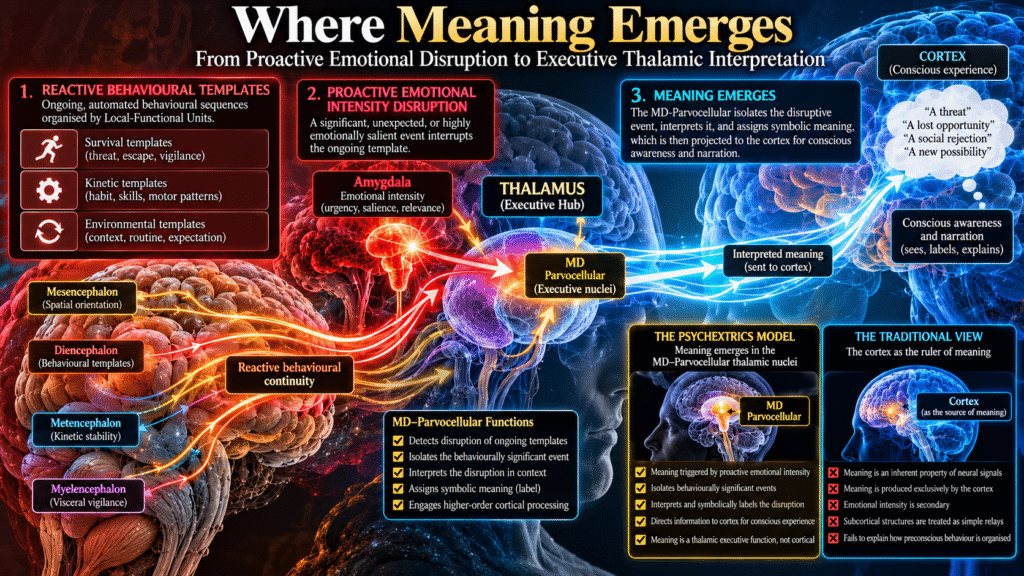
Psychextrics proposes that meaning originates precisely at the point where proactive emotional intensity disrupts reactive behavioural continuity.
Under ordinary conditions, reactive behavioural templates operate continuously beneath awareness. The organism remains immersed within automated behavioural flow.
When an unexpected event, internal conflict, environmental anomaly, or biologically significant change produces a rapid alteration in the Hormonal Fluidity Index (∆HFI), emotional intensity rises abruptly.
This neurochemical surge interrupts the ongoing behavioural baseline. The interruption forces the uncaptured Mediodorsal-Parvocellular thalamic nuclei to isolate the disturbance from the previously continuous behavioural background. Only then does its conscious interpretation become necessary.
Meaning therefore appears because behavioural continuity has been broken. Without interruption there is no requirement for conscious labelling from the MD-Parvocellular. The event simply remains another component of behavioural flow.
Meaning is therefore generated not by isolated signals but by the behavioural contrast between uninterrupted continuity and sudden deviation.
5. How Consciousness Labels Experience
Once proactive intensity interrupts the reactive baseline, the MD-Parvocellular performs a unique operation. Rather than generating the behaviour itself, it identifies the interruption.
- It distinguishes the exceptional event from the ordinary behavioural background.
- It assigns symbolic representation.
- It constructs narrative.
- It produces language.
- It labels the behavioural event.
The conscious individual therefore experiences the emergence of meaning precisely because behavioural continuity has been disturbed.
The symbolic act of naming does not create behavioural significance. It follows behavioural significance.
Meaning becomes the conscious recognition of a structural interruption that has already occurred beneath awareness.
6. Rethinking Human Freedom
If meaning itself depends upon neurobiological interruption rather than purely conscious decision, classical notions of freewill become increasingly difficult to sustain.
Traditional freewill assumes that an independent conscious observer initiates action through detached rational choice.
Psychextrics argues instead that both reactive templates and proactive intensity emerge from biological organisation occurring prior to conscious narration.
- Reactive behaviour originates from inherited behavioural architecture, accumulated experiential modification, and ongoing physiological regulation.
- Proactive intensity likewise depends upon the interaction between genetic predisposition, environmental adaptation, hormonal regulation, behavioural buffering, and current physiological state.
Neither system originates independently from conscious intention.
The uncaptured MD-Parvocellular, acting as the brain’s primary conscious narrator, therefore observes the behavioural negotiation after much of it has already taken place.
7. The Psychextric Definition of Willpower
Rejecting classical Freewill does not eliminate agency. Instead, Psychextrics replaces it with a biologically measurable concept: Willpower.
Within this framework, Willpower is not an abstract psychological virtue or moral characteristic. It is a structural property of the nervous system itself.
Willpower is defined as the biological capacity of proactive emotional intensity to stabilise, regulate, and maintain reactive behavioural templates within an intelligible long-term trajectory despite changing physiological conditions.
It represents the ability of proactive thalamic organisation to preserve strategic behavioural coherence while reactive Local Functional Units continually generate competing survival demands.
The greater the structural resilience of the proactive system, the longer intelligent behavioural trajectories remain intact under pressure.
Willpower therefore becomes a measurable property emerging from the interaction between inherited biological architecture, accumulated behavioural adaptation, hormonal regulation, and Siencephalic buffering rather than from detached conscious choice alone.
8. The Behavioural Civilisation in Conflict
The human organism therefore resembles neither a dictatorship nor a democracy. It resembles a civilisation.
Within every behavioural moment, specialised biological systems continuously negotiate priorities.
- Some systems advocate immediate survival.
- Others preserve behavioural continuity.
- Others construct long-term strategy.
- Others maintain emotional stability.
- Others update memory.
- Others evaluate significance.
Under ordinary circumstances these competing systems cooperate sufficiently to produce coherent behaviour.
When behavioural buffering remains strong, proactive organisation successfully coordinates reactive demands into unified action. The organism appears calm, deliberate, and intentional.
However, under conditions of extreme physiological instability, reactive systems increasingly dominate behavioural organisation.
- The internal civilisation fragments.
- Survival vigilance overwhelms strategic reasoning.
- Kinetic stability deteriorates.
- Spatial orientation narrows.
- Behavioural continuity breaks down.
The MD-Parvocellular, conscious narrator, remains present throughout this collapse, but it no longer directs events. Instead, it attempts to explain them after they have already unfolded.
9. Identity as Behavioural Reconstruction
One final philosophical consequence follows naturally from this architecture.
If consciousness continuously reconstructs behavioural events that originated beneath awareness, then personal identity itself becomes dynamic rather than fixed.
Identity is not a permanent entity residing within one anatomical location. Nor is it an immutable psychological essence.
Instead, identity becomes the ongoing behavioural reconstruction produced through continuous interaction among reactive continuity, proactive organisation, Siencephalic integration, Diencephalic valuation, and Telencephalic symbolic rendering.
The self therefore exists as an evolving behavioural narrative generated from deeper biological negotiations that never become directly accessible to consciousness itself.
What appears to be one stable individual is, in reality, the continuously updated public face of a remarkably complex biological civilisation.
Conclusion
The philosophical implications of Psychextrics extend far beyond Neuroscience. By proposing that behaviour precedes consciousness, the framework challenges long-standing assumptions about freewill, agency, personality, and the nature of subjective experience.
Meaning is no longer treated as an inherent property of neural signals or as the exclusive product of conscious reasoning. Instead, it emerges whenever proactive emotional intensity interrupts the ongoing continuity of reactive behavioural templates, compelling the executive MD-Parvocellular thalamic nuclei to isolate, interpret, and symbolically label the disruption. In this view:
Consciousness becomes an interpreter of behavioural change rather than its original architect.
This reorganisation also transforms the concept of human agency. Freewill gives way to Willpower—not as an abstract moral capacity, but as the structural ability of proactive behavioural organisation to maintain coherent trajectories against the competing pressures of reactive survival systems.
The human organism is therefore better understood not as a singular thinker directing behaviour from above, but as a layered behavioural civilisation whose specialised systems continually negotiate beneath awareness. The conscious self is the reflective surface upon which these negotiations become visible.
As the discussion now turns toward the revised Telencephalon, attention shifts from the hidden engines that assemble behavioural reality to the cortical display that symbolises, renders, and ultimately allows that reality to be consciously experienced.
Back to: 👇