
The Hormonal Index Marker (HIM): Establishing the Biological Scaffolding of Duality
BY: OMOLAJA MAKINEE
I. Defining the HIM Framework
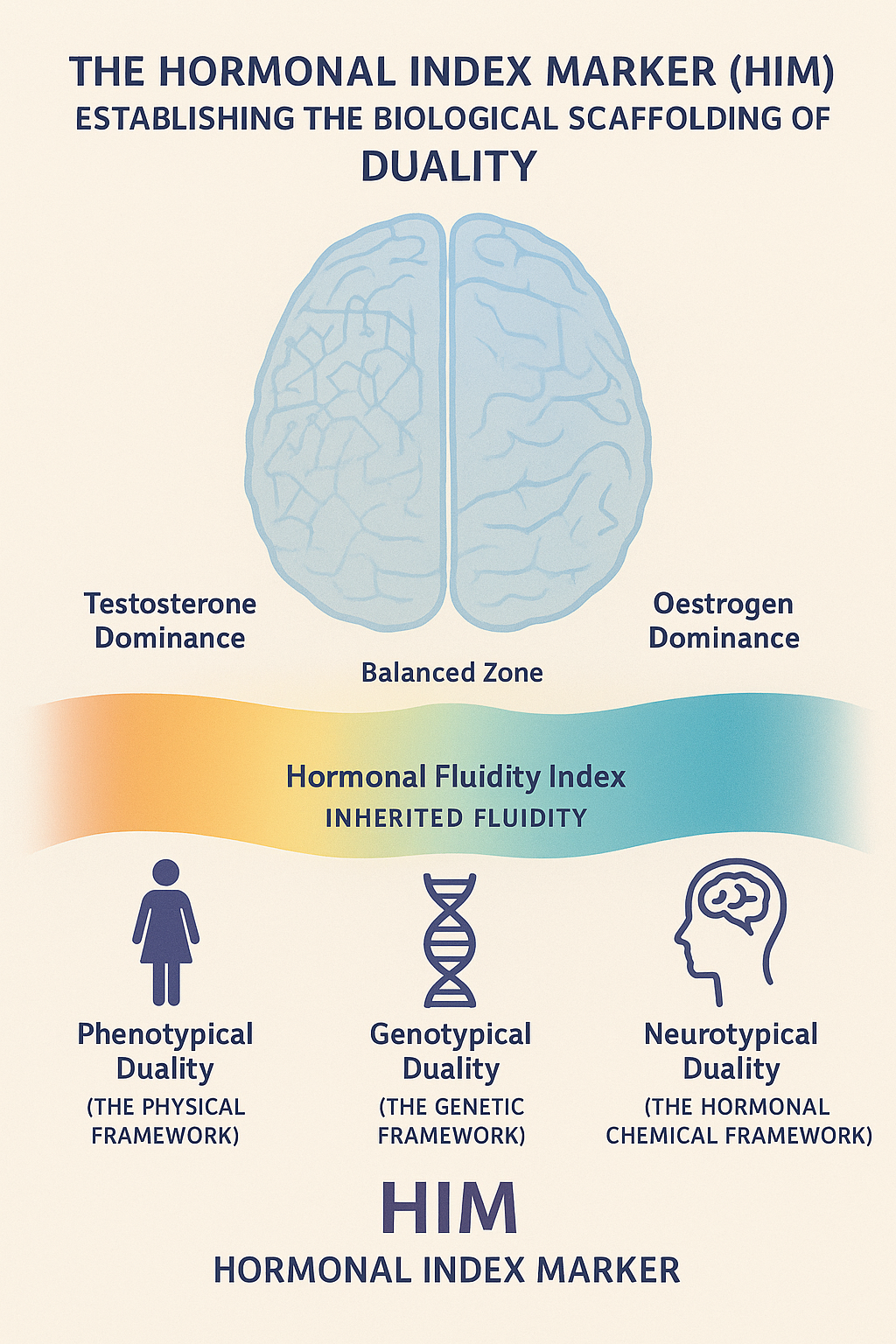
The Hormonal Index Marker (HIM) represents the foundational biological architecture through which the duality of human sex and hormonal design is expressed. It describes the structural integrity of how the phenotype, genotype, and neurotype interlock to form the scaffolding of gendered biology.
In the psychextrical model, this tripartite system is not merely anatomical or genetic—it is behaviourally architectural, encoding how hormonal interactions determine the baseline upon which logic and emotion evolve in human expression.
Unlike the Hormonal Fluidity Index (HFI)—which operates dynamically through inheritance, environment, and neurochemical adaptation—HIM is static, belonging to the architectural constants of biology. Its design establishes the “housing” in which hormonal fluidity manifests, much like a framework that defines the boundaries within which dynamic processes unfold.
II. The Three Axes of Duality in HIM
1. Phenotypical Duality (The Physical Framework)
The phenotypical axis represents the visible expression of sex, wherein the chromosomes XX and XY manifest the architectural template of female and male bodies respectively.
Here, HIM governs the external reproductive anatomy and hormonal configuration that defines sexual phenotype.
- Normal Condition: Clear male or female physical form, functioning reproductive organs, and corresponding secondary sexual characteristics.
- Abnormal Condition: Divergent physical manifestations—such as intersex variations, incomplete sexual differentiation, or ambiguous reproductive organs. These are not products of inheritance fluidity but of architectural deviation within the HIM framework itself.
Thus, the phenotypical HIM reflects architectural duality, not behavioural diversity. It operates at the blueprint level, defining physical sex as a binary baseline.
2. Genotypical Duality (The Genetic Framework)
The genotypical axis represents the biochemical encoding of duality, embedded in the sex chromosomes (XX or XY). This defines the chromosomal blueprint from which hormonal potentialities arise.
- Normal Condition: Stable chromosomal pairing (XX or XY) corresponding to reproductive viability.
- Abnormal Condition: Infertility, chromosomal anomalies (e.g., XXY, X0, mosaicism), or genetic disorders affecting sex determination. These are not expressions of fluidity but structural anomalies within the HIM framework—a malfunction in the architectural script of biological duality.
Thus, genotypical HIM defines the root biological instruction, whereas fluid hormonal variations belong to its operational dynamics (HFI).
3. Neurotypical Duality (The Hormonal Chemical Framework)
At the neurotypical level, HIM defines how hormonal chemicals interface with the brain’s architectural nuclei—notably the thalamic and hypothalamic systems—to regulate emotion, logic, and behavioural equilibrium.
- Normal Condition: Testosterone in males and oestrogen in females act in complementary harmony with cortical pathways, establishing heterosexual alignment as the baseline or default state of human sexual behaviour. This alignment sustains a balanced spectrum of logical and emotional outputs consistent with the biological architecture of HIM.
- Abnormal Condition: Neurotypical divergence results in atypical hormonal interactions that inherently manifest as homosexual, lesbian, bisexual, or non-binary behavioural orientations. However, some of these are not malfunctions but expressions of inherited hormonal fluidity (HFI) operating within the stable architectural duality of HIM.
Thus, HIM sets the dual biological framework upon which human behaviour is organised, while HFI governs the fluid emotional and logical variance that defines individual behavioural expression.
These represent HIM-level abnormalities, meaning that the divergence occurs within the constitutional framework of hormonal biology itself, rather than its behavioural operations. They are not defects, but constitutional variations that alter the baseline configuration of hormonal architecture.
However, within these same orientations—and also among heterosexuals—HFI-level abnormalities may emerge on a spectrum. These may occur not in the biological framework, but in the fluid behavioural layer that governs how hormones interact epigenetically and express through behaviour. Such manifestations include tendencies toward cross-dressing, drag performance, femboy or tomboy presentation, and other forms of gender-expression fluidity that do not necessarily redefine sexual orientation or sex hormone but reflect the adaptive flexibility of hormonal behaviour.
In essence, while HIM abnormalities redefine what the individual hormonally is within the dual biological spectrum, HFI abnormalities redefine how that hormonal inheritance behaves within social, emotional, or expressive contexts. Both coexist within the psychextrical continuum: HIM as the structural constant, and HFI as the behavioural variable.
From a psychextrical and evolutionary standpoint, heterosexual alignment represents the biological equilibrium between the architectural (HIM) and behavioural (HFI) frameworks. This equilibrium ensures the continuity of species through procreative compatibility, linking the dual hormonal design—testosterone and oestrogen—to the neurotypical circuitry that balances logic and emotion. In essence, heterosexuality emerges as the natural neurotypical baseline, not as a social construct, but as a biogenetic default shaped by the architecture of survival.
However, this baseline does not exclude behavioural diversity; rather, it provides the reference point from which variations of HFI fluidity may express as non-heteronormative orientations. These variations signify hormonal fluid reconfigurations within the cortical and limbic systems—expressions of inherited flexibility rather than structural anomalies. Psychextrics thus recognises heterosexual alignment as the neurotypical constant, and all other orientations as adaptive spectrums within the continuum of emotional and logical evolution.
Within the neurotypical duality, the abnormalities of HIM can also be observed in the behavioural symmetry of sexual response patterns. For instance, under the normal condition, male sexual behaviour is biologically constrained by the ejaculation reflex—an endpoint that halts further engagement—whereas the female sexual sequence typically sustains continuity beyond orgasmic peaks, allowing cyclical arousal and prolonged engagement. Yet, a minority within each sex demonstrates inverse response architecture: some women experience an abrupt cessation of arousal post-orgasm, mirroring the male pattern; while some men exhibit sustained post-orgasmic engagement, mirroring the female pattern.
Psychextrically, such inversions are not pathologies but manifestations of static HIM abnormalities, where the architectural duality of hormonal mapping expresses cross-sex behavioural templates within an otherwise stable biological framework. These anomalies correlate with inherited variations of hormonal encoding that can predispose to homosexual, bisexual, or non-binary orientations, reinforcing that HIM abnormalities also represent architectural reconfigurations, not malfunctions, of the neurotypical sexual design.
Epigenetic Modulation of Behavioural Fluidity
A practical demonstration of this inverse response architecture can be observed in the pharmacological use of Viagra and similar vasodilatory agents. Under ordinary HIM conditions, male sexual behaviour is terminated by the ejaculation reflex, governed by testosterone-linked neurovascular closure that signals the end of arousal. However, when Viagra is introduced, it temporarily suppresses this natural terminus, prolonging vasodilation and sustaining post-ejaculatory engagement. In effect, the drug induces a reversal of the male response pattern, allowing the male to mimic the female’s cyclical continuity beyond orgasmic peaks.
Psychextrically, this reveals a critical distinction: Viagra does not alter the man’s HIM—it cannot restructure the biological architecture that defines male sex reflexes—but it epigenetically modulates the HFI, altering hormonal responsiveness at the neurochemical level. The fact that this state persists only while the chemical remains active in the body demonstrates the epigenetic lifespan of HFI modulation, which is transient and non-heritable. This pharmacological mimicry shows that HFI can be programmed, suppressed, or enhanced through biochemical or environmental influence, while HIM remains genetically fixed. Thus, drugs like Viagra offer a vivid example of epigenetic reprogramming of behavioural fluidity without architectural alteration—evidence that while the body’s design is immutable, its hormonal performance remains deeply adaptive and programmable.
The psychextrical framework recognises that behavioural fluidity is not fixed, but rather epigenetically programmable through biological, environmental, and psychological stimuli. This means that an individual’s HFI (Hormonal Fluidity Index) can be influenced—sometimes subtly, sometimes dramatically—by the chemical and social conditions to which the body and brain are exposed.
For instance, just as Viagra pharmacologically extends male arousal beyond its architectural limit, environmental and dietary factors can likewise alter the tempo and strength of hormonal responses. Diets rich in phytoestrogens (such as soy products), exposure to endocrine-disrupting compounds in plastics or cosmetics, and chronic stress—all have measurable effects on the body’s neurotypical relay between thalamic and hypothalamic nuclei, which are the regulators of hormonal secretion. These changes do not rewrite the HIM (the biological framework of duality), but they temporarily shift the internal balance of HFI, leading to behavioural variations such as altered libido, emotional reactivity, or cognitive pacing.
Similarly, psychological environments—prolonged exposure to empathy-demanding professions, artistic training, or even high-stress leadership roles—can epigenetically recalibrate the thalamic relay pathways, producing heightened emotional or logical dominance irrespective of gender. Under psychextrical analysis, these variations are not random but adaptive recalibrations of HFI, designed by evolution to allow neurotypical survival within changing environmental and social contexts.
What this reveals is profound: while HIM defines the immutable blueprint of sex and biological duality, HFI operates as the living code, responsive to chemistry, environment, and cognition. The epigenetic modulation of HFI—whether through medicine, diet, or life experience—demonstrates that human behaviour is a programmable spectrum rather than a fixed binary. Psychextrics thus positions itself at the intersection of neurotype genetics, behavioural endocrinology, and adaptive epigenetics, offering a new frontier in understanding—and eventually treating—the human condition not by gender, but by fluid neurotype orientation.
III. The Distinction Between HIM and HFI
| Aspect | HIM (Hormonal Index Marker) | HFI (Hormonal Fluidity Index) |
|---|---|---|
| Nature | Architectural / Static | Inherited / Dynamic |
| Scope | Phenotype, Genotype, Neurotype Framework | Emotional, Logical, and Behavioural Expression |
| Basis | Defines dual biological structure (XX/XY) | Defines inherited hormonal interaction patterns |
| Abnormalities | Present as structural deviation | Present as natural fluidity |
| Inheritance | Inheritable pathway via fixed biological blueprint | Inheritable pathway via epigenetic transmission |
| Analytical Focus | Biological Architecture and Baseline | Hormonal-Cortical Dynamics and Fluidity |
| Default State | Heterosexual Duality | Fluid Continuum of Logic and Emotion |
IV. The Psychextrical Interpretation
Within Psychextrics, HIM is the constitution of biology, whereas HFI is its legislature of behaviour.
HIM defines what can be built; HFI determines how it behaves once built.
In this framework:
- HIM ensures that human biology maintains its dual framework (male and female), even though fluidity exists internally.
- HFI ensures that human behaviour, emotion, and logic operate across an inherited continuum—fluid, adaptive, and epigenetically mutable.
Therefore, although the internal hormonal operations (HFI) are fluid, they remain nested within the external architectural duality (HIM), including within their respective abnormalities.
This explains why heterosexuality remains the biological baseline, yet behavioural fluidity continues to appear across all sexes—not only as an abnormality, but can also be as an inheritance constraint of hormonal interaction.
This also explains why a homosexual man may exhibit full testosterone presence in his Hormonal Index Marker (HIM)—the biological framework of maleness—while simultaneously expressing heightened oestrogenic attributes within his Hormonal Fluidity Index (HFI). Likewise, a lesbian woman may carry a complete oestrogenic HIM consistent with female biological architecture, yet manifest elevated testosterone-driven behavioural or cognitive patterns within her HFI. The same principle applies across the diverse spectrum of non-binary behavioural orientations, where the interplay between HIM and HFI creates unique configurations of emotion, logic, and attraction.
However, it is the epigenetic modulation that determines how these HFI variants are expressed. Environmental factors such as diet, stress, medication, exposure to chemicals, or even sustained visual and social stimuli can activate dormant genetic expressions within the neurotypical architecture, reprogramming the behavioural hormones in real time. Under psychextrical science, this means that HIM remains the immutable biological constitution—alterable only by surgical intervention or genetic modification—whereas HFI is inherently adaptive and treatable through epigenetic pathways.
In other words, while HIM defines what one is built as, HFI defines how one behaves within that build. The psychextrical approach therefore distinguishes between the fixed architectural design of biology and the fluid legislative behaviour of hormones, showing that human diversity is not a deviation from nature, but a continuum of inherited and environmental harmonics acting through neurotype genes, hormonal chemistry, and cortical interpretation.
V. The Psychextrical Implications of Hormonal Modification
Within the psychextrical framework, the distinction between HIM (the architectural constant) and HFI (the behavioural continuum) becomes crucial in evaluating the scientific and ethical implications of sex change through hormone therapy.
What this study reveals is that HFI activation is a naturally occurring phenomenon. It arises through the interplay of epigenetic triggers, environmental factors, and inherited neurotypical predispositions. When an individual experiences a mismatch between their behavioural expressions (HFI) and their biological architecture (HIM), the result is an internal conflict between fluidity and duality—a psychological state modern society interprets as gender dysphoria.
However, hormone therapy for sex change, under psychextrical interpretation, represents an artificial induction of HIM abnormality through synthetic hormone intervention. In essence, it is the deliberate attempt to realign behavioural fluidity (HFI) with the opposite biological framework (HIM) by pharmacological force. Such intervention does not modify the architectural blueprint; instead, it chemically superimposes a secondary hormonal layer over the existing genetic structure.
This process, while externally transformative, does not reprogram the genotype-driven architecture of HIM. Instead, it creates dual hormonal conflicts within the body—one organic and one synthetic—resulting in heightened instability across the emotional–logical spectrum. From a generational perspective, this artificial interference may also influence epigenetic transmission, potentially amplifying or introducing new variants of hormonal abnormalities in offspring, as synthetic hormones interact with the genetic programming of germ cells.
Therefore, under the principles of Psychextrics:
- Any modification to HIM should only be approached through surgical alignment, which respects the architectural duality of the biological framework, rather than through synthetic hormonal mimicry.
- Treatments targeting HFI, on the other hand, remain therapeutically valid, since HFI operates within the behavioural and epigenetic spectrum, and can be modulated safely through environmental, psychological, or biochemical regulation.
The lesson is scientifically clear: HIM is genotypically programmed and forms the stable constitution of the human framework, while HFI is epigenetically programmable and expresses the flexible range of human behaviour. Intervening in HFI is an act of modulation; intervening in HIM through artificial hormones is an act of biological contradiction.
In summary, psychextrics warns that tampering with HIM through synthetic means may not only disrupt individual equilibrium but could gradually distort the natural architecture of the species’ hormonal blueprint. By contrast, guiding HFI through psycho-behavioural and epigenetic therapies honours the harmony between the biological duality and behavioural fluidity that defines the human condition.
The Bioethical Reflection: Treating Architecture vs. Expression
The psychextrical model draws a line of moral and scientific distinction between treating the architecture of being and treating the expression of being. To alter the architecture (HIM) is to attempt to rewrite the biological constitution upon which life itself is engineered. To guide the expression (HFI) is to accompany the natural variability of human experience, where emotion, cognition, and identity are allowed to find balance within inherited constraints.
Modern medicine, in its zeal to provide relief to the dysphoric mind, has too often chosen the path of architectural interference over behavioural alignment. Hormone therapy, when used to enforce conformity to societal gender narratives, risks crossing the thin boundary between care and coercion — between guiding nature and attempting to redesign it. Psychextrics cautions that the true therapeutic act lies not in suppressing the body to mirror the mind, but in harmonising the body and mind within the natural range of fluidity permitted by the biological framework.
In this philosophy, bioethics must evolve beyond the binaries of right and wrong treatment to a higher principle: architectural sanctity. The HIM represents the biological covenant — the unalterable foundation of human duality — while the HFI represents the spectrum of behavioural adaptation within that covenant. To interfere with the covenant through synthetic hormones is to risk a cascade of biological misalignments whose echoes may persist through generations.
Future medicine, guided by psychextrical insight, must therefore differentiate between restoration and redesign:
- Restoration honours the inherited architecture (HIM) and regulates the behavioural fluidity (HFI) to achieve inner equilibrium.
- Redesign attempts to remodel architecture itself, mistaking the fluidity of expression for the malleability of biology.
Psychextrics urges humankind to remember that to heal is to listen to the code of nature, not to rewrite it. The task of science is not to re-engineer human duality, but to illuminate and harmonise the spectrum within it — for therein lies the balance of logic, emotion, and identity that defines the totality of the human psyche.
Conclusion: The Scientific Implication
This psychextrical interpretation challenges the assumption that XX and XY alone define gender, emotion, or sexuality.
Instead, it proposes that the architecture of duality (HIM) and the inheritance of fluidity (HFI) coexist in a complementary hierarchy:
- HIM defines what we are biologically capable of being.
- HFI defines how we emotionally and logically express that capability.
The failure of modern science to distinguish these two dimensions has led to the conflation of chromosomal biology with behavioural diversity.
Psychextrics, by contrast, separates the architectural from the adaptive, the biological from the behavioural, and the dual from the fluid—thus introducing the Hormonal Index Marker (HIM) as a fundamental premise for decoding human neurotype and behavioural genetics.
Back to: 👇