
From Populism to Populocracy: How the People Turned Inward and Became the State
BY: OMOLAJA MAKINEE
Introduction: Populism as the Eternal Seed
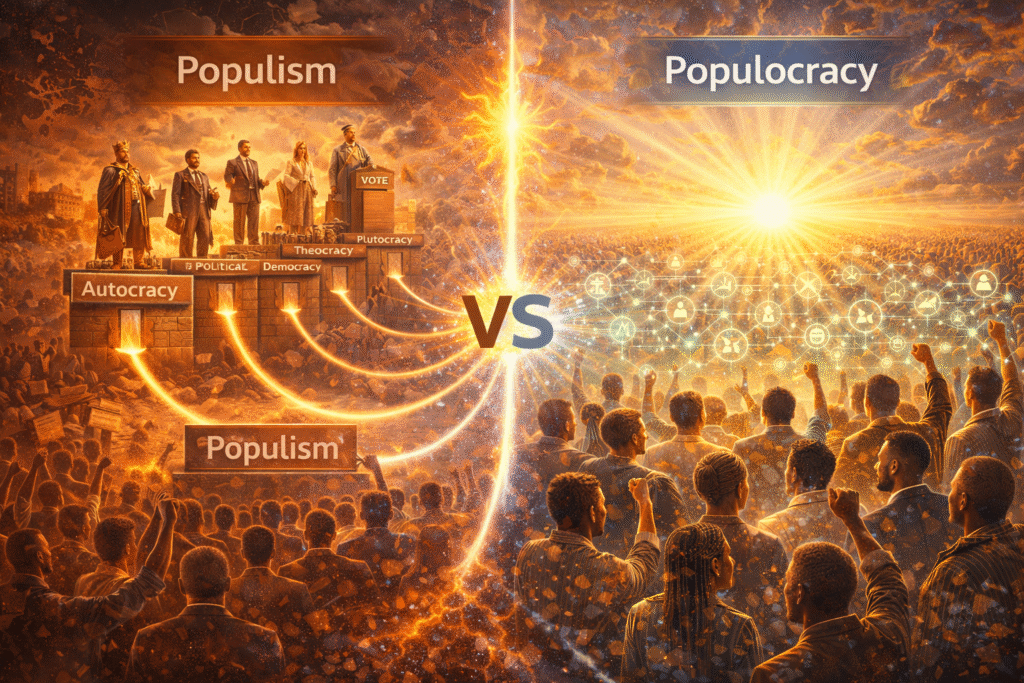
Populism is not an ideology. It is a condition. It is the persistent will of a people to assert meaning, demand relevance, and project collective intent into the structure that governs them. Across human history, no system of governance—regardless of how rigid, divine, or authoritarian it claimed to be—has ever existed without first standing on a populist podium.
Autocracy mobilises the people through fear and loyalty. Aristocracy through tradition and lineage. Meritocracy through expertise. Theocracy through divine populism. Plutocracy through economic persuasion. Political Democracy through electoral promise.
Each system, though styled differently, relies on populist expression to mobilise compliance, legitimacy, or transformation. This reveals a critical truth: populism is the precondition of governance, not its by-product.
Yet until now, populism has always been externalised—forced to express itself through an already-existing structure of rule. It shouted from below while power sat above. Populocracy is the moment when populism stopped shouting outward—and evolved inward.
1. The Inward Turn: When Populism Became Self-Aware
The decisive rupture in political history occurred not when people demanded representation, but when they demanded direct authorship of governance. This was not a revolution of streets and barricades. It was a revolution of consciousness.
Populism turned inward—away from overthrowing rulers and toward constructing a system where rulers became unnecessary. This inward evolution marked the transition from populism as mass protest to populocracy as governance structure.
An inward evolution is not reactionary. It is developmental. It occurs when a force recognises that external opposition cannot resolve internal contradiction. Populism realised that protesting governments did not free the people—because protest itself presupposed separation between ruler and ruled.
Populocracy dissolved that separation.
2. Why All Other Systems Require Protest—and Populocracy Does Not
In every inherited system of governance, the protesters are not the decision-makers. That is why protest exists.
- In political democracy, citizens protest representatives.
- In autocracy, citizens protest rulers.
- In oligarchy, citizens protest elites.
- In theocracy, citizens protest dogma.
- In plutocracy, citizens protest capital.
Protest is the voice of exclusion.
Populocracy renders protest structurally obsolete—not by suppressing dissent, but by embedding dissent directly into governance architecture. Those who would protest are already the decision-makers. Objection becomes deliberation. Resistance becomes vote. Dissent becomes policy revision.
Where protest once stood outside power, populocracy internalises it as continuous self-correction. This is why populocracy cannot coexist with any system where a government rules over the people. The two logics are mutually exclusive.
- Either the people rule themselves, or
- A government rules over them.
There is no hybrid. There is no compromise. There is only one-way.
3. Democracy’s Fatal Flaw: Externalised “People Rule”
Political democracy emerged as an external ideology of “rule by the people,” but structurally it never trusted the people with power. Instead, it outsourced authority to representatives. This single decision rendered democracy corruptible.
Representation creates distance. Distance creates discretion. Discretion creates elite capture. Political democracy did not fail because people disengaged. It failed because people were never truly engaged beyond episodic voting.
Populocracy corrects this error by abolishing representation as a governing intermediary. There are no representatives to corrupt because policy authority resides permanently with the governed themselves.
This is not radical idealism. It is architectural realism.
4. Web-Internetisation: The Incubator of Populocracy
Populocracy did not emerge from political theory—it emerged from technological reality. The web-internetisation of human society fundamentally altered three conditions of governance:
- Information asymmetry collapsed.
- Collective deliberation became scalable.
- Decision-making became distributable.
For the first time in history, millions could deliberate, verify, challenge, and decide in real time, without mediation.
What began as online discourse evolved into digital self-organisation. Communities governed themselves informally long before States recognised it. Platforms became proto-parliaments. Forums became courts of opinion. Consensus formed without permission.
Populocracy was already functioning socially before it was articulated politically. This Manifesto does not invent populocracy. It transfers it—from the digital commons to State governance.
5. Populocracy Defined: Governance Without Rulers
Populocracy is not rule for the people. It is not rule on behalf of the people. It is rule by the governed themselves—absolutely.
Under populocracy:
- Policy originates from the populace.
- Deliberation is collective.
- Authority is non-delegable.
- Governance is continuous, not episodic.
- Law is an evolving social contract, not a fixed elite decree.
Regulation exists—but as self-regulation. Law exists—but as collective discipline. Order exists—but without domination. This is why populocracy cannot be corrupted. Corruption requires intermediaries. Populocracy abolishes them.
6. The Highest Stage of Governance
Populocracy represents the most advanced stage of State governing evolution—not because it is perfect, but because it is complete. It closes the loop between:
- Power and responsibility.
- Freedom and regulation.
- Rights and obligation.
- Individual expression and collective welfare.
Under a populocratic order, individuals are free to express the full breadth of their identities, ideas, and aspirations—yet remain regulated under laws they author themselves. Such regulation is not coercive; it is preservative. It safeguards public welfare, economic stability, social harmony, moral balance, and the freedoms of future generations.
This is governance as collective self-awareness.
Conclusion: The End of Inherited Rule
All previous systems of governance were transitional. They ruled over humanity while humanity learned how to rule itself.
Populocracy is not an ideology competing with democracy, autocracy, or oligarchy. It is the termination point of that lineage. Once the people govern themselves, no authority above them can remain legitimate.
The question is no longer whether populocracy will emerge—but whether States will resist it long enough to collapse under their own irrelevance.
Populocracy is not coming. It is already here. This manifesto merely gives it form.
Back to: 👇