
From Monarchy and Republicanism to Ethnopublican Statehood: Why Mixed-Form Governance Has Failed and Why a Third System Is Necessary
BY: OMOLAJA MAKINEE
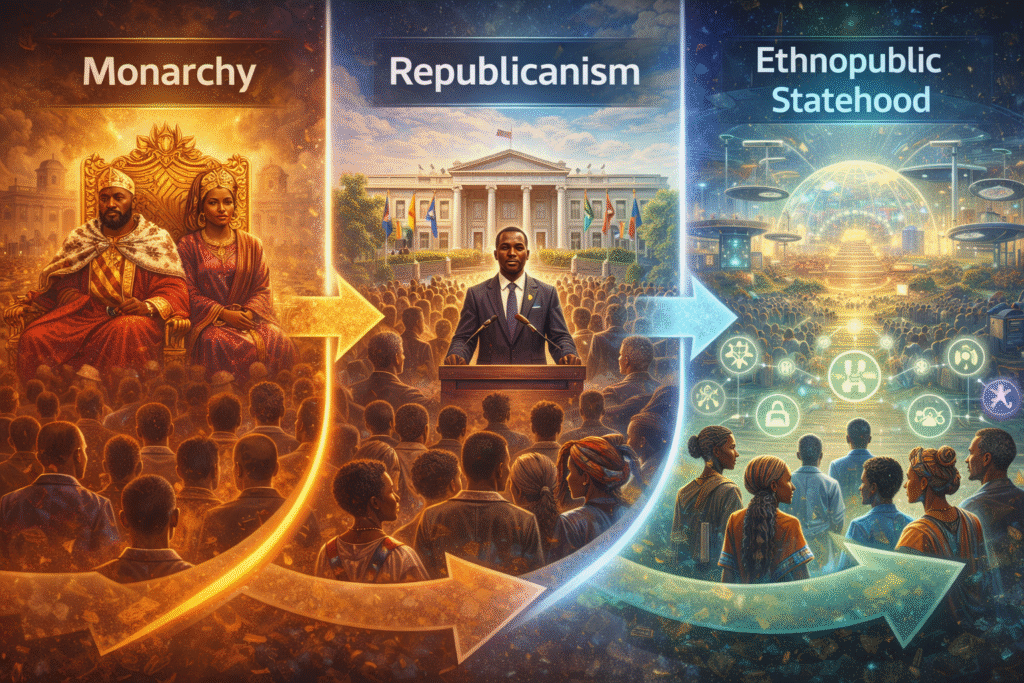
For centuries, the architecture of human State systems has been dominated by two overarching nationalist structures: Monarchy and Republicanism. Each emerged as a response to the limitations of its predecessor. Each claimed legitimacy. And each, in practice, proved structurally vulnerable to elite capture, power oscillation, and systemic disorder.
Western Monarchy exercised a single formal system of governance: autocracy. Power was concentrated in one sovereign authority. Yet beneath this apparent simplicity, monarchy concealed a volatile internal reality. Its daily operational mode was never fixed. Depending on the personality, temperament, and interests of the ruler, monarchical governance could operate as oligarchy, aristocracy, dictatorship, anarchy, or even crude populism. The system itself did not regulate power; the sovereign’s character did.
Republicanism emerged as a revolt against this concentration of authority. By dethroning monarchy, republics sought to replace hereditary power with civic legitimacy. Yet almost immediately, republicanism encountered two fundamental crises.
First, democracy as a singular governing form proved too restrictive for the complexities of State administration. Second, unlike monarchs, politicians could not be granted broad discretionary autonomy in daily governance without recreating tyranny under another name. The republican solution was constitutionalism: codified rules, separation of powers, regulations, and legal constraints designed to bind political actors within fixed limits.
But this solution introduced a deeper contradiction.
Republicanism retained class-based organisation and partisan politics, and with them, a mixed-form governance structure. While citizens were rhetorically positioned within democracy, the internal operation of State power oscillated unpredictably. The judiciary and legislature appeared democratic when “checking” each other, oligarchic when protecting elite interests, autocratic when enforcing executive discretion, and technocratic when convenient. Governance ceased to be principled and became situational.
In practice, there is no substantive difference between the power exercised by monarchy and that exercised by republics. In both systems, internal daily governance is not structurally fixed but shifts according to the personality, ideology, and ambitions of those exercising Executive power—who remains head of government over both judiciary and legislature.
The problem is compounded by the reality that republican political leaders often serve multiple terms. Over time, their governing style becomes embedded into institutions, bureaucracies, legal interpretations, and enforcement cultures. When leadership changes, the system itself resists transformation. Politics, structured around two or more competing partisan camps, narrows societal imagination into rigid binaries. No leader—however revolutionary—can easily dismantle a deeply entrenched mixed-form system.
Consider criminal justice as a concrete illustration. If a political leader expands offence categories, builds more prisons, and pressures policing to fill them, the entire system recalibrates. Courts begin normalising punitive sentencing. Police internalise enforcement quotas. Exculpatory evidence becomes secondary to conviction metrics. Testimony alone may suffice as “proof.” The system adapts not to justice, but to political direction.
Judiciaries, often insulated through life tenure or high removal thresholds, become paradoxical actors. They may protect minority rights against the “tyranny of the majority,” yet simultaneously enable:
- Selective enforcement, where laws are harshly applied to the general population and leniently toward elites.
- Contractual primacy, prioritising property and capital over human welfare.
- Gatekeeping, blocking reforms that would redistribute power or wealth.
- Telephone justice, where verdicts are dictated informally by political authority.
- Political repression, through show trials under national security pretexts.
- Lack of independence, where judges serve at Executive pleasure.
- Restorative justice, selectively applied when it serves State interests.
The Legislative-branch fares no better. Its power fluctuates with the political frame imposed by the Executive. Laws become compromises between parties rather than expressions of collective will. Legislatures engage in rent-seeking, monopoly creation, informal “kitchen cabinet” decision-making, co-optation of opponents, executive decrees bypassing debate, and ceremonial unanimous voting that signals obedience rather than consent.
This is not dysfunction by accident. It is the natural outcome of mixed-form governance.
Republicanism is therefore not merely flawed—it is structurally incoherent. No political leader can fix it without confronting resistance from entrenched elites across all branches of government who benefit materially from inherited powers. Reform becomes impossible. Stability becomes stagnation.
It is here—precisely at this impasse—that this manifesto introduces the third category of State organisation: the Ethnopublican System.
Ethnopublicanism does not emerge from naïve idealism or from the assumption that single governance forms are insufficient. Rather, it is grounded in the recognition that power must be functionally differentiated yet structurally fixed. Where republicanism allows internal governance to shift opportunistically, ethnopublicanism locks daily operational power into defined, unalterable functions.
Under ethnopublican Statehood:
- Judicial power is structured through gerontocratic wisdom, ensuring constitutional continuity and ethical restraint.
- Economic power is organised through meritocratic evaluation, centring productivity, labour, and material welfare.
- Executive power operates through technocratic administration, focused on implementation rather than domination.
- Legislative power is exercised by the citizenry-electorates through a liberal-socialist orientation, prioritising collective wellbeing and social justice.
These are not competing systems fused into confusion. They are fixed operational domains, each constrained by constitutional design and supervised by the judiciary. Change cannot occur through executive whim or partisan manoeuvre. If transformation happens, it occurs only by the explicit consent of the citizenry.
Such change is, by design, rare. This is because ethnopublican governance is function-based, not personality-based. Each branch exists to perform a defined role, and each role is governed directly by citizenry-electorates who collectively hold State legislative power. The people do not merely choose leaders; they prescribe the operational direction of society itself.
NATIONALISM-SYSTEMS OF STATE GOVERNMENT
NATIONALISM STRUCTURE | FORMS OF GOVERNMENT | GOVERNING ADMINISTRATION | ORGANISATION MODE |
| Monarch | Autocracy | Dictatorship | Monocracy |
Republic | Mixed-form: Democracy Oligarchy Aristocracy Constitutional-Monarchy Political-Autocracy Political-Ethnocracy | Politics | Bureaucracy |
| Ethnopublic | Populocracy | Govox-Populi | Commicracy |
Ethnopublicanism thus represents the end of mixed-form governance. It rejects the oscillation of power, the masquerade of democracy under autocracy, and the illusion of reform within republican disarray. It establishes a coherent, populocratic order in which governance is stable, accountable, and structurally aligned with the collective intelligence of the governed.
This is not the refinement of monarch or republican system. It is the rebirth of their predecessor.
Back to: 👇