
From Mass Media to Mass Counsel: How Informal Advisory Bodies Will Supersede Traditional Media in an Ethnopublican State
BY: OMOLAJA MAKINEE
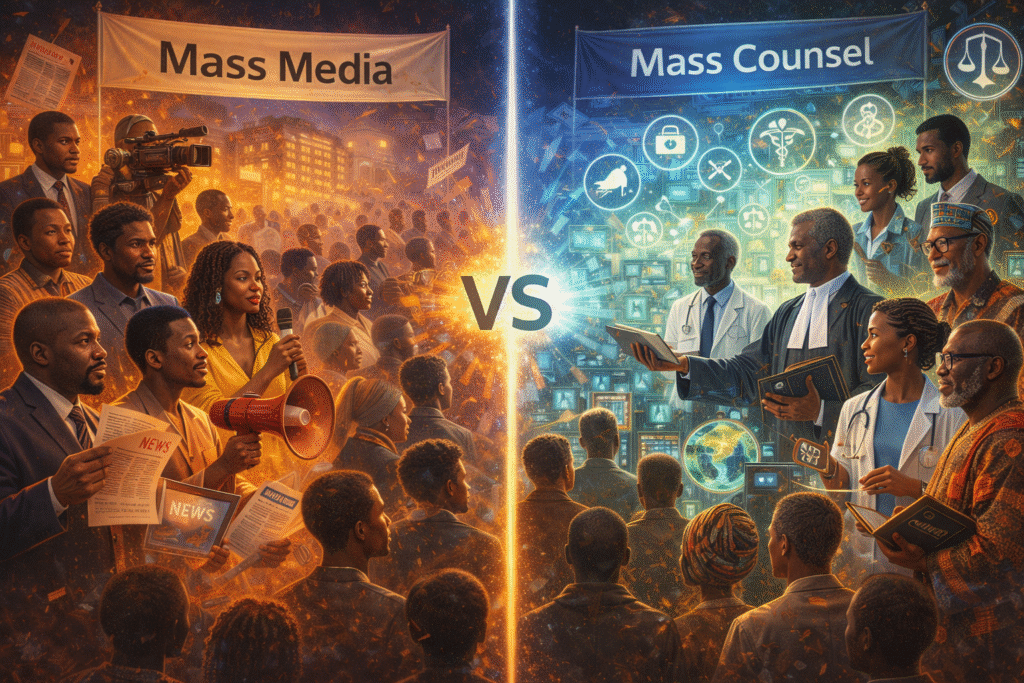
The decline of traditional media is often discussed as a crisis of trust, revenue, or relevance. Yet these diagnoses miss a deeper structural transformation already underway: the displacement of generalised narration by specialised counsel. In an Ethnopublican State, this transition does not require the abolition of media institutions. It renders them unnecessary by absorbing their function into a more precise, participatory, and socially embedded system of knowledge production—Informal Advisory Bodies.
1. The Limits of Traditional Media in the Age of Revelation
Traditional media institutions arose in an era defined by scarcity: scarcity of printing presses, broadcast frequencies, editorial authority, and public access to information. Their legitimacy rested on gatekeeping—deciding what matters, what is true, and what should be known. In republican systems, this gatekeeping function became entangled with political power, commercial interests, and ideological alignment.
In the present revelation-age—defined by digital internetisation, open data, and ubiquitous access—this scarcity no longer exists. Yet traditional media persists as if it does. The result is distortion: sensationalism replaces depth, speed replaces accuracy, and narrative competition replaces public understanding. Media institutions increasingly speak about society rather than with it, and their authority erodes accordingly.
Ethnopublicanism does not attempt to reform this structure. It simply outgrows it.
2. The Ethnopublican Alternative: Informal Advisory Bodies
In an Ethnopublican State, the Secretariat-Branch—specifically through the Secretariat-Ministry of Govoxical and Constitutional Affairs—encourages citizens to establish and formally register informal advisory bodies. These are not adversarial parties, nor media corporations, but recognised professional collectives operating within clearly defined domains of social expertise.
Such advisory bodies may form around:
- Law and legal interpretation.
- Science and climate research.
- Behavioural studies and Psychextrics.
- Family counselling and social mediation.
- Medicine and public health.
- Engineering and infrastructure.
- Agriculture and food systems.
- Technology and digital ethics.
- Education and apprenticeship.
- Public policy analysis.
- Editorial commentary and civic interpretation, etc.
Registration grants them recognition—not control. Their legitimacy flows from expertise, consistency, and public trust, not from monopoly or State patronage.
3. News as Counsel, Not Spectacle
Each advisory body publishes daily, weekly or monthly newsletters to its regional audience. These are distributed digitally by subscription, with paper copies available at a token exchange via entitlement chips—or free in most cases to ensure universal access. Crucially, these publications are narrow in focus and deep in substance.
Where traditional media attempts to cover everything—crime, family, economics, international affairs, morality—within a single editorial frame, advisory bodies do the opposite. They specialise. They contextualise. They advise.
- A family advisory body explains domestic disputes, childcare changes, and social welfare updates.
- A legal advisory body interprets new rulings, palaver-court outcomes, and citizenry legal guidelines.
- A behavioural advisory body analyses social trends, digital fatigue, workplace stress, and behavioural science neurotype adaptation.
- An agricultural advisory body reports on climate impact, crop cycles, and regional food security.
- A science advisory body explains discoveries without sensationalism or partisan distortion.
What disappears is not information, but noise.
4. Why Traditional Media Becomes Obsolete—Naturally
In such an environment, traditional media institutions do not face censorship, regulation, or abolition. They face something far more decisive: irrelevance.
Why would a citizen rely on a generalist broadcaster when:
- Every domain of life has a dedicated, accountable advisory body;
- Information is locally contextualised rather than abstracted for national drama;
- Analysis is provided by practitioners rather than commentators;
- Errors are corrected transparently within professional communities;
- Citizens can directly engage, question, and respond?
Traditional media thrives on aggregation and spectacle. Advisory bodies thrive on precision and trust. Over time, audiences migrate—not by decree, but by preference.
Media institutions may attempt to adapt. Many will dissolve into advisory bodies themselves—journalists reconstituting as legal analysts, science explainers, or regional editorial councils. Others will fade quietly, their institutional form no longer aligned with social need.
This is not suppression. It is absorption.
5. The Role of the Secretariat and National Coordination
While regional advisory bodies dominate everyday informational life, the Ethnopublican system retains coordinated national and continental communication.
- The State-Ambassador Ministry within the Secretariat-Ministry of Govoxical Affairs publishes a national daily bulletin, radio service, and television channel focused strictly on matters of collective interests.
- The Secretariat publishes pan-African and international briefings, ensuring coherence across States without narrative dominance.
These outlets do not compete with advisory bodies. They summarise what matters most across them.
6. From Opinion Power to Knowledge Ecology
What ultimately replaces traditional media is not another institution, but an ecosystem—a living ecology of knowledge where authority is distributed, contextual, and continuously revised.
In this system:
- Truth is not declared; it is worked out.
- Public understanding is not manipulated; it is cultivated.
- Citizenship is not passive consumption; it is daily interpretation.
The ethnopublican arrangement recognises a simple reality: modern societies do not need narrators—they need advisors.
7. Answering the Media’s Objections: Why Ethnopublican Advisory Bodies Strengthen—Not Destroy—Freedom
As the ethnopublican model advances the replacement of traditional media institutions with decentralised, domain-specific advisory bodies, resistance is inevitable. Media institutions, press unions, and republican theorists will raise familiar objections—invoking press freedom, censorship fears, propaganda, and democratic decay.
These criticisms must be confronted directly, not dismissed. What follows is a systematic response to each major objection, demonstrating why the ethnopublican framework does not weaken public freedom—but rescues it from institutional distortion.
OBJECTION 1: “This model abolishes press freedom by stealth.”
The Claim: Critics will argue that encouraging advisory bodies while traditional media becomes obsolete amounts to a covert abolition of the free press.
Response: Press freedom is not the freedom of institutions to dominate discourse—it is the freedom of citizens to access, produce, and interpret information.
Ethnopublicanism abolishes no newspaper, shuts down no broadcaster, censors no journalist. It does something far more populocratic: it removes institutional privilege. Traditional media is free to continue publishing. It simply loses its monopoly over attention.
If press freedom requires public dependency on a handful of corporate or ideological narrators, then it was never freedom—it was managed perception.
True freedom is choice. Advisory bodies multiply choice.
OBJECTION 2: “Advisory bodies will become State propaganda tools.”
The Claim: Because advisory bodies are registered through a Secretariat ministry, critics will claim they are instruments of State control.
Response: Registration is not subordination. Recognition is not command. Advisory bodies are:
- Not funded by partisan parties.
- Not editorially directed by the Secretariat.
- Not protected from criticism or competition.
- Not insulated from failure or irrelevance.
Their authority derives from expertise and public trust, not from the State. In fact, their narrow domain focus makes propaganda harder, not easier—because misinformation is immediately detectable by peers and users within that domain.
Traditional media is far more susceptible to propaganda precisely because it concentrates narrative power. Ethnopublican advisory bodies disperse it.
OBJECTION 3: “This fragments public discourse and destroys national conversation.”
The Claim: Critics will argue that specialised newsletters will isolate citizens into informational silos.
Response: What they call “national conversation” has long been a national monologue—dominated by editors, advertisers, and political alignment. Ethnopublicanism replaces shallow unity with functional coherence:
- Citizens access multiple advisory streams based on lived needs.
- Cross-domain synthesis occurs at citizenry assemblies and StateLords’ judicial interpretation.
- National and continental bulletins still exist for shared priorities.
Unity does not require uniformity. It requires shared stakes, not shared headlines.
OBJECTION 4: “Without investigative journalism, corruption will flourish.”
The Claim: Media institutions will argue they alone can expose corruption.
Response: This is historically false. Most major exposures come from:
- Whistleblowers.
- Professional auditors.
- Legal analysts.
- Academic researchers.
- Civil society investigators.
Ethnopublican advisory bodies formalise these roles rather than filtering them through sensationalist editors. Moreover:
- Citizens possess continuous oversight power.
- Govoxical review is real-time, not electoral.
- Judiciary is supervisory, independent and supreme.
Corruption thrives in opacity—not in distributed scrutiny. Advisory bodies create persistent daylight.
OBJECTION 5: “This kills journalism as a profession.”
The Claim: Media unions will argue this model destroys livelihoods and cultural institutions.
Response: It destroys media aristocracy, not journalism. Journalists do not disappear. They re-embed:
- As legal interpreters.
- Policy analysts.
- Science communicators.
- Behavioural reporters.
- Editorial advisors.
- Regional chroniclers.
What dies is the generalist spectacle model that monetises outrage and ignorance. If a profession cannot survive without distorting reality, it deserves reinvention.
OBJECTION 6: “Who decides what is true without a neutral press?”
The Claim: Critics invoke the myth of media neutrality.
Response: Neutrality has never existed—only unacknowledged bias. Ethnopublicanism replaces hidden bias with declared position:
- Advisory bodies state their domain, methods, and limits.
- Errors are corrected publicly.
- Competing bodies coexist.
- Citizens choose whom to trust.
Truth emerges through convergence, not decree.
OBJECTION 7: “This leads to intellectual elitism.”
The Claim: Specialised bodies will exclude ordinary citizens.
Response: On the contrary—traditional media already excludes citizens by speaking at them.
Advisory bodies:
- Translate complexity into practical relevance.
- Invite citizen questions and participation.
- Operate regionally, not remotely.
- Are accountable to their audience, not advertisers.
Knowledge is no longer distant—it is locally interpretable.
OBJECTION 8: “This undermines democracy.”
The Claim: Media insists democracy requires a powerful press.
Response: Democracy requires informed agency, not narrative dominance. Republicanism needs media because citizens are otherwise passive. Ethnopublicanism needs no intermediary—because citizens govern continuously.
Media becomes unnecessary when people are no longer spectators. Advisory Bodies are protected by populocracy to serve the people affected by their advisory expertise.
FINAL OBJECTION: “The Media Fears Irrelevance, Not Tyranny”
Let us be honest. The loudest critics are not defending freedom—they are defending institutional survival. Ethnopublicanism does not silence them. It simply refuses to grant them exclusive authority over meaning.
In this system:
- Power decentralises.
- Expertise specialises.
- Citizens mature.
- Spectacle collapses.
Traditional media does not fall because it is attacked. It falls because it is outgrown. And what replaces it is not control—but collective intelligence.
CONCLUSION: The Quiet End of an Era
Thus, the end of traditional media does not arrive with headlines or resistance. It arrives quietly, as people stop listening. Not because they are silenced—but because they are finally informed. In the Ethnopublican State, media does not die. It evolves into counsel. And in doing so, it relinquishes its throne—not to power, but to collective purpose.
Back to: 👇