
From Brain Segments to Behavioural Architecture: Reconstructing the Human Brain Through Psychextrics
Beyond Regions, Networks, and Pathways
BY: OMOLAJA MAKINEE
Modern Neuroscience typically approaches the brain through a language of regions, networks, pathways, circuits, and distributed processing systems. The nervous system is often described as a vast collection of interconnected anatomical territories communicating through increasingly complex webs of connectivity.
While this perspective has generated enormous amounts of anatomical knowledge, it leaves a deeper question unresolved.
What is the overarching blueprint of behavioural production?
- Knowing where structures are located does not necessarily explain how conscious reality is assembled.
- Knowing that a pathway exists does not reveal its architectural purpose.
- Knowing that two regions communicate does not explain why they communicate or what role each serves within the larger construction of behavioural experience.
Psychextrics approaches this problem from a different direction.
Rather than treating the brain as a unified thinker or a central command machine, Psychextrics reconstructs it as a vertically layered behavioural construction system.
Reality is not generated in a single place. Reality is progressively assembled.
Within this framework, behavioural consciousness emerges through six cephalic territories:
- Myelencephalon.
- Metencephalon.
- Mesencephalon.
- Diencephalon.
- Siencephalon.
- Telencephalon.
Each cephalon contributes a distinct behavioural layer. Each performs a specialised labour. Each participates in constructing the final experience that human beings call consciousness.
The result is not a thinking machine. The result is a behavioural architecture.
1. The Limitations of Pure Segmentation
The first step toward understanding this architecture is recognising the limitations of anatomical segmentation. Segmentation remains useful.
- It allows researchers to define boundaries.
- It allows structures to be identified.
- It allows pathways to be mapped.
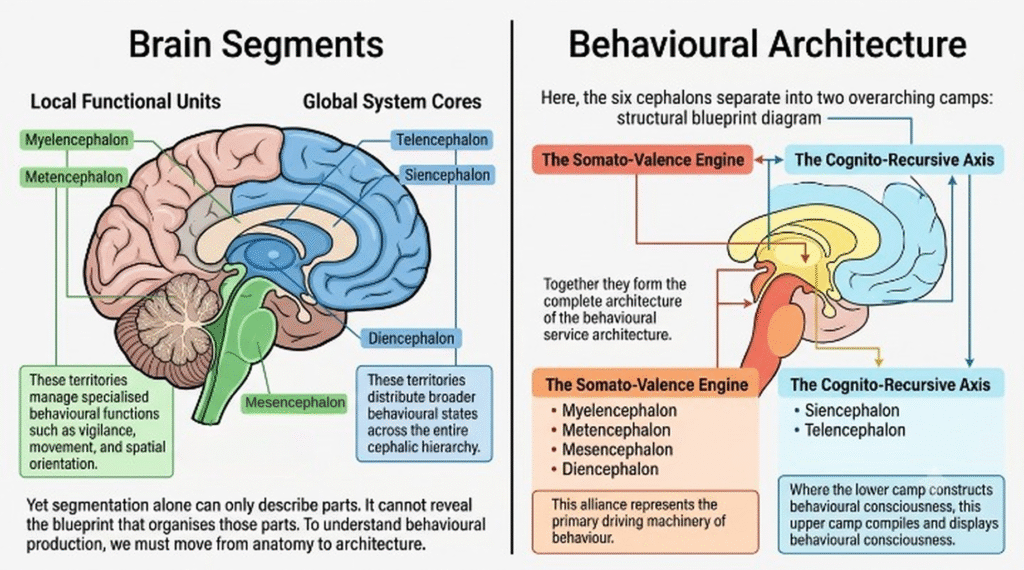
Within Psychextrics, segmentation also distinguishes between Local Functional Units and Global System Cores.
The Local Functional Units consist primarily of the Myelencephalon, Metencephalon, and Mesencephalon. These territories manage specialised behavioural functions such as vigilance, movement, and spatial orientation.
The Global System Cores consist primarily of the Diencephalon, Siencephalon, and Telencephalon. These territories distribute broader behavioural states across the entire cephalic hierarchy.
Yet segmentation alone can only describe parts. It cannot reveal the blueprint that organises those parts.
To understand behavioural production, we must move from anatomy to architecture.
2. The Emergence of Behavioural Architecture
Behavioural Architecture examines the organisational principles governing behavioural construction.
Rather than asking where structures are located, it asks what collective role they play within the production of behavioural reality.
When viewed through this lens, the six cephalons reorganise themselves into two larger macro-functional alliances. These alliances transcend anatomical boundaries. They reveal the deeper operational logic hidden beneath conventional neuroanatomical classifications.
The six cephalons separate into two overarching camps:
- The Somato-Valence Engine.
- The Cognito-Recursive Axis.
Together they form the complete architecture of the psyche.
3. The Two Great Camps of Behaviour
At first glance, the six-cephalon hierarchy appears to be a simple vertical ladder. A closer examination reveals something more sophisticated.
- The lower four cephalons naturally align into a behavioural construction engine.
- The upper two cephalons naturally align into a behavioural compilation and rendering system.
These become the two great camps of behavioural production. The first constructs behavioural consciousness. The second compiles and displays behavioural consciousness.
One generates the force. The other organises the force.
One creates the impulse. The other transforms the impulse into a coherent behavioural reality.
4. The Somato-Valence Engine
The Somato-Valence Engine consists of:
- Myelencephalon
- Metencephalon
- Mesencephalon
- Diencephalon
This alliance represents the primary driving machinery of behaviour.
Its evolutionary role is immediate. Its concern is the present. It reads the body. It reads the environment. It reads urgency. It reads opportunity. It reads threat.
Unlike the higher architecture, it possesses little interest in behavioural history. It does not compile autobiography. It does not maintain narrative identity. It does not organise life stories. Its task is to create behavioural states in the moment.
The Somato-Valence Engine therefore serves as the active constructor of behavioural consciousness.
Before memory can contextualise experience, before consciousness can display experience, the organism must first occupy a behavioural state.
That state is generated here.
5. The Lower Brainstem Trio: Holders of Conscious Behavioural Templates
Within the Somato-Valence Engine, the Myelencephalon, Metencephalon, and Mesencephalon function as foundational template generators. Each possesses specialised behavioural capabilities.
- The Myelencephalon contributes survival vigilance.
- The Metencephalon contributes kinetic stability.
- The Mesencephalon contributes spatial orientation.
However, these systems possess a crucial limitation. They operate through conscious behavioural templates. Their outputs are inherently rigid.
- They can identify a state. They cannot determine its volume.
- They can trigger an alarm. They cannot independently determine how loud that alarm should become.
A startle remains a startle. An orienting response remains an orienting response. A retreat remains a retreat.
The lower trio possess templates. They do not possess intensity.
6. The Diencephalon as Behavioural Thermostat
The Diencephalon resolves this limitation. Within the Somato-Valence Engine, it functions as the master scaling system.
- Where the lower trio provide templates, the Diencephalon provides magnitude.
- Where the lower trio identify behavioural states, the Diencephalon determines behavioural intensity.
The subthalamic, epithalamic, hypothalamic and thalamic systems read hormonal conditions, environmental significance, physiological urgency, and contextual meaning. Through this process, behavioural templates become behavioural experiences.
- A mild concern can become overwhelming fear.
- A passing curiosity can become obsessive focus.
- A subtle discomfort can become unbearable distress.
Without the Diencephalon, the lower behavioural templates would remain emotionally flat.
The Somato-Valence Engine therefore depends upon the Diencephalon to transform behavioural possibilities into behavioural realities.
7. The Cognito-Recursive Axis
Opposite the Somato-Valence Engine stands the second great alliance.
The Cognito-Recursive Axis consists of:
- Siencephalon.
- Telencephalon.
Where the lower camp constructs behavioural consciousness, this upper camp compiles and displays behavioural consciousness.
- Its role is historical rather than immediate.
- Its concern is continuity rather than urgency.
- Its labour is integration rather than reaction.
The Cognito-Recursive Axis transforms isolated behavioural moments into coherent behavioural lives. Without it, experience would remain fragmented into disconnected episodes. Behaviour would occur. Identity would not.
8. The Siencephalon: The Hidden Civilisation
At the centre of the Cognito-Recursive Axis lies the Siencephalon.
The Siencephalon functions as the great integration civilisation beneath consciousness. It receives behavioural deposits from across the cephalic hierarchy.
- It indexes.
- It packages.
- It compresses.
- It cross-references.
- It stabilises.
- It binds present events to historical traces.
- It compares current reality against previous realities.
- It transforms behavioural fragments into behavioural continuity.
Yet despite performing these immense computational tasks, the Siencephalon remains fundamentally silent.
- It cannot display its own work.
- It cannot observe its own calculations.
- It cannot directly experience the behavioural reality it constructs.
Like an invisible city operating beneath the surface, it continuously assembles behavioural history without ever seeing the final product.
9. The Telencephalon: The Screen of Conscious Awareness
The Telencephalon resolves this limitation. Within the Cognito-Recursive Axis, it functions as the display interface.
The Telencephalon does not compile behavioural continuity. The Siencephalon performs that labour. The Telencephalon renders behavioural continuity visible.
- It receives integrated packages.
- It projects them into conscious awareness.
- It transforms indexed signals into visible experience.
- It creates the conscious field.
Without the Telencephalon, behavioural continuity would still exist. Memory would still function. Adaptation would still occur. Learning would still accumulate. Yet none of these processes would enter consciousness.
The organism would remain behaviourally competent while existing in perpetual experiential darkness.
The Telencephalon therefore serves as the conscious screen through which the hidden work of the Siencephalon becomes visible.
10. The Deep Law of Behavioural Dependency
Both behavioural camps reveal the same architectural law:
No cephalon is behaviourally complete by itself.
Every major behavioural function exists through partnership.
- The lower trio require the Diencephalon.
- The Siencephalon requires the Telencephalon.
- Templates require intensity.
- Integration requires display.
The brain therefore operates through structural dependency rather than isolated autonomy.
This principle represents one of the central discoveries of Behavioural Architecture:
The power of a cephalon does not emerge from what it possesses independently. Its power emerges from how it cooperates within the larger hierarchy.
11. The Unified Blueprint of the Psyche
When viewed through the lens of Behavioural Architecture, the six-cephalon model becomes remarkably coherent.
- The Somato-Valence Engine constructs behavioural consciousness.
- The Cognito-Recursive Axis compiles and displays behavioural consciousness.
The lower engine generates the impulse. The upper axis contextualises the impulse. The display screen reveals the result.
Behavioural reality therefore emerges through a sequence of layered operations.
The organism first occupies a behavioural state. The state receives intensity. The state becomes integrated with behavioural history. The integrated package enters conscious awareness. Only then does the thalamic narrator generate the experience of understanding what has occurred.
The conscious self arrives at the end of a process that began much deeper within the cephalic hierarchy.
Conclusion: The Transition from Anatomy to Architecture
The transition from Brain Segments to Behavioural Architecture represents a major shift in how the nervous system is understood. Instead of viewing the brain as a collection of isolated regions, Psychextrics reveals a coordinated construction system organised around behavioural production.
The six cephalons remain anatomically distinct. Yet behaviourally they reorganise into two great alliances. The Somato-Valence Engine creates behavioural force. The Cognito-Recursive Axis transforms that force into behavioural continuity and conscious awareness. Together they form the complete architecture of the psyche.
- The lower engine determines what behavioural state emerges.
- The Diencephalon determines how intensely it is experienced.
- The Siencephalon determines how it relates to behavioural history.
- The Telencephalon determines how it becomes consciously visible.
Reality is therefore not discovered by the brain. Reality is progressively assembled through a layered behavioural architecture that transforms biological activity into lived experience.
Back to: 👇