
The Five Pillars of Listening: A Psychextric Architecture of Perception
BY: OMOLAJA MAKINEE
Listening is commonly mistaken for hearing. In psychextric science, listening is something far deeper: it is the biological method by which meaning is permitted to exist inside the mind. Hearing is mechanical; listening is moral, emotional, mnemonic, and structural. It is not one faculty but a five-pillar spectrum, each pillar governed by a distinct neural organ system, genetically scaffolded at birth, and epigenetically modulated across life.
While surface psychology often treats listening ability as a matter of maturity, empathy, or attentiveness, psychextric analysis reveals a deeper truth: how an individual listens is largely inherited. The Genetic Index Marker (GIM) establishes the architectural capacity for each listening mode, while the Epigenetic Index Marker (EIM) and Hormonal Fluidity Index (HFI) modulate how that capacity is expressed at any given time. Listening, like temperament or memory bandwidth, is therefore biologically unique to each individual.
All humans are born with all five listening pillars present. However, no two individuals occupy the same spectrum position within each pillar. One may be strong in Resonant Listening yet narrow in Echoic Listening; another may be rhythmically brilliant yet emotionally opaque. The diversity of listening is not a flaw—it is the signature of human variation.
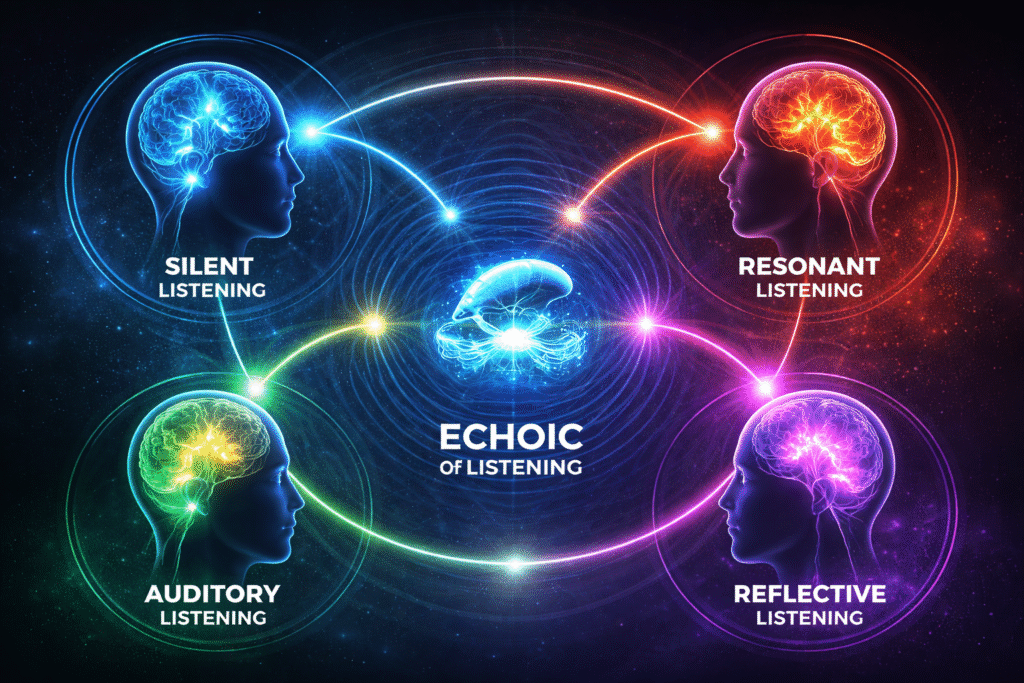
What follows are the five pillars of listening, each defined by its dominant organ, its perceptual priority, and its role in meaning-making.
- Silent Listening is percpetual-first and it is Concept-specific.
- Resonant Listening is emotional-first and it is Value-specific.
- Reflective Listening is deliberation-first and it is Narrative-specific.
- Echoic Listening is memory-first and it is Vocal-specific.
- Auditory Listening is rhythm-first and it is Accent-specific.
Together, they complete the five-spectrum architecture of listening within the psychextric model.
1. Silent Listening — Sensory-First Perception
Primary Organ: Subthalamic region with cerebellar and sensory-integration support.
Silent Listening is the foundation of all perception. It is the listening node that opens the perceptual field. The listening node without sound; the capacity to extract meaning from stillness, gesture, pattern, movement, and symbolic presence. In this mode, the psyche does not wait for vibration. It listens through pre-verbal intelligence.
Neurologically, Silent Listening is anchored in subthalamic and cerebellar circuits that integrate spatial, kinesthetic, visual, and somatic cues before sound is ever considered. For individuals born deaf, this pillar becomes dominant; for others, it emerges during wakefulness, meditation, danger, grief, or heightened awareness.
GIM determines the inherited strength of this pillar. Some individuals possess extraordinary silent acuity—reading rooms, sensing intention, detecting shifts in atmosphere—while others require sound to perceive meaning. EIM and HFI modulate Silent Listening through stress, safety, or sensory overload, either sharpening or dulling this capacity.
Silent Listening reminds us that meaning precedes language and it is concept-specific.
Concept-Specific Listening
Silent Listening is the primordial listening state in Psychextrics. It is not the absence of sound, but the absence of external vocal stimulus. In this mode, perception is concept-first rather than signal-first. Meaning arises internally, before words, visual, tone, or even audible vibration enter the system. Silent Listening is the node that is dominant in individuals when they walk on the streets quietly, driving without distractions, focus on movements, or just simply minding their own business in peaceful ambience.
Within the psychextric architecture, Silent Listening operates in the background of Echoic and Reflective Listening. It is initiated when the diencephalic network is not responding to incoming sound via the MGN, but instead is generating meaning from internally evoked representations stored across the GIM–EIM lattice and modulated by the individual’s HIM–HFI variants.
In Silent Listening, the brain does not ask:
“What was said?” but rather: “What is the concept?”
This makes Silent Listening concept-specific. The individual is listening to their immediate environment for ideas themselves, not to how those ideas are expressed or valued. This is why people often asked the question ‘What is this?’ ‘What is happening?’ when the perceptual field of their Silent Listening activates Resonant Listening nodes to ascribe emotional value to an encountered event.
Comparative Overview of Dominant Silent Listening Modes
Silent Listening does not present as a single cognitive style. Instead, it expresses itself through distinct perceptual modes, each representing a different way the psyche internally formats concepts before they ever reach the cortical display window.
| PERCEPTION MODE | PRIMARY “LANGUAGE” | OUTPUT EXAMPLE |
|---|---|---|
| Visual-Spatial | Mental Images | A painting or blueprint |
| Logical-Abstract | Patterns / Ratios | A mathematical proof |
| Linguistic | Words / Syntax | A persuasive essay |
| Kinesthetic | Sensation / Weight | A physical performance |
Spectral Integration and Cognitive Profiles
Silent Listening is spectral, not exclusive. Individuals rarely operate within a single mode. Instead, excellence often emerges from harmonic overlap. A classic example is the Architect profession:
- Visual-Spatial dominance ensures aesthetic coherence.
- Logical-Mathematical dominance ensures structural integrity.
In Psychextrics, this is understood as conceptual resonance across multiple silent listening channels, shaped by inherited GIM–EIM patterns and stabilised or destabilised by HIM–HFI variants.
Silent Listening therefore sets the conceptual substrate upon which all other listening pillars operate. What is silently perceived determines how sound will later be echoed, reflected upon, resonated with, or evaluated by.
2. Resonant Listening — Emotional-First Perception
Primary Organ: Hypothalamus and limbic emotional circuitry.
Resonant Listening is the mode through which we listen with emotion. Here, tone matters more than words. A sentence is felt before it is understood. This pillar determines whether a voice is perceived as safe, threatening, loving, dismissive, or sincere.
The hypothalamus governs this mode by aligning sound with hormonal states. HIM provides the inherited spectral variation of emotional architecture—how a person is predisposed to interpret emotional cues—while HFI introduces fluid volumes shaped by environment, stress, bonding, diet, and cultural exposure.
This explains why two people can hear the same sentence and walk away with opposite emotional impressions. Resonant Listening is not about correctness; it is about emotional truth as filtered by neurotype.
At its strongest, this pillar produces deep empathy. At its weakest, it produces emotional deafness. Neither is moral failure—both are biological positioning.
Value-Specific Listening
If Silent Listening is concept-specific—the how by which information is internally structured—then Resonant Listening is value-specific: the why that determines what matters to the self. Perception maps the architecture of reality. Emotion maps the significance of reality.
Within the psychextric model, Resonant Listening is the phase in which concept-bundles—already formed during Silent Listening—are passed through the HIM–HFI network and assigned emotional weight. This is not decorative or secondary. It is decisive.
If the brain is imagined as a computational system:
- Perception is the operating system that renders data intelligible.
- Emotion is the priority-weighting algorithm that decides which data receives energy, time, and action.
Without Resonant Listening, perception remains inert.
If Perception Is the Lens, Emotion Is the Light
Silent Listening is the perceptual field that determines what can be seen. Resonant Listening is the value that determines what is illuminated in what can be seen.
A great theorist may possess exceptional logical-abstract perception, allowing them to see the mathematics of the universe. But it is value-specific emotion—curiosity, dissatisfaction, the itch of incompleteness—that holds attention steady for ten years on a single unsolved problem.
Without Resonant Listening:
- perception is accurate but indifferent,
- intelligence is present but unmotivated,
- reality is visible but weightless.
Resonant Listening is therefore the engine of persistence, the bridge between understanding and commitment, and the emotional gravity that pulls certain concepts into the centre of the self.
3. Reflective Listening — Deliberation-First Perception
Primary Organ: Thalamic integrative nuclei (including pulvinar networks).
Reflective Listening is the mode of conversation, reasoning, and mutual clarification. It listens not to react, but to consider. Meaning is weighed, contextualised, compared, and reframed.
This pillar is anchored in the thalamus, the great integrator of perception. Here, GIM provides inherited capacity for abstraction, sequencing, and conceptual balance, while EIM contributes learned language structures, logic patterns, and conversational norms.
Reflective Listening thrives in dialogue, teaching, negotiation, and philosophical inquiry. It is also the mode most vulnerable to collapse under emotional overload; when Resonant Listening overwhelms it, deliberation disappears.
This pillar is not about intelligence—it is about architectural patience.
Narrative-Specific Listening
If Silent Listening determines what can be perceived (concept), and Resonant Listening determines what matters (value), then Reflective Listening determines what can be said—internally—about what matters.
Reflective Listening is the stage at which perception and emotion are translated into narrative sequence. It is not communication yet; it is logical self-communication. Here, the psyche does not listen to sound, but to its own unfolding self-narrative.
In psychextric architecture, Reflective Listening occurs when the integrated concept–value bundle produced by GIM–EIM and HIM–HFI activity is re-encoded into narrative structure and looped back through the diencephalon into cortical awareness.
This is the moment meaning becomes explainable.
Reflective Listening Is Where Meaning Becomes Speakable
Silent Listening perceives the concept. Resonant Listening assigns its emotional value. Reflective Listening weaves the narrative into logical coherence.
It is the bridge between inner experience and inner coherence, between feeling and logic, between impulse and justification. Without Reflective Listening:
- emotion remains raw,
- perception remains illogical,
- identity remains unarticulated.
With it, the psyche gains self-narrative continuity—but also the burden of self-reinterpretation.
4. Echoic Listening — Memory-First Perception
Primary Organ: Hippocampus and parahippocampal memory systems.
Echoic Listening is the gateway through which listening becomes possible at all. It is not comprehension-centric but retention-centric. This mode listens by holding sound long enough for meaning to emerge.
The hippocampus governs this pillar, creating a retroactive loop between present stimulus and stored memory. Meaning here is constructed backward—from archive to awareness. Without sufficient echoic stability, input of perception collapses before it can be interpreted emotionally or reflectively.
GIM determines inherited memory-holding capacity, while EIM reflects how memory has been shaped by age, trauma, repetition, or cognitive decline. In childhood development and ageing alike, echoic instability explains delayed responses, misinterpretation, or apparent inattention.
Echoic Listening decides whether listening can be retained to proceed at all.
Vocal-Specific Listening
If Silent Listening perceives concepts, Resonant Listening assigns value, and Reflective Listening narrates meaning, then Echoic Listening is the point at which external sound re-enters the psyche and is captured by memory.
Echoic Listening is vocal-specific. It does not yet concern itself with what the voice means (Reflective Listening) nor how it is emotionally weighted (Resonant Listening). Instead, it answers a more primitive question:
“What exactly was heard? Does the vocal make sense to me to be retained”
In psychextric architecture, Echoic Listening is memory-first perception. It is the system that holds input of perception long enough for higher-order interpretation to occur.
Echoic Listening Is the Gatekeeper of Sound
Echoic Listening does not interpret. It preserves. It ensures that input of perception exists long enough to be:
- valued,
- translated,
- narrated,
- or discarded.
Without it:
- language cannot unfold,
- music cannot be followed,
- voices cannot be remembered,
- entire human civilisation cannot exist.
Echoic Listening is therefore the temporal holding chamber of the auditory psyche—the memory place where psyche waits to tell its story.
5. Auditory Listening — Rhythm-First Perception
Primary Organ: Auditory cortex with Broca’s and Wernicke’s areas, thalamic coordination.
Auditory Listening is the most familiar and the most misunderstood pillar. It listens through rhythm, structure, and arrangement. Words are decoded as patterns: stress, cadence, syntax, flow, and articulation.
Here, GIM defines inherited sensitivity to linguistic rhythm—why some are drawn to poetry, rap, or eloquence, while others remain indifferent. HIM supplies emotional charge to rhythm, producing excitement, pleasure, or irritation in response to speech style.
This pillar explains natural editors, proofreaders, lyricists, song writers, and orators who recognise misalignment instantly without training. It also explains why accent, pacing, or delivery can matter more than content for some listeners.
Auditory Listening hears clearly—but does not necessarily understand deeply.
Accent-Specific Listening
If Echoic Listening preserves sound, then Auditory Listening places sound.
Auditory Listening is the stage at which sound is no longer treated as a neutral acoustic object, but as a social signal. Here, the psyche asks not what was said nor even how it was said, but something more ancient and decisive:
“Who is this?” “Where does this sound come from?” “How does this voice relate to me?”
Auditory Listening is therefore accent-specific and rhythm-first. It evaluates sound for identity, origin, belonging, and threat, long before semantic interpretation is complete.
Auditory Listening Is Where Sound Becomes Social
Silent Listening perceives the concept. Resonant Listening assigns emotional value. Reflective Listening narrates meaning. Echoic Listening preserves sound. Auditory Listening places the voice in the world. It is the final interpretive gate before action.
Through rhythm and accent, Auditory Listening answers the most relational of questions:
“Is this voice one of us?”
In Psychextrics, this pillar completes the listening cycle—transforming sound not just into meaning, but into social reality. It is the bridge between inner experience and outward expression, between feeling and explanation, between concept and relationality.
Conclusion: Listening as a Biological Signature
Together, these five pillars form a moral geometry of perception. All are present in everyone. All are constrained by inherited GIM architecture. All are modulated by EIM and HFI across time. The apparent fluidity between them is not learned flexibility alone—it is genetic possibility expressed epigenetically.
This is why two people can sit in the same room, listen to the same words, and leave with different truths. They did not hear differently because they chose to—but because their psyche listened differently.
In psychextrics, listening is not a skill to be perfected. It is a personal dialect of perception, written into the nervous system long before speech ever begins.
The Five Pillars of Listening form a single perceptual circuit:
- Silent — concept is formed.
- Resonant — value is assigned.
- Reflective — meaning is narrated.
- Echoic — sound is preserved.
- Auditory — identity is positioned.
Together, they explain why humans do not merely hear the world. They listen themselves into it.
Back to: 👇