
Ethnopublicanism: Unity from Fragmentation to Belonging
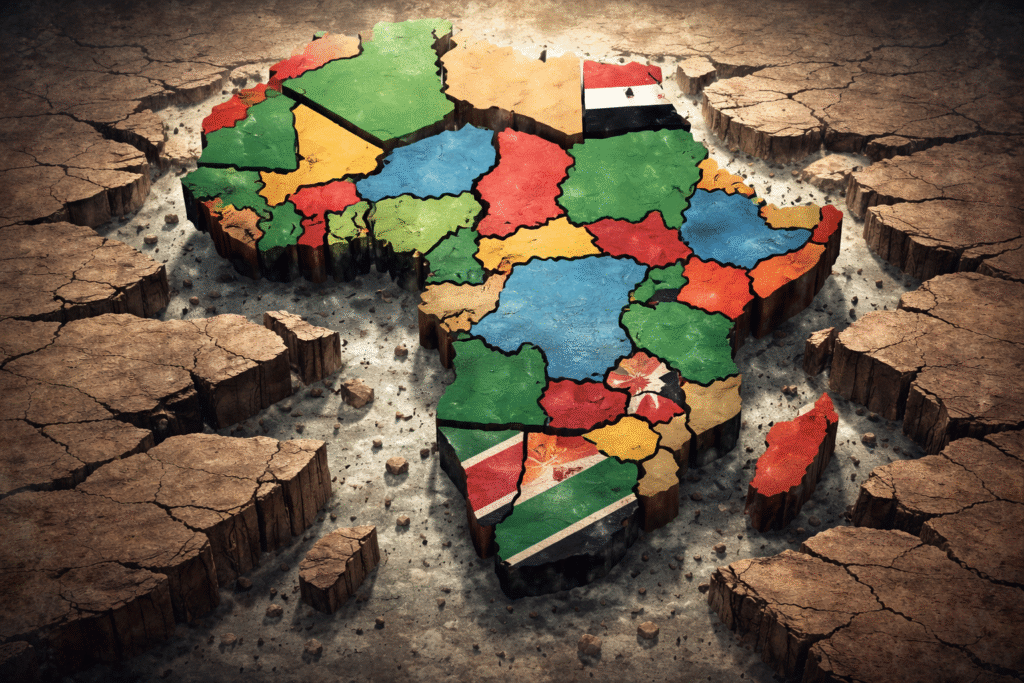
Why Africa’s Future Lies in the Restoration of Its Organic Order
BY: OMOLAJA MAKINEE
Colonialism did not merely occupy Africa; it fractured it.
Artificial borders were carved across living civilisations. Languages were imposed where indigenous tongues already carried law, memory, and cosmology. Ethnic differences were exaggerated, renamed, and weaponised. What emerged from this violence was not nationhood, but administrative fiction—colonial States stitched together for convenience, extraction, and control.
The consequence is visible across the continent today: States that struggle to inspire loyalty, identities split between imposed nationalities and ancestral belonging, and perpetual instability rooted not in African incapacity, but in colonial design.
Pan-Africanism arose as a response to this fracture. Yet unity cannot be sustained by sentiment alone. It requires a structure strong enough to carry difference without erasing it. This is where Ethnopublicanism enters history.
Ethnopublicanism, theorised in the five-volume work Manifesto of African Corporatist Society, liberates Africa from the illusion of colonial Statehood. It does not seek to manage the colonial map better—it seeks to replace the map with truth.
1. What Is an Ethnopublic?
An Ethnopublic is a people organised as a govoxical community on the basis of shared ancestry, language family, cultural memory, and moral tradition. It is neither a tribe nor a race. It is a civilisational unit—larger than clan, deeper than State.
Ethnopublicanism recognises that Africa’s true governing structure was never the colonial State. It was a constellation of organic nations—Yoruba, Igbo, Akan, Wolof, Fulani, Shona, Oromo, Amhara, Berber, Nubian, and many others—each internally diverse, yet civilisationally coherent.
The genius of Ethnopublicanism lies in its scalability.
It dissolves artificial colonial borders without descending into chaos. It replaces imposed States with ethnopublics, while federating those ethnopublics into a continental civilisation. Difference is not erased; it is architected.
Yet one cannot speak of ethnopublicanism in isolation, for without ethnosocialism, ethnopublicanism collapses into abstraction. The two are not parallel doctrines; they are mutually generative conditions. Ethnosocialism defines the economic ethic of shared material interest, while ethnopublicanism defines the govoxical architecture through which that ethic is lived, regulated, and protected. One without the other is incomplete.
Together, they describe the moment when two or more distinct ethnic communities consciously converge—not by erasure, conquest, or assimilation—but by reciprocal agreement to govern and produce in common.
Ethnosocialism, properly understood, does not dissolve ethnicity; it presupposes plurality. It arises only when multiple ethnopublics recognise that their survival, prosperity, and continuity are best secured through shared economic coordination rather than competitive fragmentation. The emphasis, therefore, is not on sameness, but on cooperation among difference. It is the collective management of life-sustaining systems—land, labour, infrastructure, knowledge, and technology—by peoples who retain their cultural autonomy while pooling their shared economic destiny.
Africa stands today as the clearest illustration of why this synthesis is necessary. The continent is not lacking in community; it is overburdened by artificial divisions. What are currently called “African nation-States” are, in reality, disparate ethnopublic communities forcibly enclosed within republican frameworks inherited from colonial cartography. These republican nationalisms demand loyalty to abstract borders rather than to organic social units, pitting ethnic groups against one another under the illusion of a singular national identity. The result has been chronic instability, ethnic competition for State power, and the perpetual weaponisation of difference.
The Manifesto of African Corporatist Society exists precisely to correct that distortion.
2. Nigeria and the Failure of Artificial Nationhood
Few examples expose the colonial experiment more clearly than Nigeria.
The forced unification of the Yoruba, Igbo, and Hausa-Fulani was never an act of organic nation-building. It was an administrative convenience for colonial governance. These are three major civilisations with distinct languages, cosmologies, governing traditions, and historical trajectories—compressed into a single State that has struggled with legitimacy since its inception.
Nigeria’s persistent instability is not accidental. It is the predictable result of merging incompatible sovereignties under an imposed identity. The same fault-line runs through many postcolonial African States.
Ethnopublicanism does not attempt to heal this wound through stronger centralisation or endless constitutional tinkering. It removes the source of the wound. It recognises that major ethnic civilisations are too distinct to be fused into a single organic polity. Instead, it follows Africa’s ancestral governance logic: unifying within civilisations first—harmonising smaller subgroups whose languages, cultures, and histories naturally align—before federating outward.
3. The Kemetian Precedent: Unity Through Balance
This logic is not new. It is ancient.
The unification of Upper and Lower Kemet under the early Pharaohs was not conquest, but harmonisation. Two ethno-governed regions, bound by the Nile, trade, and cosmology, were woven into a single civilisation without erasing local identities.
Each region retained its deities, customs, and rhythms of life. What united them was Ma’at—the moral geometry of balance, justice, and equilibrium.
The Pharaoh was not a tyrant over difference, but a mediator of multiplicities. The double crown—the red and white diadem—was a visible philosophy: unity without domination, power without erasure.
Ethnopublicanism restores this layered sovereignty for modern Africa: local autonomy nested within continental unity.
4. Kemet Reborn: Continental Unity Without Assimilation
At the continental level, Ethnopublicanism offers a higher synthesis. Africa becomes a single civilisational nation composed of many sovereign ethnopublics. Each ethnopublic governs itself fully, while sharing a collective destiny with the whole.
Anthropological and linguistic mappings identify roughly twenty-one major African ethnic civilisations. Under Ethnopublicanism, these can mature into thirty or more structured ethnopublics, each harmonising its subgroups into a coherent national organism.
Each ethnopublic is governed by a StateLord—a life-peer head of State and moral custodian—seated in the continental Council of the Great House, the supreme assembly of the Ethnopublican States of Africa.
This council replaces the patchwork of postcolonial summits with a moral organ grounded in ancestral legitimacy rather than electoral theatrics.
5. The Myth of “Thousands of Tribes”
The idea that Africa is composed of thousands of unrelated tribes is a colonial illusion. What appears as multiplicity is often a single people observed from different riversides, renamed through missionary orthography and colonial linguistics. Dialects became “tribes.” Regional variations became “new ethnicities.”
The Yoruba illustrate this clearly. Colonial maps separate Yoruba in Nigeria, Anago in Benin, Ana-Ife in Togo, Aku in Sierra Leone, and Yoruba in Liberia. Yet these are one people—dispersed, not divided. The same pattern exists among the Akan, Igbo, Fulani, Wolof, Shona, and many others. Ethnopublicanism ends this duplication.
A Yoruba in Liberia, Benin, Sierra Leone, or Nigeria belongs to one Yoruba Ethnopublic, answerable to one StateLord, participating in one cultural parliament, and voting in one ancestral council—regardless of geographic residence. Identity follows genealogy, not colonial cartography.
6. Governance by Conscience, Not Coercion
Each ethnopublic governs itself internally. The continental Africa is governed collectively. The Council of StateLords embodies Ma’at—justice, balance, and reciprocity. Executive organs—continental secretaries, economy and citizenry prime ministers, regional committees—operate beneath this moral ceiling, not above it.
Leadership is stewardship. Governance is conscience. Power is responsibility.
Ancestral Legitimacy and Distributed Civic Participation
Under Ethnopublicanism, governance is precisely layered, not confused. Rights of participation are aligned to the nature of the issue at hand—whether it concerns place of residence or ancestral legitimacy.
Take the Aku people of Sierra Leone as an example. Though geographically resident within the territory presently called Sierra Leone, the Aku are ancestrally Yoruba. Under the ethnopublic order, this dual reality is not suppressed—it is structured.
An Aku citizen would possess full civic participation in all regional and local matters that directly affect life in Sierra Leone: taxation, infrastructure, environmental regulation, education policy, local economy, public health, and communal security. In these matters, they are governed by—and answerable to—the ancestral governance authority of the land they inhabit, respecting the ethnopublic sovereignty of their host region.
However, when it comes to questions of ancestral authority—such as the selection or affirmation of a StateLord, cultural canon, sacred law, or long-term civilisational direction of the Yoruba ethnopublic—all Yoruba citizen from everywhere votes only within their ancestral govity. They do not vote for the StateLord governing Liberia or Sierra Leone, nor do they impose ancestral authority upon a land to which they do not belong by origin. This distinction preserves legitimacy on all sides.
It prevents demographic displacement from corrupting ancestral succession, while simultaneously preventing exclusion or second-class citizenship in regions of residence. One belongs civically to the land one lives in, and ancestrally to the people one descends from. Neither domain dominates the other.
This principle applies continent-wide. A Fulani in Ghana, a Wolof in Mali, an Akan in Côte d’Ivoire, or a Yoruba in Liberia participates fully in the civic life of their region of abode, yet remains ancestrally anchored to their ethnopublic’s sovereign lineage.
Voting, therefore, is issue-specific, not absolute. Individuals vote where they are affected, and where they are ancestrally legitimate. Matters of residence are decided by residents. Matters of ancestry are decided by descendants.
In this way, Ethnopublicanism dissolves the coercive logic of modern States—where one vote is forced to apply to all matters regardless of legitimacy—and replaces it with moral precision. Governance ceases to be a blunt instrument and becomes an ethical architecture.
By respecting both geography and genealogy, Ethnopublicanism ensures that no community is overruled by outsiders, and no individual is alienated from their ancestral authority. This is governance by conscience—not by coercion.
Conclusion: Restoration, Not Regression
The task before Africa is not to invent new identities, but to restore ancient ones—to rearrange society back into its organic ethnopublic formations, where governance aligns naturally with culture, land, and historical memory. From this restoration emerges a higher unity: not fragmented republicanism, but continental ethnosocialism—a cooperative economic order in which all ethnopublics participate as equals, bound by shared material interests and mutual guarantees of dignity.
Under this framework, ethnopublicanism becomes the governing logic: each ethnopublic retains internal self-rule, while participating in a larger federated system of collective decision-making. Ethnosocialism becomes the economic glue: resources are managed not for elite accumulation or ethnic dominance, but for the shared prosperity of all participating communities. Together, they give rise to a unified ethnonationalism—not a nationalism of blood or exclusion, but one of shared destiny, rooted in Africa’s geography and animated by its peoples’ collective will.
Thus, Africa does not move forward by dissolving its ethnic reality into republican abstraction, nor by retreating into parochial isolation. It advances by harmonising plurality through structure, difference through cooperation, and autonomy through unity. Ethnosocialism provides the purpose; ethnopublicanism provides the form. And from their union emerges a civilisation no longer divided against itself, but consciously assembled—many peoples, one shared future.
Repartitioning Africa along organic ethno-historical boundaries is not tribalism. It is equilibrium restored. Ethnopublicanism does not drag Africa backward; it realigns it forward—by reconnecting modern governance with ancestral logic. It is the return of Africa’s governing science to itself, reinterpreted for the 21st century.
Unity is not born from forced sameness. It is born from balanced belonging. Ethnopublicanism is not an experiment. It is a remembrance. And through it, Africa may finally stand whole—not as a collection of fractured States, but as a civilisation of our ancestral formation reunited.
Back to: 👇