
ÈṢÙ, SATAN AND THE POLITICS OF DEMONISATION
Why Indigenous Polytheistic Traditions Must Be Understood on Their Own Terms
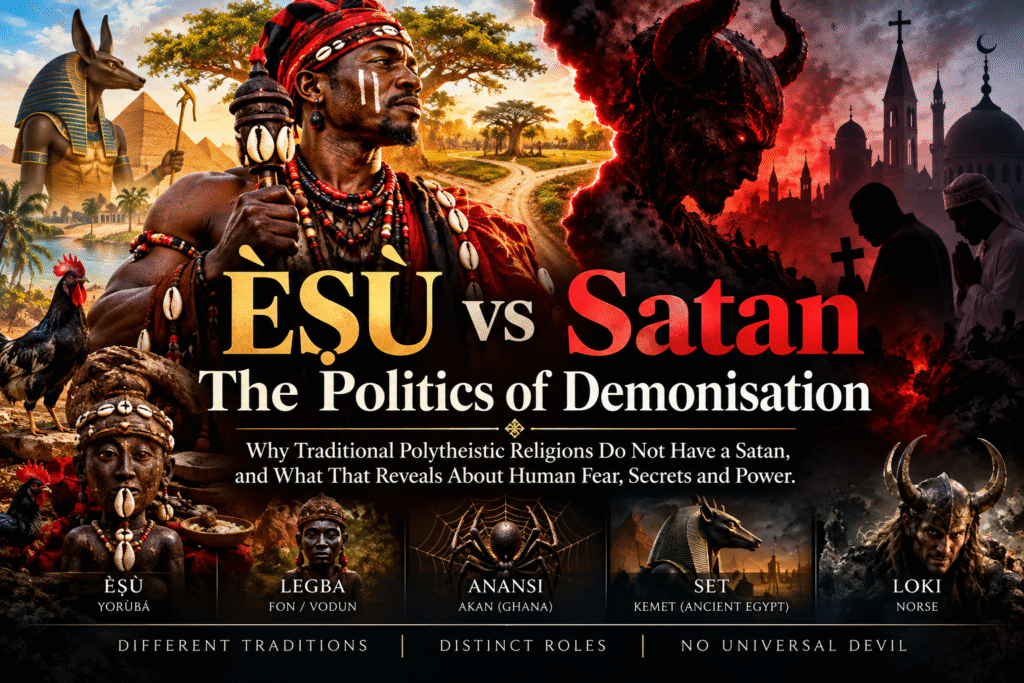
How the demonisation of what unsettles us reveals the difference between the Yoruba Èṣù and the Abrahamic Devil—and what this distinction means for Orthodox-Pantheism.
BY: OMOLAJA MAKINEE
Introduction: When Difference Becomes Evil
One of the most persistent habits in human society is the tendency to demonise what we dislike, what challenges our authority, or what refuses to conform to our understanding of morality. A person who questions our conduct may be called troublesome. Someone who exposes our secrets may be described as dangerous. An individual who refuses to take our side may be accused of serving the opposing side.
When this habit enters religion, the consequences can extend far beyond personal disagreement. A figure associated with disruption, uncertainty, communication or the exposure of wrongdoing can be reinterpreted as the embodiment of absolute evil. A deity whose role is intelligible within one religious cosmology can consequently become a devil within another.
This distinction is particularly important when examining
Èṣù in Yoruba traditional religion and Satan in Abrahamic religious traditions.
Although the two figures have sometimes been treated as equivalent, they arise from different religious histories and cannot simply be understood as interchangeable names for the same being.
Orthodox-Pantheism approaches this question from its own practical doctrine of existence. It does not recognise Satan or the Devil as a literal supernatural entity, and it does not require a cosmic enemy to explain human wrongdoing. Its interest in indigenous polytheistic traditions is not to declare every polytheistic belief identical to its own, but to examine how different religious systems interpret existence without necessarily organising it around a universal embodiment of evil.
The central question is therefore broader than whether Èṣù is Satan. It is this:
Why do human beings so often transform what unsettles them into something they consider evil?
1. Satan and the Historical Development of Abrahamic Theology
The concept of Satan did not appear in its fully developed form at the beginning of Jewish religious history. The Hebrew term satan originally carried the meaning of an adversary or opponent and could describe opposition without necessarily identifying a supreme supernatural embodiment of evil. In the Book of Job, the figure called “the Satan” operates within a heavenly setting and tests Job with God’s permission. Later Jewish, Christian and Islamic traditions developed differing accounts of Satan, the Devil and related figures. Christianity especially came to portray Satan as a rebellious supernatural enemy of God, while Islam discusses Iblīs and the shayāṭīn within its own theological framework.
It is therefore more accurate to say that the familiar figure of Satan as a cosmic adversary belongs to the historical development of Abrahamic traditions than to claim that the idea of every kind of malevolent spirit originated exclusively within them.
Other religious cultures have long recognised harmful spirits, dangerous supernatural beings, disorderly forces and antagonistic figures. But these are not automatically equivalent to Satan.
- A spirit associated with misfortune is not necessarily an enemy of the supreme deity.
- A trickster is not necessarily the personification of evil.
- A deity associated with chaos may also protect a community or serve a necessary cosmic function.
The crucial distinction is between the existence of beings or forces that can cause disruption and the idea of a single, supreme adversary who embodies evil and opposes divine authority.
Traditional polytheistic religions do not share one universal theology. Some contain figures who can be dangerous, hostile or morally troubling; others give divine figures roles that cross the boundaries modern readers might draw between good and evil. It is therefore misleading to assume that every polytheistic tradition must contain its own version of Satan.
Yoruba cosmology provides a particularly instructive example.
2. Èṣù in Yoruba Cosmology: Messenger, Mediator and Enforcer
In Yoruba traditional religion, Èṣù is an Òrìṣà (god) whose functions include communication, mediation, choice and the movement of offerings and messages between different levels of existence. His significance cannot be reduced to the role of a supernatural enemy seeking to destroy the purposes of the Supreme Creator, Olódùmarè (God).
Èṣù occupies a complex position within the religious order. He is associated with crossroads, interpretation, the consequences of decisions and the unpredictable circumstances through which human character is revealed. In some interpretations, his role is also connected with the administration of justice and the enforcement of cosmic or moral obligations.
These functions make Èṣù a figure of considerable philosophical importance. Communication is not always comfortable. A message can reveal an inconvenient truth. A decision can expose a person’s priorities. A consequence can reveal the difference between what someone claims to believe and how that person actually behaves.
A figure who occupies the crossroads between intention and consequence can therefore unsettle those who would prefer their actions to remain unexamined.
Yet being unsettling is not the same as being evil.
Èṣù is not a Yoruba name for a Devil who rebels against God (Olódùmarè). Nor should every story about Èṣù be reduced to a simple moral lesson. Yoruba religious thought contains different interpretations, oral traditions and ritual understandings, and Èṣù’s character is more complex than any single description can capture.
Nevertheless, the distinction remains fundamental: a divine figure associated with mediation, choice and the consequences of human conduct cannot be assumed to be identical to a figure defined primarily as the supernatural enemy of God.
3. Why People Demonise Those Who Know Too Much
Consider an ordinary human experience: the desire for privacy.
People often maintain parts of their lives that they do not wish to expose publicly. These may include private conversations, personal relationships, embarrassing mistakes, financial difficulties, unspoken ambitions or opinions they would rather not have broadcast to others. Having private matters does not automatically mean that a person has done something wrong. Privacy is a normal part of human life.
Now imagine someone who appears to know what you said privately, what you attempted to conceal, or what you did when you believed nobody was watching.
Your first response might not be gratitude. You might feel exposed, suspicious or threatened. You might dislike the person who possesses the information, particularly if you do not control how that information is used.
The person who reveals a secret may be accused of gossiping, interfering, spying or causing trouble. Sometimes those accusations are justified: privacy can genuinely be violated, and information can be shared maliciously. At other times, however, the accusation may be a way of discrediting someone whose knowledge is inconvenient.
This is where the human tendency to demonise becomes relevant.
The person who exposes wrongdoing may be treated as more offensive than the person who committed it. Attention shifts away from the conduct that was revealed and towards the individual who revealed it. Instead of asking whether the information is true, people may concentrate on condemning the messenger.
The same pattern can operate in religious imagination. A figure associated with exposing contradictions, unsettling expectations or bringing hidden matters into the open may be feared by those who would prefer not to be examined. The figure can then acquire a reputation for trouble, and the reputation can gradually become an accusation of malevolence.
This analogy should not be mistaken for a claim that every traditional story about Èṣù describes him as a supernatural spy or gossip. Rather, it offers a way of thinking about why a figure associated with communication, disruption and the consequences of decisions might be feared or misrepresented.
The person who reveals an uncomfortable truth can become the target of the anger that should have been directed at the truth itself.
The modern analogy: Media, privacy and exposure
Consider contemporary accusations that media organisations, online platforms or individuals intrude into people’s private lives to obtain information that can be circulated as news. Celebrities, in particular, may object to the publication of private messages, personal photographs or details of relationships.
The ethical issues are real. There is a difference between exposing conduct that genuinely concerns the public and publishing private information simply because it attracts attention. There is also a difference between legitimate investigation and intrusive surveillance.
Yet the analogy illustrates a recognisable social mechanism. People who fear exposure may develop hostility towards those they believe are watching them. The watcher becomes the problem; the information becomes the offence; the question of what actually happened may be pushed aside.
This does not mean that a person who objects to surveillance must be hiding wrongdoing. Privacy is not evidence of guilt, and the demand for privacy should not itself be demonised. The point is that the fear of exposure can produce strong reactions, particularly when a person feels unable to control what others know.
Read in this light, the crossroads associated with Èṣù becomes a useful philosophical image. A crossroads is a point at which different paths meet and choices become consequential. It is not necessarily a place of evil. It is a place where a decision cannot be avoided simply because the decision is uncomfortable.
4. The Translation Trap: How Èṣù Became Associated with Satan
The identification of Èṣù with Satan in Yoruba Christian language is one of the most consequential examples of what can happen when religious concepts are translated across different cultural systems.
During the nineteenth century, Christian missionaries and Yoruba translators faced the challenge of expressing biblical concepts in Yoruba. In the developing Yoruba Bible tradition, Èṣù became the term used to translate Satan or the Devil. This association subsequently entered Christian vocabulary and influenced how many people came to understand the indigenous deity.
Research by Sandra Nickel on nineteenth-century Yoruba Bible translation shows that translation was not merely a neutral exchange of words. Choices made by translators could reshape the way local religious concepts were interpreted, with broader cultural and theological consequences. The identification of Èṣù with the Christian Devil became part of this process.
It is important, however, not to reduce the entire history to a claim that one individual deliberately set out to deceive Yoruba people. The translation of the Bible involved more than one contributor, and scholars continue to debate whether Èṣù shares certain functions or characteristics with biblical portrayals of Satan. Some argue that the translation is defensible; others maintain that it obscures fundamental differences between the two figures.
The issue is not resolved merely by declaring that the figures have no similarities whatsoever. Some stories about Èṣù involve opposition, testing, disruption or consequences, and some biblical portrayals of Satan also involve testing or accusation. Similarities in particular functions, however, do not establish identity across two religious systems.
A translator who uses a familiar indigenous deity to explain an unfamiliar religious figure may help an audience understand one aspect of the new concept. But the choice can also transfer the moral assumptions of one tradition into another. Once the translated term becomes established, later generations may encounter the indigenous deity through the imported theological category rather than through the deity’s own religious context.
That is the translation trap:
A word can appear to make a concept understandable while simultaneously changing the meaning of the concept it claims to explain.
The result can be more than a linguistic disagreement. When a revered or complex indigenous figure is equated with absolute evil, the translation can contribute to the marginalisation of the religious tradition from which that figure comes.
In both Yoruba Christianity and Islam, the influence of Abrahamic theology has led some adherents to identify Èṣù with Satan—the adversary who rebels against God. Consequently, Èṣù’s name has been invoked in prayers and religious expressions that portray him as a demonic force responsible for disrupting people’s personal lives. Yet this identification confuses two fundamentally different religious figures and imposes an imported theological interpretation upon Yoruba cosmology.
But Èṣù is not Satan.
Nowhere in the established narratives of Yoruba cosmology is Èṣù defined as a rebellious deity who rises against Olódùmarè. On the contrary, Èṣù remains a divine messenger and intermediary within the cosmic order, serving Olódùmarè and facilitating communication between human beings and the Òrìṣà. To portray him as Satan is therefore not simply to translate a name; it is to transform the identity and religious significance of a Yoruba deity.
5. Ancient Kemet: Why Seth Is Not Simply a Kemetian Satan
Ancient Kemet offers another instructive comparison through the god Seth, also written Set.
Seth was associated with the desert, storms, violence and disruptive forces. In the Osiris myth, he kills his brother Osiris and becomes an adversarial figure in the conflict involving Osiris and Horus. These associations have sometimes encouraged modern readers to describe Seth as an ancient Egyptian equivalent of Satan.
But that comparison is too simple.
Seth also served as a protector of the sun god Ra against the serpent Apophis, a force associated with cosmic disorder. Seth was worshipped in ancient Kemet, and some Pharaohs bore names honouring him. The British Museum’s educational account notes both his fearsome associations and his protective role.
The significance of Seth therefore cannot be reduced to the role of an absolute enemy of all divine order. His place within ancient Egyptian mythology changes according to the narrative, historical period and theological context.
Seth is not an exact equivalent of Èṣù, either. Èṣù’s associations with mediation, crossroads and communication differ from Seth’s characteristic associations with storms, the desert and conflict. The two can be compared because both complicate simple classifications of divine figures into wholly good and wholly evil. They should not be presented as the same deity.
The lesson is that the presence of conflict within a polytheistic tradition does not automatically establish the existence of a Satan-like being. A deity may be dangerous in one context and protective in another. Divine functions may overlap, conflict or change according to the story being told.
To call Seth “the Kemetian Devil” would therefore impose a later theological category upon a much more complex indigenous religious world.
6. Akan Tradition: Anansi and the Wisdom of the Trickster
Among the Akan peoples of Ghana, Anansi is one of the best-known figures in oral tradition. Often represented as a spider or associated with spider imagery, Anansi appears in stories involving cleverness, deception, ambition, survival and the unexpected consequences of human behaviour.
Anansi is not an exact equivalent of Èṣù. Their roles, stories and religious contexts differ. Anansi is especially prominent as a trickster in Akan storytelling, while Èṣù has a distinct place as an Òrìṣà (god) within Yoruba religious cosmology.
Nevertheless, Anansi offers a useful comparison because the trickster does not fit neatly into the category of absolute evil. A trickster can deceive, manipulate or act selfishly, but the stories can also reveal human vanity, expose foolishness, challenge authority or demonstrate the consequences of greed.
The trickster’s function is not necessarily to represent a cosmic enemy. It may be to disturb complacency and expose the limits of conventional expectations.
Scholarly work on West African trickster traditions examines Anansi in Akan storytelling alongside Legba in Fon tradition, demonstrating the importance of trickster figures in regional narrative and religious thought.
The comparison reinforces the central argument of this essay. A figure who disrupts order, exposes foolishness or makes others uncomfortable is not necessarily an embodiment of evil. The meaning of the figure must be understood through the particular stories, social functions and cosmology in which it appears.
7. Legba: A Closer West African Parallel to Èṣù
Among Fon-speaking communities of Benin and in related Vodun traditions, Legba is a particularly useful point of comparison with Èṣù.
Legba is associated with communication, access, mediation and the relationship between human beings and the divine. In many accounts, his role is connected with thresholds and the opening of pathways between different realms. Like Èṣù, he is also represented in trickster narratives.
These similarities make Legba a closer functional parallel to Èṣù than Anansi or Seth in certain respects. Both figures occupy positions in which communication, access, interpretation and the unpredictable consequences of action are important.
Yet the comparison should not erase their differences. Yoruba Òrìṣà traditions and Fon Vodun traditions have their own histories, rituals and understandings of divine relationships. A shared function does not make two deities interchangeable.
Legba also demonstrates why the term “trickster” requires care. Trickster figures may challenge expectations, expose contradictions or upset established arrangements. These characteristics can make them unsettling, but they do not necessarily define them as enemies of the divine order.
The relevant question is not simply whether a figure sometimes causes trouble. It is what that disruption means within the tradition concerned.
8. Wider Comparisons: Hermes and Loki
The same caution applies to religious traditions outside Africa.
In ancient Greek religion, Hermes was associated with communication, travel, boundaries, trade and the movement between different realms. He could also be cunning and mischievous. Yet he was not the Greek equivalent of Satan. His many roles were part of the broader Greek pantheon, and his cleverness did not make him an absolute enemy of the gods.
In Norse mythology, Loki is a more complicated example. He is associated with deception, disruption and events that contribute to the gods’ eventual catastrophe. At the same time, his role varies across the surviving myths, and it is misleading to treat him as merely a Scandinavian version of the Christian Devil.
These comparisons are useful not because Hermes, Loki, Legba and Èṣù are all the same figure, but because they demonstrate the variety of ways religious traditions imagine figures who cross boundaries, unsettle established arrangements or complicate the relationship between order and disorder.
The presence of a disruptive divine figure is not sufficient evidence that a tradition contains the same doctrine as the Abrahamic concept of Satan.
Religious systems must be understood on their own terms, not forced into a single universal pattern of God against Devil.
9. The Common Error: Confusing Opposition with Evil
The examples above reveal a recurring human tendency:
The assumption that whatever opposes us must be evil.
- A person who challenges a ruler may be called a traitor.
- Someone who questions a religious authority may be described as corrupt.
- A witness who reveals misconduct may be accused of causing trouble.
- A deity who disrupts human expectations may be interpreted as malevolent.
Sometimes opposition is harmful. Some people deceive others for selfish reasons, and some forms of disruption produce genuine suffering. But opposition itself is not proof of evil.
A person may oppose an unjust decision. A journalist may reveal misconduct. A community may challenge an institution that abuses its authority. A religious figure may function within a tradition as a mediator, examiner or agent through whom consequences become apparent.
The moral character of the situation depends on the circumstances and the conduct involved—not simply on whether someone has created discomfort.
This distinction is particularly important when discussing Èṣù. If the figure is interpreted exclusively through the imported category of Satan, the interpretation may prevent people from examining the deity’s broader roles within Yoruba cosmology. The label becomes a conclusion before the religious evidence has been considered.
The same danger applies in reverse. It would be equally careless to assume that every story involving Èṣù is benevolent or that no aspect of his divinity can be troubling. Understanding a tradition requires more than replacing one simplistic label with another.
The aim is not to declare all indigenous deities morally neutral in every story. It is to reject the assumption that complex religious figures must be classified according to a binary that may not belong to their original theological setting.
10. What This Means for Orthodox-Pantheism
Orthodox-Pantheism shares with some polytheistic traditions a resistance to the necessity of a universal supernatural Devil, but the similarity must not be overstated.
Yoruba traditional religion, ancient Kemetian religion, Akan traditions and Fon Vodun have distinct cosmologies, divine beings, ritual practices and accounts of existence. Orthodox-Pantheism has its own doctrine, which defines God through Nature as the totality of existence and does not recognise Satan as a literal supernatural entity.
The traditions are not identical, and the rejection of Satan does not mean that they share the same understanding of God. Their points of contact lie in the questions they allow us to ask about the nature of existence, the interpretation of harmful conduct and the danger of treating every disruptive force as an embodiment of absolute evil.
For Orthodox-Pantheism, the absence of a literal Devil is part of a practical doctrine of existence. Human wrongdoing does not require an invisible antagonist to make it intelligible. Violence, deception, exploitation and persecution must be examined through the actions of those who commit them, the conditions that sustain them and the consequences that follow.
This position also invites a more careful attitude towards other religions. A Christian or Muslim may understand Satan through their own sacred texts and theological traditions. A Yoruba practitioner may understand Èṣù through Yoruba cosmology. An adherent of Vodun may understand Legba within that tradition. These differences need not become grounds for mockery or demonisation.
Religious understanding begins by recognising that the same word cannot automatically carry the same meaning across different systems of belief.
Orthodox-Pantheism does not need to declare other traditions false in order to explain its own doctrine. Nor does it need to turn indigenous deities into versions of its own concepts. It can recognise the integrity of different religious frameworks while maintaining that its own understanding of existence does not require Satan.
Conclusion: The Danger of Demonising What We Do Not Understand
The comparison between Èṣù and Satan exposes a larger problem in the interpretation of religion:
The tendency to treat difference as evidence of evil.
- A figure associated with communication may be feared because communication can expose what people wish to conceal.
- A figure associated with crossroads may unsettle people because crossroads require decisions.
- A trickster may reveal the vanity or foolishness of others.
- A deity associated with chaos or conflict may perform functions that cannot be understood through a simple division between good and evil.
None of these characteristics, by itself, proves that the figure is Satan.
- Èṣù belongs to Yoruba religious thought and should be understood within that context.
- Legba belongs to Fon and related Vodun traditions.
- Anansi occupies a distinctive place in Akan storytelling.
- Seth belongs to the complex tradition of ancient Kemet.
- Hermes and Loki have their own roles within Greek and Norse traditions.
They can illuminate comparative questions, but they should not be collapsed into one universal category.
The history of translating Èṣù as Satan demonstrates the importance of this distinction. Translation can make unfamiliar ideas accessible, but it can also reshape them, particularly when a term from one religious system is made to carry the moral assumptions of another.
The broader human lesson is equally significant. People may condemn the person who exposes a secret rather than confront the conduct that the secret reveals. They may demonise a critic rather than consider the criticism. They may label an opposing figure evil because the figure challenges their expectations or refuses to serve their interests.
That is not proof that every accusation of evil is false. It is a reason to examine the evidence before accepting the label.
For Orthodox-Pantheism, this examination returns us to a practical principle:
The existence of wrongdoing does not require the existence of a cosmic Devil, and the existence of a disruptive figure does not automatically make that figure the embodiment of evil.
The responsibility is to distinguish the traditions, examine the conduct and understand the role of each figure within its own religious world.
Èṣù need not be Satan. Legba need not be Èṣù. Seth need not be an ancient Egyptian Devil. And a person or deity who unsettles us need not be evil simply because we find that presence uncomfortable.
The demonisation of what we do not understand often tells us as much about the fears and interests of the observer as it does about the figure being condemned.
Orthodox-Pantheism therefore offers not a demand that other religions abandon their beliefs, but a reason to approach religious difference with greater precision:
Understand before translating, examine before condemning, and never mistake the discomfort of being challenged for proof that the challenger embodies evil.
References and further reading
- Jewish Encyclopedia, “Satan”—on the historical meanings and development of the term.
- Encyclopedia.com, “Satan”—on the evolution of Jewish, Christian and Islamic understandings.
- Sandra Nickel, “Spreading Which Word? Philological, Theological and Socio-Political Considerations Behind the Nineteenth-Century Bible Translation into Yorùbá,” Leeds Working Papers in Linguistics and Phonetics, 2013.
- Anthony Oladayo Fawole, “Èṣù is (Not) Satan: Implications of Àjàyí Crowther’s Mother-Tongue Bible Translation on Missio Dei,” African Journal of Biblical Studies, Translation, Linguistics and Intercultural Theology, 2025. This article argues in favour of the translation, illustrating that the issue remains contested.
- British Museum, “Ancient Egyptian Gods and Goddesses”—including the complex roles of Set and Ma’at.
- The Trickster in West Africa: A Study of Mythic Irony and Sacred Delight—discussion of Anansi in Akan tradition and Legba in Fon tradition.
Back to: 👇