
The Display Cortex Is Not the Hard Drive: Why the Cortex Lacks a Master Relay but Retains the Amygdala–Hippocampal Axis
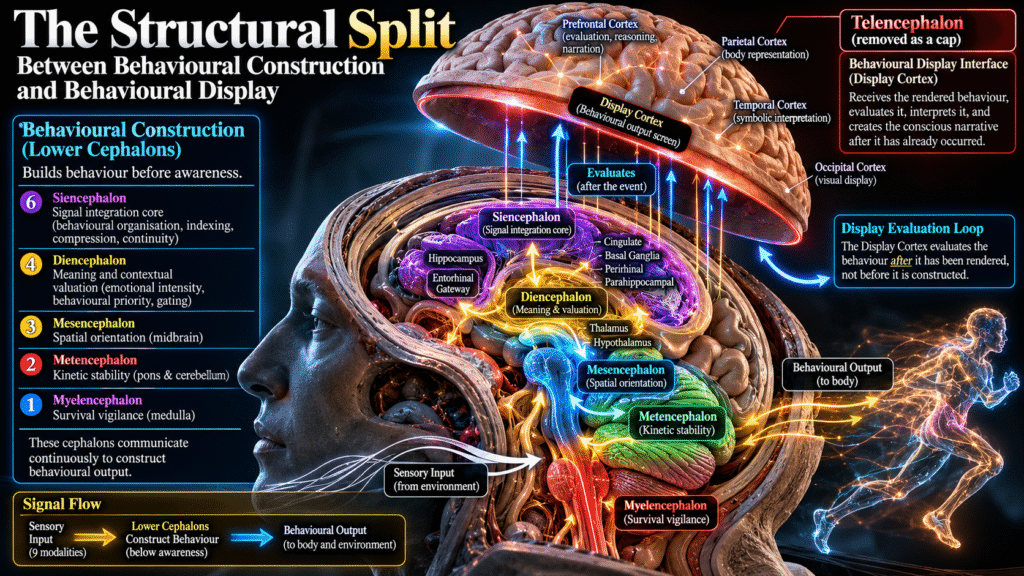
Part II: The Structural Split Between Behavioural Construction and Behavioural Display
BY: OMOLAJA MAKINEE
Having established that the revised Telencephalon functions as the Display Interface rather than the biological archive of behaviour, a deeper architectural question naturally follows.
If the cortex neither stores behavioural reality nor generates emotional valuation, why does it maintain such extensive communication with the deepest emotional and memory structures of the brain?
Why does a structure that merely renders conscious experience possess such intimate, bidirectional access to the amygdala and hippocampus?
The answer lies in recognising that communication does not necessarily imply authorship.
Throughout the cephalic hierarchy, every independent cephalon must continuously exchange information with the behavioural civilisation as a whole. The purpose of these exchanges, however, differs according to the functional role of each cephalon.
- The lower cephalons communicate to build behaviour.
- The Display Cortex communicates to evaluate behaviour after it has already been rendered.
This distinction explains why the cortex possesses a dedicated amygdala-hippocampal axis despite lacking its own Master Relay.
Before examining this specialised relationship, it is useful to contrast the behavioural architecture of the Somato-Valence Engine with that of the revised Telencephalon.
1. The Behavioural Builder versus the Symbolic Theatre
The Somato-Valence Engine operates as the biological builder of behavioural reality. Every behavioural trajectory begins within this engine.
- Survival vigilance emerges from the Myelencephalon.
- Kinetic stability develops within the Metencephalon.
- Spatial orientation is organised through the Mesencephalon.
- Contextual valuation and conscious prioritisation emerge from the Diencephalon.
These cephalons continuously assemble behavioural trajectories before consciousness becomes aware that any behavioural event exists.
The revised Telencephalon occupies an entirely different position within this hierarchy. It does not assemble behavioural trajectories. Instead, it sequentially renders them.
- The visual cortex transforms integrated spatial signals into conscious images.
- The auditory cortex transforms integrated acoustic signals into meaningful sound.
- The somatosensory cortex renders bodily experience.
- Association cortices transform behavioural integrations into language, imagination, symbolic reasoning, and reflective narration.
The Display Cortex therefore functions as a symbolic theatre rather than a behavioural construction site.
This distinction explains why consciousness experiences completed behavioural reality rather than witnessing its biological assembly. By the time behavioural activity reaches the Display Interface, countless negotiations have already occurred beneath awareness.
The cortex dramatises behaviour. It does not manufacture it.
2. Independent Biological Civilisation versus Dependent Rendering Interface
The difference extends beyond functional roles into the very organisation of biological architecture.
The Somato-Valence Engine functions as a high-bandwidth subcortical civilisation. Its cephalons operate continuously in parallel, each processing immense quantities of behavioural information simultaneously.
They communicate directly with visceral physiology, endocrine regulation, autonomic control, motor execution, sensory orientation, and survival memory without requiring conscious participation. Their operations remain metabolically immersed within the biological systems they regulate.
The revised Telencephalon exhibits the opposite organisational strategy. Rather than operating as an independent civilisation, it functions as a serial rendering interface.
Every behavioural packet entering the cortex has already passed through numerous stages of subcortical negotiation before being compressed into symbolic display. Consequently, the cortex experiences a severe processing bottleneck relative to the immense behavioural bandwidth operating beneath it.
Its conscious stream appears continuous precisely because the lower cephalic civilisation continuously performs the hidden work required to maintain that continuity.
The cortex depends upon behavioural civilisation. Behavioural civilisation does not depend upon the cortex.
3. The Biological Currency of Emotional Valence
Perhaps the clearest distinction between these two domains concerns emotional valence.
The Somato-Valence Engine possesses genuine behavioural currency. Its structures generate both inherited template valences and dynamic proactive intensity states. These emotional currencies determine whether behavioural trajectories become defensive, exploratory, affiliative, aggressive, avoidant, or investigative.
The lower cephalons therefore possess direct authority over behavioural execution because they operate with biologically active emotional value.
The revised Telencephalon possesses no comparable currency. It introduces no independent emotional charge into behavioural processing.
Instead, every symbolic representation rendered upon the Display Cortex already carries emotional weighting supplied by the subcortical systems. The cortex may represent fear, hope, grief, joy, curiosity, or determination, but it does not manufacture these behavioural conditions independently.
Its symbolic simulations remain emotionally dependent upon the valence already assigned by the deeper cephalic architecture.
Consequently, the cortex functions as a valency-neutral rendering vacuum. It displays emotional reality without generating emotional reality.
4. Memory Without Storage
The same principle governs memory.
Human beings often experience memories as though they are stored somewhere within conscious awareness. Recollection feels immediate, giving the impression that consciousness itself contains the behavioural archive.
Psychextrics separates these experiences into distinct biological operations.
The Siencephalon maintains the active behavioural archive. Through the Entorhinal Gateway, hippocampal indexing systems, and associated memory architecture, behavioural history remains continuously organised beneath awareness. The archive exists independently of conscious display.
The Display Cortex merely visualises selected portions of this archive. Whenever an autobiographical event appears in consciousness, the cortex is not retrieving information from itself. It is rendering behavioural indices already supplied by the Siencephalon.
The screen therefore possesses no native storage capacity. Its apparent memory arises from continuous access to the genuine behavioural archive maintained elsewhere.
The distinction resembles the relationship between a computer monitor and a storage device. The monitor faithfully displays archived information while remaining entirely incapable of storing that archive independently.
5. Gating Authority and Behavioural Permission
The difference between construction and display becomes even clearer when considering behavioural gating.
The Somato-Valence Engine controls the biological keys required to initiate conscious display.
Through the Master Relays, ascending behavioural packets receive emotional authentication before they can illuminate Layer I of the cortical column. Whether behavioural information originates through the Thalamus, the Entorhinal Gateway, or the Olfactory Bulb, conscious rendering cannot begin until the appropriate subcortical valence has unlocked the display interface anchored with the amygdala.
The Display Cortex possesses no equivalent authority.
- It cannot independently open its own Layer I gateway.
- It cannot initiate conscious illumination.
- It cannot construct behavioural frames through autonomous activation.
Instead, it waits for behavioural permission from the structures responsible for constructing consciousness itself.
This dependence is not an incidental anatomical detail. It represents one of the defining architectural principles of Psychextrics.
The Display Interface remains entirely dependent upon the behavioural builders beneath it.
Conclusion: Why the Cortex Retains the Amygdala–Hippocampal Axis
At first glance, this dependence creates an apparent paradox.
If the cortex neither generates emotional valence nor stores behavioural-memory, why does it maintain one of the most extensive bidirectional relationships with the amygdala and hippocampus found anywhere in the cephalic hierarchy?
The answer emerges by recognising that every independent cephalon requires two universal communication systems.
- First, every cephalon requires an amygdala-hippocampal axis through which behavioural information can be emotionally authenticated and historically indexed.
- Second, every cephalon requires a gateway capable of transmitting behavioural feedback to the wider cephalic civilisation.
These systems are not optional. They constitute mandatory organisational features of every autonomous cephalon.
What differs is how each cephalon uses them.
The lower cephalons access the amygdala-hippocampal axis to:
- extract survival templates,
- evaluate behavioural urgency,
- deposit behavioural outcomes, and
- continually refine instinctive execution.
Their interactions occur primarily during the construction of behaviour.
The revised Telencephalon accesses the same axis for an entirely different purpose. Its communication begins only after behaviour has already been rendered into conscious symbolic experience.
The cortex therefore does not retain the amygdala-hippocampal axis because it is secretly another behavioural construction engine. It retains the axis because every autonomous cephalon must remain continuously integrated with the collective behavioural civilisation.
The difference lies not in the existence of the axis, but in the function it serves.
For the Display Cortex, the amygdala-hippocampal axis becomes the essential communication pathway through which rendered consciousness can later participate in the refinement of future behavioural architecture—a specialised role that naturally leads into the function of Layer V, Layer VI, and retrospective calibration explored in the final part of this discussion.
Back to: 👇