
The Display Cortex and Language: A Psychextric Reconstruction of Symbolic Speech
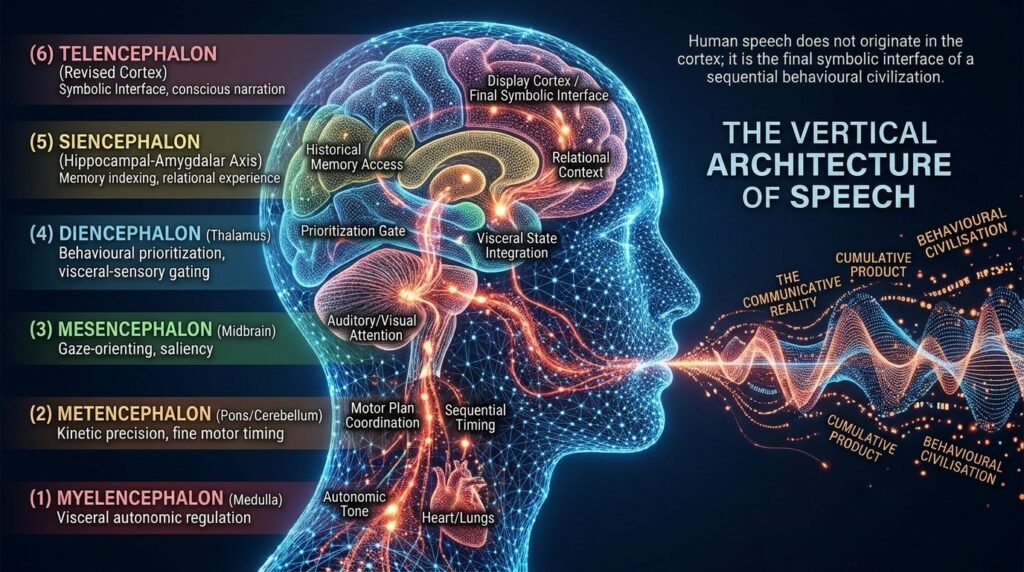
Part II: The Vertical Architecture of Speech Across the Six Cephalons
BY: OMOLAJA MAKINEE
The preceding discussions established that the cortical language fields do not independently manufacture speech. They function as sophisticated rendering interfaces that translate already integrated behavioural states into symbolic expression.
To understand why this reconstruction fundamentally departs from traditional cortical-centred models, we must now trace the complete behavioural ascent of language through the six cephalons.
Within Psychextrics, speech is organised as a vertical behavioural architecture rather than a horizontal cortical computation. Every spoken sentence climbs progressively through the cephalic hierarchy before appearing upon the conscious display.
Each cephalon contributes a unique behavioural operation that cannot simply be replaced by another. Speech therefore emerges as the cumulative product of six specialised biological systems operating in sequence.
1. Myelencephalon: The Passive Motor Foundation of Vocal Behaviour
At the base of the hierarchy lies the Myelencephalon, the Survival Vigilance Gateway.
Long before symbolic language evolved, organisms required reliable biological mechanisms capable of producing vocal outputs necessary for survival.
Within this lowest gateway reside the cranial nerve nuclei responsible for the physical execution of vocal behaviour.
- The Hypoglossal Nucleus coordinates the complex movements of the tongue.
- The Nucleus Ambiguus regulates the muscles of the larynx and vocal folds.
- The Facial Motor Nucleus controls the lips, cheeks and facial musculature that shape speech.
Together these structures provide the passive behavioural templates upon which every spoken word ultimately depends.
From the Psychextric perspective, these nuclei do not understand language. They possess no vocabulary, syntax or symbolic reasoning. Instead, they represent inherited behavioural motor templates capable of executing vocalisation whenever higher cephalic systems recruit them.
Speech begins not with meaning but with biological capability.
Without this inherited motor infrastructure, no symbolic language could ever reach the external world.
2. Metencephalon: The Kinetic Architecture of Fluent Speech
Above the Myelencephalon sits the Metencephalon, responsible for kinetic stability.
Language is not merely a sequence of words; it is an exquisitely coordinated motor performance requiring hundreds of muscles to operate with extraordinary temporal precision.
The cerebellum and pons continuously regulate respiratory timing, articulation, vocal rhythm, jaw coordination, tongue velocity, and fine muscular synchronisation. Every syllable depends upon this kinetic architecture.
When people speak effortlessly, they rarely appreciate the immense computational work occurring beneath awareness. Each sentence requires constant adjustments to airflow, vocal cord tension, tongue position, lip configuration and facial expression, all occurring within fractions of a second.
The Metencephalon silently performs these calculations. Rather than deciding what to say, it determines how speech can be executed smoothly and efficiently.
Within Psychextrics, fluent language depends upon behavioural stability long before it depends upon symbolic reasoning.
3. Mesencephalon: Spatial Orientation of Communication
Communication always occurs within space. Human speech requires orientation toward another individual. The speaker must direct the eyes, face, head and body toward an intended behavioural target while simultaneously monitoring environmental positioning.
This responsibility belongs to the Mesencephalon.
The Midbrain organises spatial targeting so that vocal behaviour remains anchored within a meaningful behavioural environment.
- It determines where attention is directed.
- It aligns gaze with the listener.
- It coordinates head movement with vocal projection.
- It rapidly redirects orientation whenever unexpected behavioural events interrupt communication.
Speech therefore unfolds within a continuously updated spatial framework rather than in isolation.
The organism does not simply speak. It speaks toward someone.
4. Diencephalon: Meaning and Behavioural Intensity
The Diencephalon introduces an entirely new dimension to speech.
Where the lower cephalons supply execution, coordination and orientation, the Diencephalon supplies behavioural significance.
Within the Psychextric reconstruction, the Thalamus organises symbolic meaning while the Hypothalamus supplies the physiological intensity necessary to energise communication. Meaning and intensity therefore become inseparable.
The same sentence spoken under grief differs profoundly in emotional valuation of meaning from that sentence spoken under joy.
Identical vocabulary may express entirely different behavioural realities depending upon the physiological intensity supplied by the Somato-Valence Engine.
- The Hypothalamus determines the metabolic drive behind speech.
- The Thalamus determines the symbolic organisation through which that drive becomes consciously intelligible.
Together they transform vocal behaviour into meaningful communication.
5. Siencephalon: Behavioural Memory and Emotional Continuity
Meaning alone cannot sustain coherent language across time. Every conversation depends upon memory.
Every sentence must connect with previous experiences, emotional associations, autobiographical history and behavioural expectations. This continuity emerges within the Siencephalon.
The Entorhinal Gateway links current behavioural conditions with compressed memory indices while the amygdala assigns emotional value to the developing communicative state. The hippocampal system simultaneously indexes the unfolding behavioural episode within the broader historical archive.
Consequently, words acquire personal significance because they remain embedded within behavioural-memory.
Speech therefore never exists independently of lived experience. Every conversation becomes another behavioural packet entering the continuing historical architecture of the organism.
6. Telencephalon: The Behavioural Display Interface
Only after the preceding cephalic systems have completed their specialised operations does the revised Telencephalon perform its unique role. It renders.
The Display Cortex converts compressed behavioural integrations into symbolic grammar, conscious words, internal narration and externally communicable language.
This final rendering stage creates the compelling subjective impression that language originates within consciousness. Yet from the Psychextric perspective, consciousness witnesses only the completed symbolic projection.
The Display Cortex displays the finished behavioural product. It does not manufacture the biological architecture from which that product emerged.
Speech therefore reaches awareness only after the cephalic civilisation has already negotiated its behavioural foundations.
7. The Somato-Valence Realisation of Speech
This vertical organisation demonstrates one of the central principles of Psychextrics.
Speech is fundamentally a Somato-Valence phenomenon.
Every spoken sentence reflects the integrated activity of survival physiology, kinetic coordination, spatial orientation, contextual valuation, behavioural-memory and symbolic rendering.
Communication therefore extends far beyond language itself. The body participates in every conversation.
- Respiration adjusts.
- Cardiovascular activity shifts.
- Posture changes.
- Facial muscles reorganise.
- Eye movements adapt.
- Emotional physiology fluctuates.
- Memory systems retrieve behavioural indices.
Only after these biological operations converge does symbolic language appear upon the cortical display.
The organism therefore speaks with its entire behavioural architecture rather than with its cortex alone.
Lived Experience: Speaking Before You Realise What You Have Said
Nearly everyone has experienced moments in which words emerge with remarkable fluency before conscious reflection catches up.
During an animated conversation with a close friend, you may deliver a thoughtful explanation, offer comforting advice, or tell a humourous story without consciously constructing each sentence in advance. Only after the conversation ends do you pause and think, “I didn’t even realise I knew how to explain it that clearly.”
Within the Psychextric framework, this everyday experience illustrates the vertical architecture of speech.
- Behavioural-memory within the Siencephalon continuously indexes relevant experiences,
- the Diencephalon organises present meaning and behavioural intensity,
- the lower cephalons coordinate vocal execution, and
- the Display Cortex renders the completed symbolic narration into conscious awareness.
The feeling that the words simply “flowed out” reflects the fact that language has already been behaviourally assembled before it becomes consciously experienced as speech.
8. Sleep-Talking and the Behavioural Foundations of Language
The architecture of sleep-talking provides an especially revealing illustration of this reconstruction.
Somniloquy demonstrates that vocal behaviour can persist even when the higher symbolic systems of the Display Cortex are partially disengaged. During sleep, cortical input layers undergo extensive physiological reorganisation while conscious symbolic planning is greatly reduced.
Yet many individuals continue speaking. They utter isolated words.
- Short phrases.
- Fragments of conversations.
- Occasionally complete sentences.
Within Psychextrics this phenomenon illustrates the persistence of lower behavioural architectures.
The Myelencephalon retains the passive motor programmes necessary for vocal execution. The Metencephalon continues coordinating respiratory and articulatory movements. Behavioural templates remain available even when higher symbolic rendering is diminished.
Because proactive thalamic planning and full cortical grammatical rendering are no longer dominating the behavioural hierarchy, speech emerging during sleep frequently lacks coherent narrative organisation. Words appear without sustained symbolic structure. Behaviour continues while reflective narration recedes.
Sleep-talking therefore illustrates an important Psychextric principle.
Behavioural execution possesses deeper biological foundations than conscious narration.
The capacity to vocalise survives even when the conscious symbolic display is substantially reduced.
Conclusion: The Psychextric Interpretation of Human Speech
The vertical organisation of language ultimately transforms how communication itself is understood.
Speech is not the beginning of behaviour. Speech is behaviour made visible.
Every sentence reflects negotiations that have already occurred throughout the cephalic hierarchy.
- Survival systems establish biological readiness.
- Kinetic systems coordinate execution.
- Spatial systems orient communication.
- The Somato-Valence Engine assigns behavioural significance.
- The Siencephalon integrates emotional memory with behavioural continuity.
- Finally, the revised Telencephalon renders this completed biological architecture into the symbolic grammar recognised as conscious language.
Human beings therefore do not speak because the cortex independently invents words. They speak because an entire behavioural civilisation has already assembled a communicative reality beneath awareness, with the Display Cortex serving as its final symbolic interface.
Language becomes the visible expression of invisible behavioural organisation, revealing that communication is not generated from the top of the brain downward, but constructed from the depths of the cephalic hierarchy upward until it finally appears as the familiar experience of conscious speech.
Back to: 👇